ENVIRONMENT

LIME and cement manufacturing is increasingly on the rise as a result of high demand in Papua New Guinea’s building industry.
Construction – in buildings and real estate development, road works or marine infrastructure requires these products.
Lime, primarily derived from limestone, plays a crucial role in cement manufacturing as a key raw material and as an admixture that significantly influences the quality and properties of the final product.
Role of lime in cement production
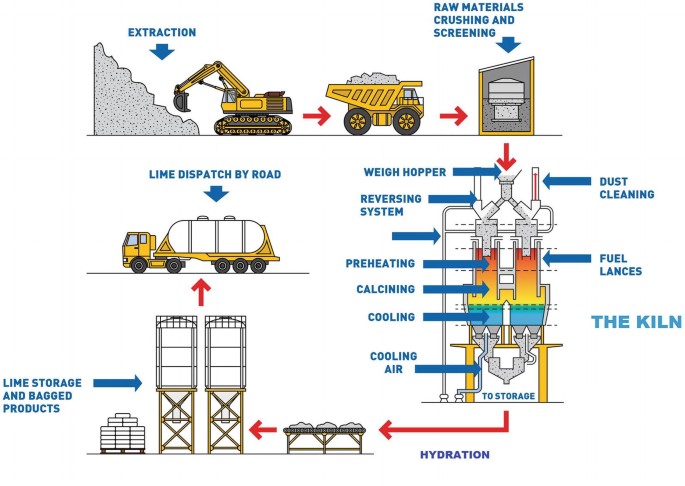
Raw material for clinker: Lime is essential for producing cement clinker, which is the primary component of cement. Approximately 80-90 per cent of the raw material for cement production is limestone, which is rich in calcium carbonate (CaCO₃). When heated in a kiln at high temperatures (around 1400-1500 °C), limestone decomposes to form lime (CaO) and carbon dioxide (CO₂).
Chemical reactions: During the cement manufacturing process, lime reacts with silica, alumina, and iron oxide to form various compounds that contribute to the strength and durability of cement. The main compounds formed include tricalcium silicate (C₃S) and dicalcium silicate (C₂S), which are responsible for the strength of the cement.
Admixture for sustainability: Lime is also used as a mineral admixture in cement to enhance sustainability. It can improve the workability of the cement mix, increase strength, and reduce the carbon footprint of cement production by lowering the amount of clinker needed.
Benefits of using lime
Enhanced strength and durability: The presence of lime in cement improves its mechanical properties, making it more resistant to environmental factors such as sulfate attacks and moisture.
Hydration efficiency: Lime promotes better hydration of the cement, leading to a more uniform texture and improved performance in construction applications.
Environmental impact: Incorporating lime can help reduce CO₂ emissions associated with cement production, as it allows for a lower clinker-to-cement ratio, thus contributing to more sustainable building practices
In summary, lime is a fundamental component in cement manufacturing, not only as a primary raw material but also as an additive that enhances the performance and sustainability of cement products. Its chemical properties and reactions during the production process are vital for creating high-quality cement that meets industry standards.
Cement kilns
Cement kilns are industrial furnaces that heat raw materials to produce clinker, the key ingredient in cement.
A cement kiln is a large, rotating cylindrical furnace used in the production of Portland and other hydraulic cements. Its primary function is to heat raw materials such as limestone, clay, and other additives to high temperatures (around 1,400–1,500°C or 2,700°F) to produce clinker, which is then ground into cement powder.
The kiln is central to the cement manufacturing process because it drives the chemical reactions that form calcium silicates, the main binding compounds in cement.
Types of cement kilns
Rotary kilns: The most common type, consisting of a long, slightly inclined cylinder that rotates slowly. Raw materials move from the cooler end to the hot end, undergoing calcination and clinkering as they progress. Modern rotary kilns are lined with refractory bricks to withstand high temperatures and chemical reactions.
Wet process kilns: Early rotary kilns where raw materials are supplied as a slurry containing about 40 per cent water. These require longer kilns due to energy-intensive water evaporation.
Dry process kilns: Modern kilns where raw materials are supplied as dry powders, improving energy efficiency and reducing fuel consumption.
Operation and process
Inside the kiln, calcination occurs. Calcium carbonate decomposes into calcium oxide and carbon dioxide. As the material moves through the burning zone, it reaches clinkering temperatures, forming nodules of clinker. The clinker then cools gradually before being ground into cement. Kilns are often equipped with preheater towers, rawmix silos, and exhaust stacks to optimise heat transfer and material flow.
Energy and environmental considerations
Cement kilns are energy-intensive, consuming nearly 60 per cent of the energy in cement production. They traditionally burn fossil fuels but can also use alternative fuels like waste tires or agricultural residues. Kilns are a significant source of carbon dioxide emissions, contributing about 2.5 per cent of global anthropogenic carbon emissions, both from fuel combustion and the chemical decomposition of limestone.
Modern strategies to reduce emissions include carbon capture, reducing clinker content, and exploring hydrogen or electric heating.
Technological advancements
Advances in kiln technology focus on efficiency, durability and environmental impact. Innovations include online condition monitoring, improved refractory materials and energy recovery systems. These improvements enhance production capacity, reduce maintenance and lower emissions, making cement kilns more sustainable.
Summary
Cement kilns are the heart of cement production, transforming raw materials into clinker through high-temperature chemical reactions. Their design, type, and operation significantly influence energy efficiency, product quality, and environmental impact. Continuous technological improvements aim to optimise performance while reducing the carbon footprint of cement manufacturing.
Lime and cement Projects in PNG
The Pacific Lime and Cement (PLC) project, located near Port Moresby, currently under construction, is aiming to establish Papua New Guinea’s first integrated cement and lime facility by 2027. The project, featuring two kilns, aims to produce 1,200 tonnes per day of quicklime, with plans to produce cement later.
According to company information, the project, which was previously known as Mayur Resources Limited, has rebranded to Pacific Lime and Cement Limited. This rebranding reflects the company’s transformation from a resource developer to an integrated supplier of building and industrial materials.
The Central Cement and Lime Project is set to become PNG’s first vertically integrated manufacturing hub for cement and lime, with the aim of supplying these products to various sectors in PNG. The project is strategically located within a special economic zone, providing substantial fiscal incentives for its integrated approach.
Phase 1 of the project will be fully equity funded, with the company focusing on delivering locally manufactured, high-quality, and competitively priced building materials to PNG and the Pacific region.
Pacific Lime and Cement is developing a world-class lime and cement business in PNG that will deliver locally manufactured, high quality and competitively priced building materials to PNG and the Pacific region.
Pacific Lime and Cement’s competitive advantage is driven by the strategic location of its exceptional quality resource in Papua New Guinea.
Led by the Central Lime Project (CLP) and Central Cement Project (CCP), PLC is developing a high-quality, long-life, exceptional resource which has all the qualities to underpin a globally significant building materials company.
The project’s coastal location in PNG provides substantial logistical advantages. It is situated 24km from Port Moresby and adjacent to the PNG LNG facility, placing it at the heart of PNG’s industrial infrastructure.
The CLP and CCP are situated within a 100 per cent owned and controlled special economic zone (SEZ), providing substantial fiscal incentives for its integrated approach. The SEZ framework specifically rewards downstream processing and value-addition, aligning perfectly with the company’s integrated lime-to-cement strategy.
PNG’s lime market presents a classic import replacement opportunity, with annual demand of 250-300,000 tonnes representing 70-75 per cent of the company’s planned phase one capacity.
The country’s major gold miners and nickel producers currently source all lime requirements from Southeast Asia, creating vulnerability in supply chains and incurring higher costs.
The primary goal of PLC is to support and build PNG’s and the wider Asia Pacific region’s path to prosperity through the production of low-cost, high-quality building materials.
Rigo Cement and Lime Project
This is another recently approved major industrial initiative in Central, aimed at producing cement and quicklime locally, reducing imports, and creating significant economic and employment opportunities.
The Rigo Cement and Lime Project is located in the Rigo District of Central. The project represents a K2 billion investment, with construction already underway for initial infrastructure.
Stage 1 includes quicklime kilns, a quarry, a wharf, and supporting infrastructure, with production expected to commence by 2027.
Stage 2 will focus on clinker and cement manufacturing, providing locally produced cement for domestic use and export. The facility is designed to reduce reliance on imported cement, which in 2024 amounted to over US$14 million (about K60 million) in imports, mainly from Japan and Indonesia.
The project is also expected to:
- Lower local cement prices by up to 53 per cent, making construction materials more affordable;
- Support national infrastructure building, including the Connect PNG Programme, by providing a domestic supply of cement and quicklime; and
- Stimulate downstream industries, such as casting and brick manufacturing, expanding PNG’s industrial base.