Loading Text-to-Speech…
In Helsinki’s commercial harbor is the “Palace”, a building built to serve as the main hotel for the 1952 Olympic Games and today housing the offices of Teknologiateollisuus, an employers’ association of the country’s technology companies. There I heard from the association’s director of skills and training Lena Pontinen to mention a number that made a big impression on me: 140,000. That’s how many skilled workers Finnish businesses will need to find in the next ten years. These workers do not exist in the country’s workforce. If they don’t find them, their GDP will shrink by 0.6%.
How is this possible? That was my question to Ms. Pontinen that rainy morning. OR Finland it is supposed to have an amazing education system, the best schools of the world. How is it possible that it cannot produce the skilled workers its economy needs?
But let’s take things from the beginning.
I was in Finland as a guest of the country’s Ministry of Foreign Affairs, which regularly organizes thematic missions with journalists from all over the world. Finland and other Northern European countries are in many ways a model for our own, problematic, southern ones. How do they do it? What laws are they passing? What kind of measures? During the visit we were accompanied to 18 scheduled appointments and spoke to a total of around 30 people, from ministers and civil servants to university professors and businessmen. I learned many new things from these discussions, some of which I had not even suspected. And I came to a basic, fundamental conclusion, very different from what I had in mind before. First of all, about the Finnish education system.

PISA shooting stars
Since 2000 when Mr OECD began testing the skills of high school students from dozens of countries around the world in subjects such as reading comprehension, mathematics and science with the famous PISA program, Finland became famous around the world. The country’s students fared better in the competition than all their peers around the world. Everyone started talking about the Finnish education system and how other countries’ systems can copy it.
There is, however, an important factor here: since 2006, the skills of 15-year-old Finns have been getting worse. This is certainly a global phenomenon – from 2015 onwards, the skills of children in most countries of the world are getting worse, year after year, generation after generation. But in Finland it preceded and is more intense than in many other countries. Finnish 15-year-old girls in 2006 scored an average of 548 in maths, but their counterparts in 2022 scored 484. In reading comprehension the average fell over the same period from 547 to 490. In science, from 563 (the highest average country score ever recorded by the OECD) to 511.
Annual expenditure for each student: 4,000 euros in Greece, 10,000 euros in Finland
This change has been attributed to a variety of causes: from the reduction in education spending in the mid-2010s to a major, very progressive education reform that emphasized student freedom and individual initiative, the reduction of exams, and the introduction of technology into the classroom. This reform is today considered highly controversial and many of its innovations – such as tablets and laptops in classrooms – are slowly being reduced.

Of course, this does not mean that Finland has become a simple country. It may have fallen from the top, but its education system still produces students with above-average skills. Remember the Finnish children’s PISA 2022 scores we mentioned above? Do you want me to write down the Greek children’s scores for the same year? 430 in math, 432 in reading comprehension, 441 in science. On the PISA grading scale, a difference of 20-30 points corresponds to the knowledge and skills a child acquires after attending school for one year. This means that today the children in Greece are so far behind the children in Finland that it is as if they have gone to school two and a half years less. Why? What exactly do they do there so much better than we do here? To find out, I visited a primary school in the suburb of Tapanila in the north of Helsinki.
Hot food and low hangers
Two and a half million euros a year. If we want to simplify the matter and summarize the answer to the questions of the previous paragraph in just five words, these are the five words: Two and a half. Millions. Euro. The. Time.
This is the budget for running a primary school with two hundred and fifty students in Finland. We toured all the sites of Tapanila, talked to students and teachers, saw the infrastructure and services and, in the end, we had an idea of where this money is going. I will describe them here.
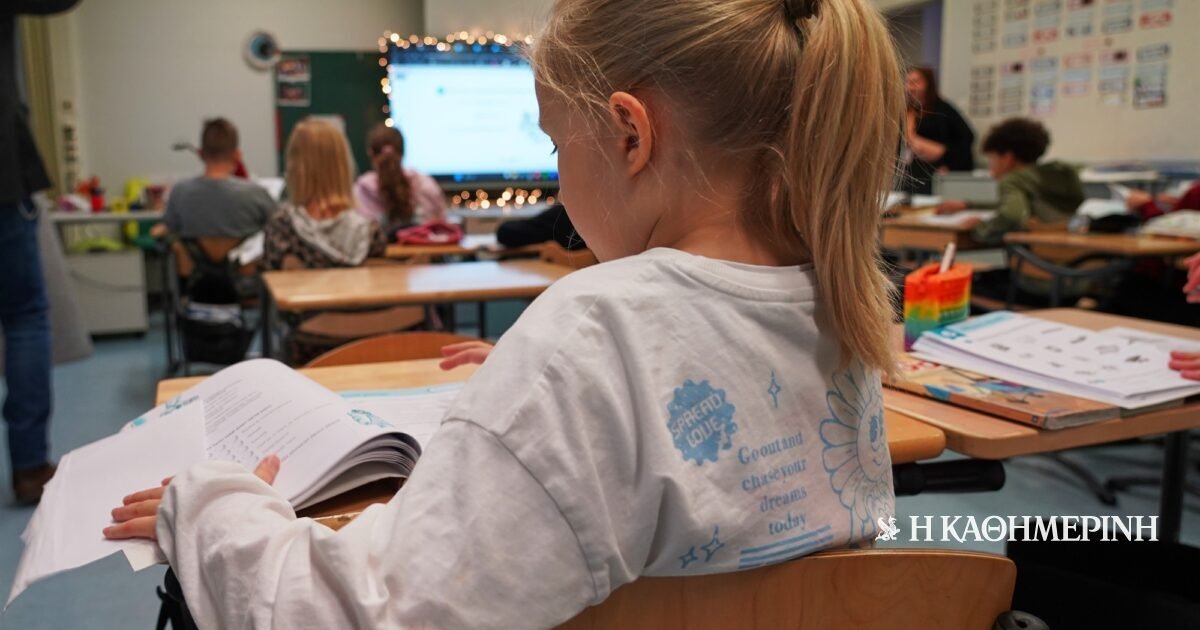
The primary school Tapanila is housed in an old building, high ceiling, with spaces and simple, clean but also distressed, with the need for a strong paint job. It has, however, everything. The warmth of a space made to be used mainly by children, comfortable classrooms, a carpentry workshop, a sewing studio, an indoor gym and a large restaurant where hot, freshly cooked food is served every day for all the students (who then take turns helping to clean the space). The school’s annual budget covers all the equipment, the cost of the workers in the restaurant’s kitchen and the consumables of all these areas, but also the consumables (notebooks, stationery, books) of the students – no parent is obliged to buy even a pencil for their child. Everything you need is in the school.

The annual budget also covers the human resources (17 teachers and 3 assistants) as well as the excursions, the children’s laptops and tablets (which are locked in lockers and used only in prescribed exercises) and all extraordinary expenses for celebrations and creative activities. The money comes from the Municipality, not from the state budget. And who manages them? That’s what I asked director Tina Tulari. She answered me with a gesture: pointing her thumbs at her. She manages them. She is the director/manager of a semi-autonomous organization that operates with not unlimited but sufficient resources and tools, of course following a curriculum and basic guidelines from the central state, but facing problems and planning actions (and paying for actions) autonomously.
The word matters. In PISA, in addition to examining students’ skills, they also measure various other elements of the children’s educational and family environment, in order to reach conclusions about the factors that influence their performance. One of the perennially interesting conclusions for us is that the educational system that offers the least autonomy to schools out of the systems of the approximately 90 countries participating in the competition, the least decentralized, the most hydrocephalous of all – but all – is the Greek one. Here principals not only don’t manage the school budget, but they can’t even make even the simplest decisions alone – they have to have the permission or approval of some higher authority, mandatorily.
There are, of course, other differences. For example, in the Finnish system children with learning difficulties are placed in separate, smaller classes. Immigrant or refugee children, or children with language difficulties, are also placed in a separate, special class. A completely different philosophy from the more inclusive (and in the opinion of many, more correct) philosophy of the Greek schools. In Tapanila, the use of cell phones by students was banned just last year.
Fundamental, however, seems to be the issue of money, both in terms of management, but also in terms of size. Finland spends more than 10 thousand euros per year for each student. Greece spends under 4 thousand. Even if one takes into account the difference in the size of economies, prices, wages and costs, it is a long distance.
Of course, the matter is much more complicated than a figure in euros. Other things also play a role in the very different performance of children there than here. The fact that there children start primary education a year later, who become teachers (and with what motivations), how teachers are retrained, all play their role. And, of course, the contradiction remains. The kids who graduated from Tapanila and primary schools like it in 2018 or 2019 took the 2022 PISA, and they did worse than the previous batches. And this education system, so much better than ours, ultimately does not produce enough workers qualified enough to meet the needs of the market. “How is this possible,” I had asked Mrs. Pontinen of the Association of Technology Companies, “when you have the best schools in the world?” I will now tell you what he answered me, and why that answer unlocked for me the really useful conclusion worth keeping here.
“We don’t have the best schools in the world,” he told me. “We have the best worse schools of the world”.
And this is the crux of the matter. That’s the point. It is not so much about PISA or the links between education and the market. Or rather, they matter, but not the most. Most importantly, according to those additional PISA measures, Finland has one of the lowest indicators of the effect of parents’ socioeconomic status on children’s skills and performance. There are almost no private schools in the country (mostly of a special type, foreign language or religious and almost all follow the state curriculum and are free). Everyone goes to public schools. The average citizen knows that the prime minister’s child will go to the neighborhood school, the public one, along with the others. In Greece there is a category of children who in PISA get an average score close to 500 – similar, that is, to the average of children in Finland. Do you know which one? Children who go to a Greek private school. But there, children from poor households have the opportunity to receive exactly the same education as children from rich ones. The “worst” schools in the “worst” areas are very good. The best worst schools in the world. This doesn’t just lead to high averages in skills competitions or more tech startups or the founding of a Nokia and a KONE. It mainly leads to another level of social cohesion, to the idea of social mobility enshrined as a given component of life in the country, and ultimately plays a crucial role in developing a degree of resilience (to pressures, to external threats, to misinformation, to polarization) that few societies in the world possess.
Equality
This, I think, is the main takeaway from my discussions with people about Finnish schools: that sometimes we focus on the wrong goals. That spending on public, free education is an investment that should not only be valued in PISA scores and the number of unicorns in the economy, but also in social mobility indicators. Perhaps the right goal for our own education system is this: to reach at some point the point where we know that the prime minister’s children will also go to the neighborhood school, along with ours.