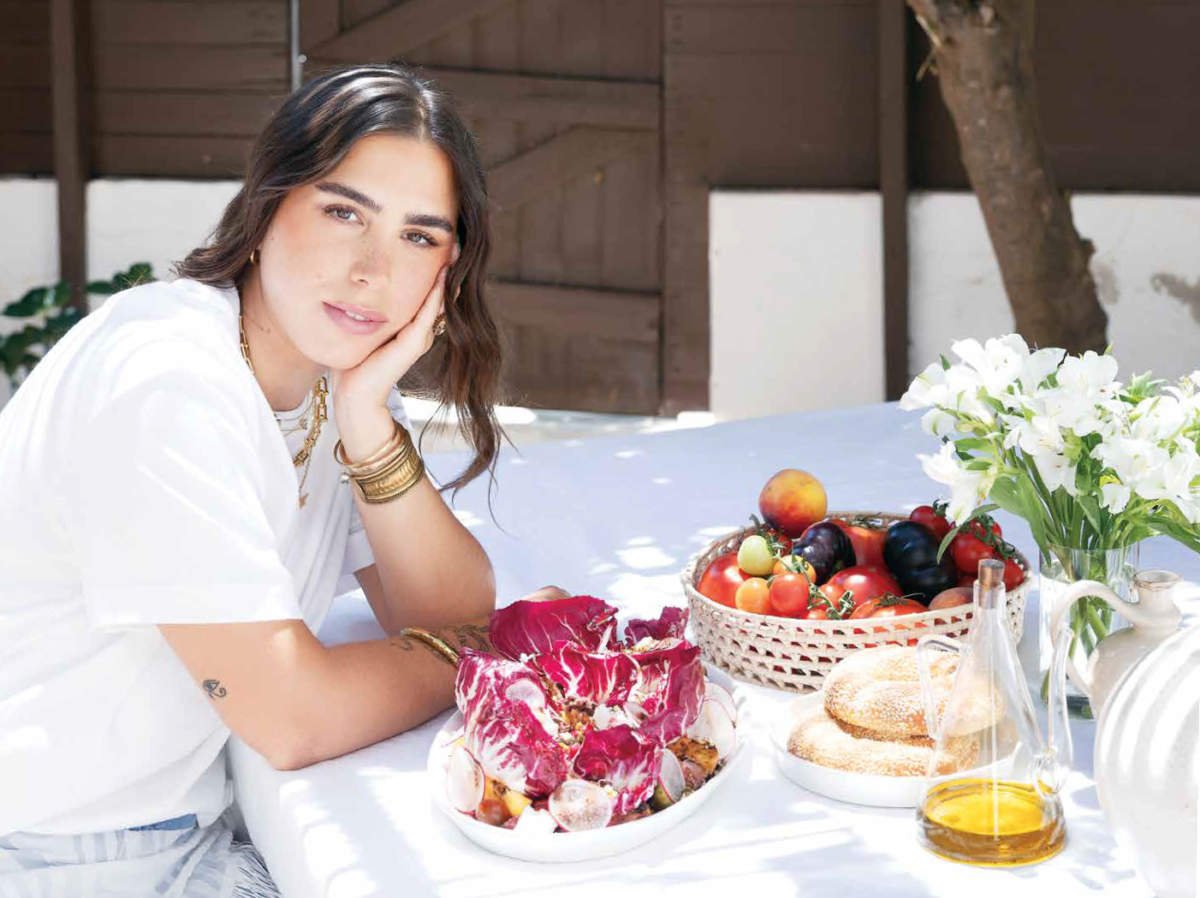
The English-born Cypriot chef, with experience in Michelin-awarded restaurants, created the platform The Green Greek, through which she promotes a more sustainable, seasonal and plant-forward approach to Mediterranean cuisine. A year ago she returned to the island, bringing with her influences, tastes, experiences and, above all, the philosophy of a more conscious cooking.
Styling: Shona Muir
What are some of your most vivid childhood food memories connected to Cyprus and Greece?
I used to come to Cyprus every summer growing up. Every morning I would wake up early with my grandmother and we would cook, filling a whole table with Greek food: stuffed, moussaka, pumpkins with eggs. In Evrycho we had fruit trucks and olives and we spent endless days picking bags of oranges and figs. During the olive harvest season, all the people from the neighboring fields participated in the process, carrying the barrels of olive oil back home.
When did you first realize that cooking could become a career?
When I was in high school I took food technology classes. It was then that I realized I had a natural aptitude for cooking, organizing and teaching. So, I started working professionally in kitchens from the age of 14.
What did Michelin-level kitchens teach you about discipline and creativity?
In my younger years as a chef I spent five years working at Michelin, training in classic French and Italian cuisines. It was difficult. I worked 15-18 hour days, often as the only woman in the kitchen. Back then the space was largely male dominated, which is now changing and I’m very happy to see it. These kitchens taught me tremendous discipline. If you weren’t at the venue 30 minutes early, they considered you late! Often after my 12 or 1 am shift, I would continue working in the office making orders for the next day. Sometimes I slept there instead of going home… It was a crazy time! Working in this environment didn’t leave much room for creativity. At that stage of my career, I was mainly responsible for executing dishes designed by the executive chefs.

How did you decide to create The Green Greek blog and platform?
I wanted to show people that Greek cuisine can be just as “refined” as French or Italian. Yes, we know how to make great home-cooked food, but we can also present it in a beautiful and modern way.
Your cooking is deeply connected to memory and storytelling. Do you consciously approach food as a way of maintaining identity?
Through the years I traveled around the world I understood that food is history, art, love, identity. A way to preserve centuries of tradition and memories. I try to express this through my food, honoring what has inspired my cooking.
Why was it important for you to focus on seasonal, plant-forward and sustainable cooking?
“The Green Greek” means: plant-forward, Greek-inspired, conscious cooking. The most important way to reduce one’s carbon footprint is to eat less meat. This is a fact. You can get the same amount of protein from plant foods without the devastating effects on the environment. Not everyone needs to go vegan, but a more plant-forward and seasonal diet is better for both our health and the planet.
What does sustainability mean to you, beyond trends and marketing?
To use wisely what we already have. Mend clothes, reuse plastic containers, source food locally. Unfortunately, the agricultural model on which the world operates is not sustainable. Food is transported thousands of kilometers so that we can eat beef imported from the Amazon. There is a lot of greenwashing today. What is important is to know where our food comes from and if we have space, to grow. We are also losing knowledge and skills. How to sew and mend things, how to grow our own food, how to live like previous generations. Sustainability is not a new concept. It used to be just our everyday life. People ate according to the seasons, shopped locally, ate meat and fish only a few times a week. This is sustainability.
Do you think that Cypriot cuisine inherently includes a sustainable way of cooking?
Yes and it is amazing that in Cyprus we produce most of our own products, farmers still respect the seasons and eat like previous generations. I think in general in the Mediterranean people prefer to buy locally. We are proud of our heritage.

Can you tell us more about Xenia Retreats and the concept behind connecting food, travel and wellness?
Xenia Retreats is a place where people learn to cook seasonal, plant-forward Greek-inspired dishes. I think in today’s society we have become too far removed from mother nature, so I wanted to create a slower paced space that helps people get back to themselves and to nature, around a communal table.
What experience do you hope people get after one of your retreats?
To leave with a better understanding of how to take care of themselves through food. That nutritious eating doesn’t have to be difficult or complicated. I also hope they leave more grounded through the breathing and yoga practices, with a greater appreciation for the food journey and a deeper respect for the planet.
Lately you have brought your work to Cyprus through collaborations and supper clubs. What drew you back to the island, creatively and personally?
I’ve spent the last six years traveling the world, trying to figure out where I truly feel “home.” Through these trips I realized that hospitality in Cyprus or Greece cannot be compared to any other place. I decided that I wanted to return to my roots and bring to Cyprus all the knowledge I gained from the culinary scenes of different countries. Your events often combine food with storytelling and community.
Why is this connection important to you?
During the pandemic I realized how much I took community for granted. I realized that I wanted to create spaces where I can share bread with strangers, laughs and stories. Spaces where the community can grow, connect and make memories.
Have local producers, farmers or Cypriot ingredients inspired you in new directions in your cooking?
Every time I have to make videos or create recipes, I don’t know what I’m going to cook until I get to the lay. I love going to the ‘OXI’ market in Nicosia, seeing what’s new on the stalls, talking to the farmers and letting the ingredients themselves inspire me.
How does the public in Cyprus respond to vegetarian menus, with an emphasis on sustainability?
I have been in Cyprus for just one year. I think this is a fairly new concept here as it is a country with a strong emphasis on meat. However, at every event I’ve hosted, the feedback I get is that no one was “deprived” of the meat. I often hear this from men who have come for their girlfriends and I laugh every time these “fanatic meat eaters” leave full and completely satisfied! It makes me very happy to change people’s perspective on what sustainable food means.