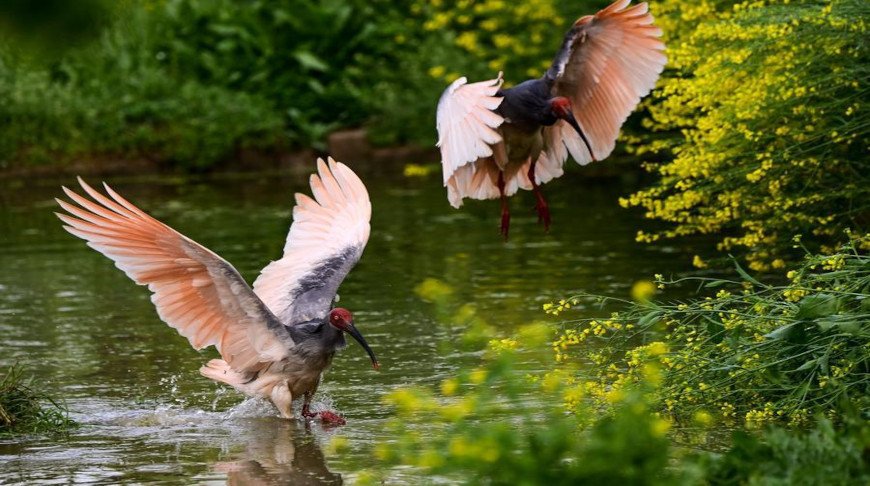
rediscovery of the world’s last seven wild crested ibises in northwest
China’s Shaanxi Province, the endangered bird has established stable
populations in 15 provincial-level regions across the country,
demonstrating exceptional conservation success.
As of the end of
2025, the global population of the crested ibis had exceeded 12,000, and
its habitat had expanded to more than 20,000 square kilometers,
according to the latest statistics from the Forestry Bureau of Shaanxi
Province. The species has been lowered from the “Critically Endangered”
status to “Endangered” on the International Union for Conservation of
Nature (IUCN) Red List.
Historically widespread in East Asia, the
crested ibis nearly disappeared from the wild due to environmental
changes and human activity. On May 23, 1981, Chinese scientists
discovered the last seven wild crested ibises in Yangxian County in
Hanzhong City, Shaanxi. Intensive conservation efforts were launched
shortly after that.
Li Jie, deputy head of Yangxian County,
recalled the immediate action taken: “After the rediscovery, the county
enforced strict ecological protection rules, banning hunting, logging,
the use of pesticides and fertilizers, and land clearance and blasting.”
Over
the past 45 years, the crested ibis population has made a remarkable
leap – from the brink of extinction to slow growth, and now to
accelerated recovery. But conservation efforts have gone beyond simply
increasing numbers. To address challenges such as low genetic diversity
and highly concentrated distribution, cross-region rewilding programs
and genetic exchanges have been implemented.
Today, the crested
ibis can be found across both the Yangtze and Yellow River basins,
ranging from inland areas to coastal zones. Yangxian County has provided
over 300 birds as breeding stock to help rebuild populations across
China, as well as in Japan and the Republic of Korea.
“Rewilding
efforts in various locations have expanded the birds’ range and living
space. Adapting to different climates, environments and food sources has
enhanced the species’ resilience to both natural changes and climate
changes to help ensure the full recovery of the crested ibises,” said
Yan Lu, deputy director of the Shaanxi Hanzhong Crested Ibis National
Nature Reserve Administration.