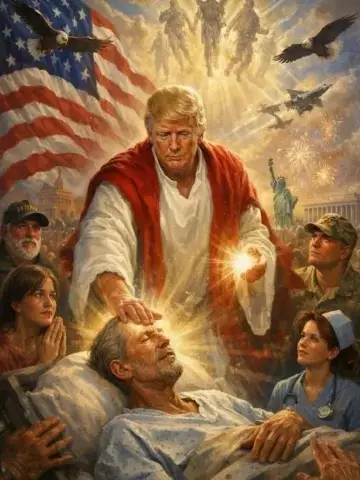
On April 13, President Donald Trump surprised millions of Christians around the world with an image produced with artificial intelligencein which he appeared dressed in a white cloak, with a girdle at his waist and healing a sick person, while in the distance heavenly troops and nationalist images of the United States were seen.
Immediately, Trump was accused of having represented himself as Christ and, although he denied it, his explanation that he appeared to expose himself as a doctor did not convince anyone. By supposedly presenting himself as the Messiah of Christians, the president crossed a line that no other politician in his country had even suggested jumping in the past.
Of course, the Christian religion has been present in American political history since its birth as a nation, but until not long ago the division between the two was a source of civic pride.
the wall
The generation that fought for the independence of the 13 colonies was clear that forging a modern State involved reserving religion for private space.
In 1785, James Madison opposed a law that sought to impose a tax to subsidize religious teachers, because he thought that this would be an “abuse of power,” because faith should not be imposed by force and should only respond to the conviction and conscience of the individual.
A year later, Thomas Jefferson presented his proposal to establish religious freedom in Virginia, stating that no person should be forced to attend or support any religious cult, since all citizens were free to profess their faith, without this affecting their civil capacities.
In 1802, Jefferson, after indicating that religion was a matter between God and human beings, that no one should be accountable to another for his creed and that the powers of government should only be responsible for actions and not opinions, stressed that there must be a wall between Church and State.
Certainly, religion continued to mark the speeches of many American politicians and their presidents during the end of the 19th century and the beginning of the 20th century, but the dividing wall continued to be the norm.
During his electoral campaign, John F. Kennedy’s Catholicism was used by his opponents to take away votes, so that Protestant ministers such as Billy Graham and Norman Vincent Peale raised curtains of fear by warning about the “dangerous” of a Catholic being the tenant of the White House.
In this regard, Kennedy gave a lesson in a speech he gave in 1960 in front of the Greater Houston Ministerial Association, stating that religion should not be a problem to discuss in an electoral campaign, because the voter should not be interested in which church he believed in, but in which United States he believed.
A few years later, when facing his critics who accused him of inciting civil disobedience, Martin Luther King, Jr. made it very clear that, in the fight for equality, Christianity had a central role, since calling himself a Christian and supporting racial inequality was an absolute contradiction.
Many white pastors in the southern United States opposed King and allied themselves with racist organizations to prevent civil rights from being recognized by the federal state. There the wall began to crack.
break the wall
In the late 1970s, evangelical pastors realized that they could more directly influence politics by allying themselves with this new American right.
For the ultra politicians that was a “blessing”, since the evangelicals had more power and influence than any other Protestant denomination and owned television channels, schools, colleges and publishing houses.
Evangelical leaders like Jerry Falwell and Pat Robertson believed they had the prominence to dictate the terms of the alliance to politicians and force the Republican Party to pay attention to their stances on abortion and gay rights.
By organizing electorally, they called themselves the “Moral Majority” and their demands became a political agenda during the Ronald Reagan administrations.
Robertson created the Christian Coalition (CC), from which he began to claim that white Christians had become a politically persecuted minority.
In 1998, the US Senate Values Action Team (VAT) was created, a coalition of Republican congressmen and CC leaders, whose goal was to introduce conservative legislation to Congress.
In November 1999, when asked in a debate between Republican candidates about the philosopher or thinker with whom he most identified, GW Bush responded: “Christ, because he transformed my heart.”
The Bush administration was, until its time, the most openly evangelical in the history of the United States: John Ashcroft, a Pentecostal who had strong support among the Christian right, was appointed attorney general.
Condoleezza Rice, who was national security adviser in Bush’s first term and secretary of state in his second, gave talks about her faith at evangelical churches and led prayer services.
Education Secretary Rod Paige praised Christian schools, and White House staff participated in weekly Bible studies or prayer meetings.
Bush signed into law the Partial Abortion Act (2003), the first federal measure to ban an abortion procedure.
Additionally, his government enacted the “Unborn Victims of Violence Law” (2004), which established that anyone who causes injury to the fetus of a pregnant woman would be subject to penalties additional to those imposed for injuring the woman.
tear down the wall
In the context of the 2008 economic crisis, the Tea Party emerged, made up of individuals who claimed that Barack Obama was born outside the United States and did not meet the requirements to be president, as well as those who considered him a socialist and those who believed he was secretly Muslim.
Many Tea Party candidates won electoral seats with the Republican Party in the 2010 elections (e.g. Marco Rubio).
A notable addition to the 2012 Republican Party platform was the inclusion of language contrary to Agenda 21, a United Nations (UN) resolution that promoted sustainable growth and which some Tea Party activists believed represented a UN plot to subvert American sovereignty.
Heir to that entire journey, after 2016 Trump became the leader who brought together the symbols and words of all the struggles of the American extreme right.
His movement then already incorporated ideologies such as anti-globalism, national conservatism, neo-nationalism and presented illiberal, authoritarian and, at times, autocratic beliefs.
But it was in his second term that Trump has most insistently used religion to support his most controversial policies.
Of course, the affair regarding the image cited at the beginning of this article crossed all limits in the use of Christianity in American politics, making it seem that the wall that Jefferson spoke of is now just rubble.
*This article was originally published in The Nationfrom Costa Rica.