April 16, 2026 – 21:06
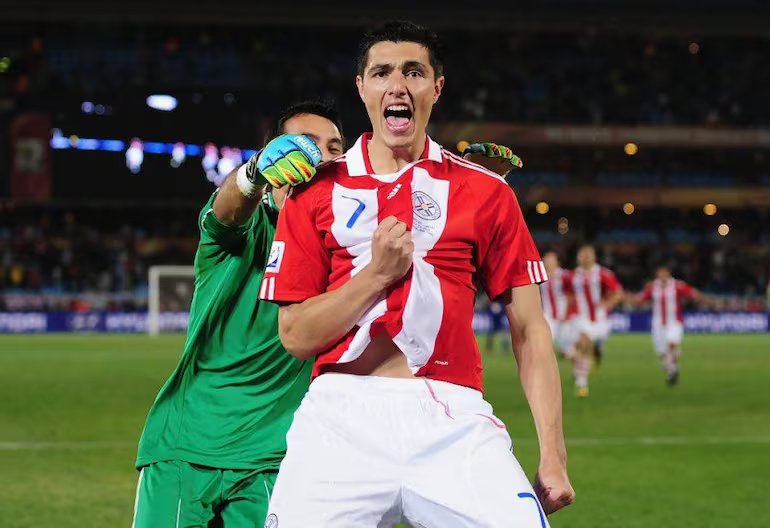
Paraguayan football says goodbye to one of its greatest leaders. Óscar “Tacuara” Cardozo officially announced his retirement from professional activity. In an emotional talk with Cardinal Deportivo, the scorer analyzed his present and remembered the sacrifice that took him from the interior of the country to the top of Europe.
After years of breaking networks, the forward assures that he is experiencing this process with absolute tranquility, taking refuge in the family. “I feel super good because I already decided a while ago what I was going to do.” and I take it very calmly. I am very good with the family, enjoying the family; and this is how I am, thank God: calm with the family, enjoying.”
Asked about nostalgia or the weight of leaving the grass, Cardozo was clear in pointing out that football more than repaid him for all his effort. “I don’t take it that way; I took it very calmly. I think I gave everything in football and football already gave me everything too. “I’m taking it very calmly and, like I told you, I already decided a while ago what I was going to do.”
Their new mission: Helping young people
Regarding his future off the court, “Tacuara” has a clear goal: to be the guide that he did not have for the boys who dream of getting ahead through sport. “No, in football I still haven’t decided what I’m really going to be in, but I want to be. Just as I said in the video (farewell), too, I want to help the kids reach their goal, so that they don’t go through what I went through when I arrived in Europe or when I left Paraguay for the first time. Many things happen when you leave the interior, you don’t know many things; So I want to help the kids a little more with that.”
The beginnings in interior football
The attacker accurately remembered his first steps in the regional leagues and his rapid rise to professional football with the Esteño club. “Yes, it was very fast, it was very fast. I started, as everyone knows, on June 24 in the Pastoreo League —when that was still the Pastoreo League, now I think it’s something else—. and there They called me to the Pastoring teamwhere I also scored many goals and that’s why he bought me the February 3, Ciudad del Este. There I did everything, from cadet to first class, and we became champions in Intermediate after seven years.”
The meteoric jump to Europe
His time in the First Division was brief due to his forceful goalscoring, which led him to cross the ocean in just a couple of seasons. “There National bought me and in Nacional I only played for a year and a half; I only played for a year and a half and Then Newell’s bought me. I played at Newell’s for a year and then I went to Europe, very quickly. In three or four years… in three years I think I was already there… since I played in first Intermediate, we were champions and there, in two or three years I was in Europe. But To get to that, to get to February 3 to play in first class, in Intermediate, is what was suffered. “There was a lot of suffering, that’s why I suffered a lot.”.
The sacrifice of the early mornings
Behind the international success there was a period of deprivation and extreme discipline, marked by the loneliness of living far from home at a very young age. “There was a lot of sufferingI tell you, because I had to get up and leave the house where I lived, the Araujo family’s house. I had to get up, say four in the morning; I had to go catch the bus, whether it rained or not, whether it was hot or cold, and I had to get to where they trained. So that more than anything.”
Cultural and language barriers
Finally, Cardozo reflected on uprooting and the difficulty of adapting to new worlds when the starting point is the humility of the Paraguayan countryside. “Later, economically. I had to leave the family there in the interior where I came from, Raúl Arsenio Oviedo. So that’s what you suffer the most, especially because you lived in someone else’s house; no matter how much they treat you well and show you that you are one of the family, you still miss it, you still suffer. That’s what you suffered a lot more. After the transfer you suffer something else, because you leave the interior and you don’t speak… I didn’t speak much, until now I don’t speak Spanish well. There they only spoke Guaraní and the people in Asunción, then in Argentina… and then you go to Portugal and it’s something else. So, you suffer in a different way.”