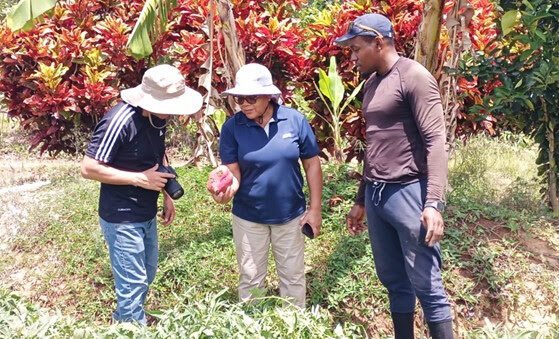

A regional push to improve sweet potato cultivation and safeguard critical plant genetics is steadily progressing through the Next Generation Sweet Potato Production in the Caribbean Project, and initiative that is actively bringing together stakeholders across Antigua and Barbuda, Barbados, Saint Lucia, Jamaica, and Trinidad and Tobago through a growing Community of Practice supported by technical experts.
A press release shared that the project is being carried out by the Inter-American Institute for Cooperation on Agriculture (IICA), working alongside the Ministries of Agriculture in Antigua and Barbuda, Jamaica, and Saint Lucia, as well as the Caribbean Agricultural Research and Development Institute (CARDI).
As part of its implementation, a series of recent online training sessions—both theoretical and hands-on—engaged 73 professionals from academic institutions, technical agencies, and both public and private sectors.
According to IICAThese sessions focused on identifying, classifying, and documenting sweet potato varieties. Delivered in partnership with the International Potato Center (CIP), the training forms part of a wider regional strategy to strengthen genetic diversity, improve seed systems, and boost climate resilience in sweet potato farming.

Participants completed five virtual sessions covering the 30 globally recognized descriptors used to distinguish sweet potato traits, including variations in leaves, vines, and roots. This knowledge was then applied in field-based practical exercises conducted across four participating countries, reinforcing both technical understanding and real-world application.
In Antigua and Barbuda, agricultural authorities reported that around 73 sweet potato accessions have already been recorded. An additional 19 varieties are expected to be introduced through collaboration with CIP under the project, further broadening the nation’s genetic resources.
IICA says that beyond training, the initiative is focused on building capacity among agricultural professionals to properly identify and conserve valuable plant genetic material. At the same time, it supports farmers in adopting improved, climate-resilient varieties that offer stronger performance. Collectively, these efforts are anticipated to strengthen food and nutrition security across the region.
Funding for the project is provided by the Benefit-sharing Fund of the International Treaty on Plant Genetic Resources for Food and Agriculture, administered by the Food and Agriculture Organization of the United Nations (FAO), with additional financial support from the European Union.

Now in its fourth year, the project continues to promote collaboration and knowledge exchange across borders, helping to establish a solid regional network dedicated to sustainable sweet potato production in the Caribbean.



![COMMENTARY: Once upon a time – Diplomacy in the image of our times [Shridath Ramphal Centre Trading Thoughts]](https://agentially.org/wp-content/uploads/2026/05/pexels-gabby-k-6289049-e1777829357976-350x250.jpg)