A study driven by Virtues note one high political disaffection and points to a scenario open to new proposals. According to the data collected, 64% of the citizens surveyed affirm that he does not feel represented or identified with any of the current political partiesa trend which, according to the training, is particularly accentuated among younger voters.
The research work was carried out last April, coinciding with the foundation of Virtus. The training points out that the political landscape is going through a moment of change and rethinkingwith an electorate that is less loyal and more conditioned by the political and social context of each moment. In this sense, the study indicates that almost half of the voters decides its support depending on the political and social situation of the moment. This data, according to Virtus, shows a greater willingness to change compared to previous stages.
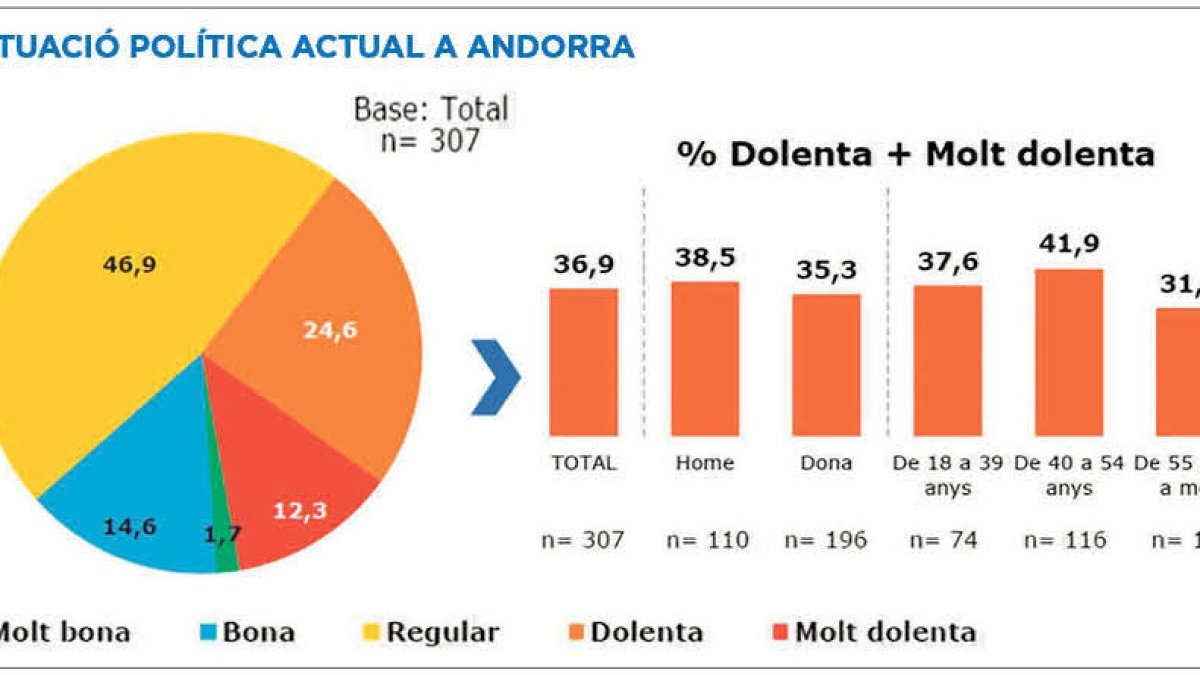
36.9% say that the political situation is bad and 16.3% see it as good
The assessment of the political situation also reflects a critical perception. 36.9% of respondents consider it bad or very bad, while only 16.3% rate it as good or very good. The rest of the participants place it in intermediate positions. Housing appears prominently as the first problem pointed out by respondents, with 78% of mentions. Behind are the wageswith 59%, and the cost of livingwith 44%. These three areas make up the block of most relevant economic and social concerns in the survey.

Ideological niche
The healthcarementioned by 28% of the participants; immigration, with 27%; the working conditionswith 23%, and mobility and trafficalso with 23%, are other issues that also generate concern. The research also points out that the public safety is perceived as one of the major priorities of country, together with economic strength, the defense of sovereignty and the preservation of one’s own identity. In this context, Virtues highlights that 50.9% consider that there is room for a new conservative party in the current political scenario. For training, this data points to the existence of a demand for political projects focused on the good management, security, institutional quality, economic sustainability and the defense of a sovereign country model. The study also emphasizes issues such as civility, identity and administrative efficiency, which appear linked to the priorities expressed by the participants.
The sample has been prepared from 307 online interviews with residents of Andorra with Andorran nationality and of legal age. According to the technical sheet, the interviews are representative of the population under study and are segmented by gender and age criteria. The margin of error is 5.6%, with a confidence level of 95%.