In a world that often celebrates what is newest and fastest, there is something quietly powerful about a place that simply endures.
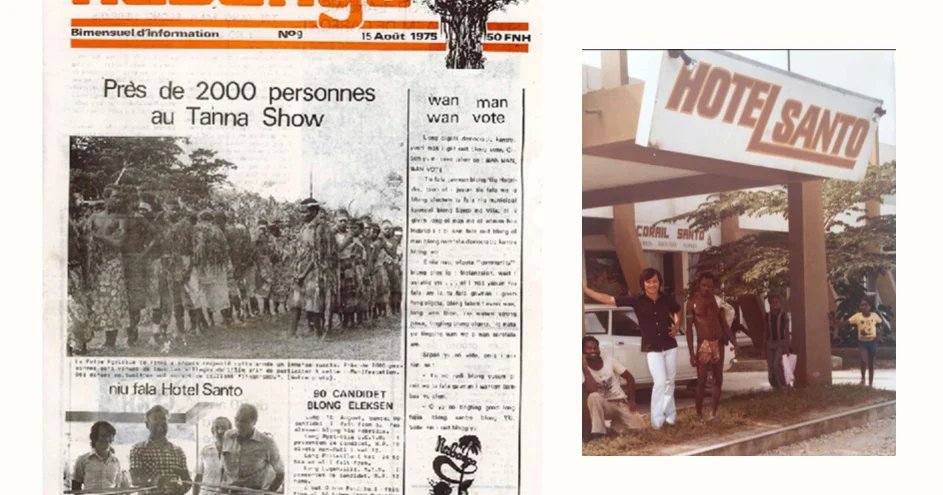
This August, Hotel Santo marks 50 years since it first opened its doors in Luganville in 1975.
To celebrate, 50 flags are being raised across the hotel — one for every year of welcome, reflecting the people from here and around the world who have passed through its doors over five decades.
But the anniversary is about more than longevity.
It is about continuity, belonging and the value of places that become part of the landscape of a town.
When Hotel Santo was built by Dinh Van Tho and his family in 1975, its striking modernist design changed the streetscape of Luganville.
Fifty years later, the building still stands unmistakably in the centre of town.
Designed by French architect D’Hausserre, a friend of Dinh Van Tho, with Italian engineers contributing to its construction, Hotel Santo was an ambitious building for Luganville of the 1970s — modern in its lines, tropical in its response to place, and deeply connected to Santo in the details that gave it its identity.
That connection began, quite literally, on the shores of Santo.
Dinh Van Tho’s sister, Blanche Durand, remembers her brother and D’Hausserre walking near the mouth of the Sarakata River, around what is today the end of Unity Park, while discussing plans for the hotel. There they came across a Venus murex shell. Its extraordinary form became the inspiration for elements of the hotel’s architecture and for the emblem Hotel Santo still carries half a century later.
It is a small family story, but one that says much about the building: Hotel Santo was conceived not simply as a hotel placed in Santo, but as something inspired by the island itself.
Dinh Van Tho himself had a connection to the development of the town beyond the hotel, including contributing to the naming of what became Unity Park.
Behind Hotel Santo was also a family story stretching back much further than 1975.
The first members of the Dinh family arrived in the New Hebrides from Vietnam more than a century ago. Dinh Van Tho was born in Port Vila in 1942, and when Hotel Santo was created, it became a family endeavour in the fullest sense.
His brothers and sisters contributed in different ways — helping with the construction, plumbing, electricity, furniture and the running of the hotel itself. Some of the furniture made for Hotel Santo by his brother Dinh Van Ku is still in use today, carefully restored after half a century. Other members of the family worked within the hotel during its early years.
So while the vision for Hotel Santo is closely associated with Dinh Van Tho, what rose in Luganville in 1975 carried the work of many hands.
Many members of that generation are no longer here. But the hotel remains a tangible part of what they built together, and of a family connection to Vanuatu that now stretches across generations.
Art was part of the building from the beginning.
Local artist Moutouh — whose work also includes the distinctive pig tusk at Pekoa Airport — was commissioned to create original pieces for the guest rooms and throughout the hotel. Many of those works remain in place today, forming a private collection that has lived with the building for 50 years.
They are more than decoration. Together with the clay tiles, bold colours, tropical spaces and distinctive architecture, they are part of Hotel Santo’s identity — reminders that from its beginning, the hotel drew from the art, culture and landscape of the island around it.
Today, preserving those elements is not about nostalgia. It is about recognising that some things become more valuable with time.
A witness to a changing country
Hotel Santo opened during the final years of the New Hebrides and lived through the transition to the independent Republic of Vanuatu.
The Dinh family was proud to count members of Vanuatu’s founding generation among its friends, and over the decades the hotel became a backdrop to countless meetings, conversations, celebrations and moments of public and private life.
In 1980, only weeks after Vanuatu achieved independence, Prime Minister Walter Lini and Papua New Guinea Prime Minister Sir Julius Chan met at Hotel Santo following the events in Santo that became known as the Santo Rebellion.
The meeting took place during an extraordinary moment in the young country’s history, when Papua New Guinean troops had been invited to Vanuatu by the newly independent government. Photographs preserved by the Dinh family show the two prime ministers together inside Hotel Santo — one of many moments of national history that unfolded within its walls.
Perhaps that is what 50 years really represents.
Not simply the passing of time, but thousands of individual stories layered upon one another: travellers arriving in Santo for the first time, families gathering around tables, businesspeople meeting over coffee, friendships beginning, staff welcoming familiar faces back through the doors, and a town changing around them.
Hotel Santo has been there through it all.
When Dinh Van Tho passed away in 1993, the story of Hotel Santo could easily have ended with him.
Instead, Mary-Jane Dinh carried it forward.
Originally from Africa, but by then deeply rooted in Santo, Mary-Jane continued the hotel and the legacy she and Dinh Van Tho had built together — through changing times, changing travellers and a changing Vanuatu.
For more than three decades since his passing, she has remained a familiar presence at Hotel Santo, welcoming guests, working alongside staff and preserving a place that had become as much a part of Santo as it was a part of the Dinh family.
Today, as Hotel Santo marks its 50th anniversary, that continuity stretches into another generation, with Dinh Van Kim and Lisa Dinh carrying the family connection forward, alongside Kim’s two sons — the next generation of a story that began long before the hotel itself.
In recent years, Hotel Santo has entered a period of careful renewal.
But the intention has never been to erase the past in pursuit of something new. Quite the opposite: it has been to recognise, uncover and celebrate what was already there.
The original clay tiles remain. Original artworks commissioned for the hotel in 1975 still hang on its walls. The distinctive lines of the building, its bold colours and open tropical spaces are being embraced rather than designed away, while modern comforts are introduced around them.
And then there are the gardens.
Over five decades, the gardens have become as much a part of Hotel Santo as the building itself. In the middle of Luganville, their sheer scale and greenery are unusual — mature tropical planting wrapping around the hotel, softening its architecture and creating the sense of space that generations of guests have known.
They have been planted, tended and cared for over many years, and today they are being given the same attention as the building itself. Preserving Hotel Santo means preserving that landscape too.
There is no attempt to make Hotel Santo look as though it was built yesterday. Its age is part of its beauty.
Instead, Hotel Santo is embracing what it has become over five decades — tropical, retro, relaxed and unmistakably Santo.
Because heritage does not mean standing still. It means knowing what is worth keeping while allowing a place to continue evolving.
Ultimately, Hotel Santo’s story has never belonged only to a building or one family. It belongs to the people who have filled it.
The staff who have given years — sometimes decades — of their lives to the hotel. The people of Santo who have celebrated milestones there. The visitors who arrived as strangers and returned as friends. And the generations who have watched the familiar building remain part of Luganville’s landscape.
That is why the hotel’s anniversary campaign is not simply 50 Years. It is 50 Years of Welcome.
The 50 flags now flying across the property are a celebration of those years, those people and the many different journeys that have passed through Hotel Santo.
And perhaps that is the greatest privilege of reaching 50 years: being able to look back and realise how many people have been part of the journey.
The Dinh family would like to personally thank every person who has been part of the Hotel Santo story.
The family also remembers with gratitude those who helped build Hotel Santo in the first place — family members, craftsmen, workers and friends whose hands shaped a building that is still standing 50 years later.
“To those who worked here. Those who stayed here. Those who ate here, celebrated here, met here or simply stopped for a coffee. To the friends who stood beside the family through good years and difficult ones. To the people of Santo who made the hotel their own. And to those who left the island years ago but still remember Hotel Santo with affection. This anniversary belongs to you too,” the Dinh family said.
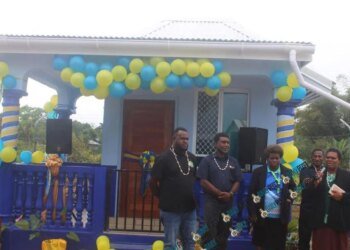
And this August, another ribbon will be cut at its entrance.
Fifty years ago, a ribbon cutting marked the beginning of Hotel Santo’s story in the New Hebrides.
Fifty years later, three generations of the family will stand alongside members of the Santo community and cut the ribbon once again — not to open a new hotel, but to celebrate one that is still here.
Still welcoming. Still evolving. Still part of Santo.
And ready, once again, to open its doors to the next 50 years.