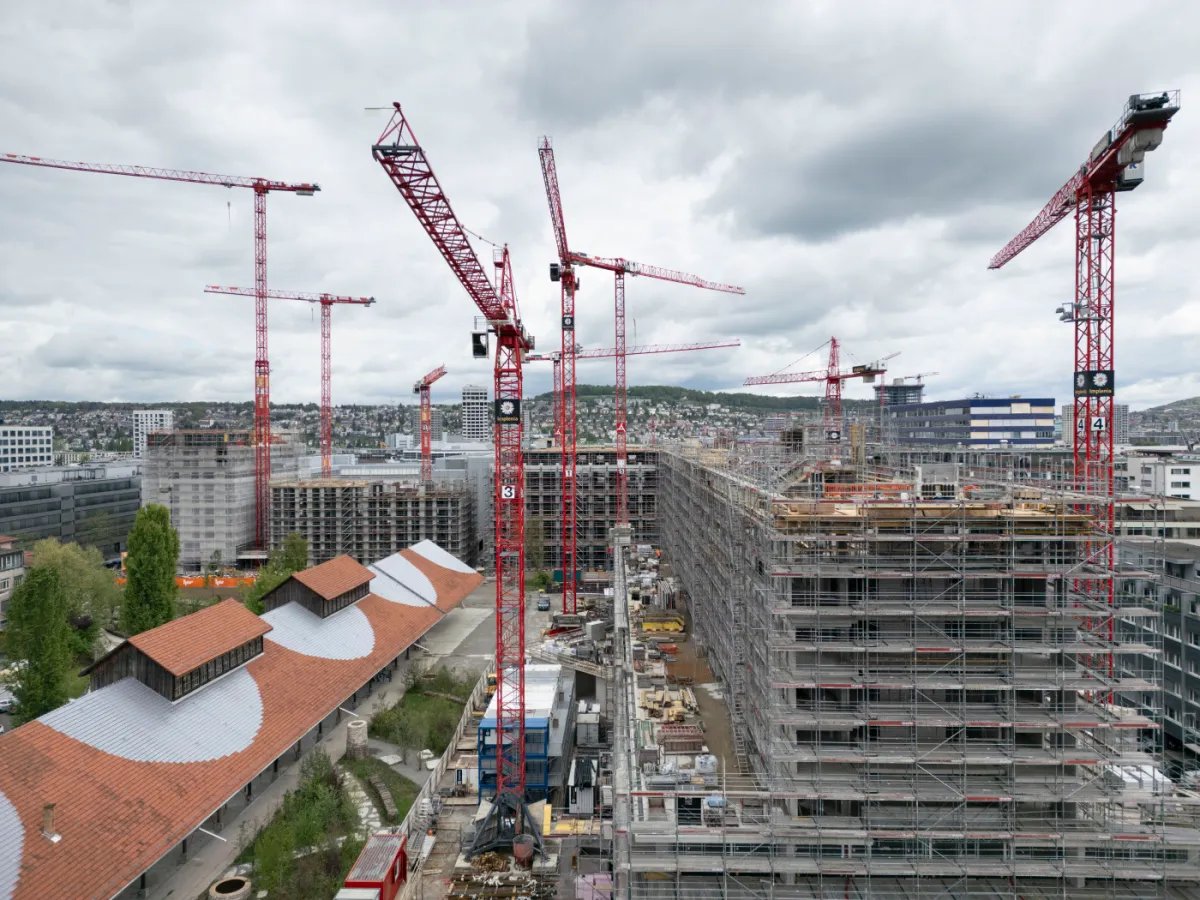

One of the initiatives on the ballot Sunday called for municipalities with a tight housing market to be able to impose temporary caps on rents following renovations.
Keystone-SDA
Voters in the canton of Zurich on Sunday rejected both a comprehensive state intervention in the housing market proposed by the left and a set of rigid quota regulations proposed by the centre-right.
The so-called housing initiative failed to secure a majority among voters: 59.7% rejected it. Voter turnout stood at around 57%.
The proposal, backed by left-wing parties, called for the canton to take on a more active role in the property market. The plan was to establish a public housing authority that would itself build or rent out affordable housing. To do this, the canton would have had to provide at least CHF500 million ($541 million).
By contrast, the counter-proposal from the cantonal parliament and government was approved by 57.9% of the electorate. This enshrines the goal of a sufficient supply of housing in the constitution, but removes the state from the role of developer. The cantonal government must now examine concrete measures within three years to improve the framework conditions for private actors and speed up approval procedures.
‘Hold black sheep landlords to account’
The second proposal from the left, the housing protection initiative, also failed to secure a majority. It was rejected by 57.3% of voters. The initiative called for municipalities with a tight housing market to be able to impose temporary caps on rents following renovations or the construction of replacement buildings. Furthermore, the conversion of rental flats into owner-occupied flats could have been restricted. The initiators pointed to a massive displacement of long-term tenants in the canton of Zurich.
More

More
Housing shortages – what works and what doesn’t
However, voters preferred the government’s counter-proposal, approving it by a 54.3% majority. The counter-proposal does not intervene in rent levels, but imposes conditions on landlords for construction projects involving 20 or more terminated tenancies. Landlords must assess whether refurbishments can be carried out while the property is occupied. Furthermore, tenants must be informed one year in advance and supported in their search for alternative accommodation.
Director of Economic Affairs Carmen Walker Späh said at a press conference on Sunday that exemplary landlords already operate in this way. “We will also hold the black sheep among landlords to account in future,” she said.
No rigid quota for home ownership
Finally, the home ownership initiative, launched by the Homeowners’ Association and supported by the right-wing Swiss People’s Party and the conservative Federal Democratic Union (EDU), stood no chance. It was rejected by 74.9% of voters. The initiative called for a fixed quota for housing projects in which the canton or municipalities are involved. This would have required an equal number of owner-occupied homes to be built as rental properties. These properties would have had to be sold to the middle class at cost price, without any profit.
More
More
Housing shortages – what works and what doesn’t
Both parliament and the cantonal government had rejected the proposal, as a fixed quota would place too great a constraint on housing promotion. In practice, affordable housing for lower incomes is almost exclusively achievable through rental properties.
Translated from German with AI/gw
We select the most relevant news for an international audience and use automatic translation tools to translate them into English. A journalist then reviews the translation for clarity and accuracy before publication.
Providing you with automatically translated news gives us the time to write more in-depth articles. The news stories we select have been written and carefully fact-checked by an external editorial team from news agencies such as Bloomberg or Keystone.
If you have any questions about how we work, write to us at english@swissinfo.ch.