
Listen to this article
Estimated 4 minutes
The audio version of this article is generated by AI-based technology. Mispronunciations can occur. We are working with our partners to continually review and improve the results.
Environment Canada downgraded an ongoing air quality warning and issued a severe thunderstorm warning across the Greater Toronto Area for strong winds, large hail and heavy rain on Saturday.
The national weather agency issued a yellow-level warning for thunderstorms starting around noon that could produce wind gusts up to 110 kilometres per hour, hail the size of quarters to ping pong balls and rainfall amounts up to 40 millimetres.
It said a cold front over Michigan was bringing in “a line of thunderstorms” that would travel southeast across the region. Residents are urged to stay indoors if they hear thunder and to be aware of difficult driving conditions.
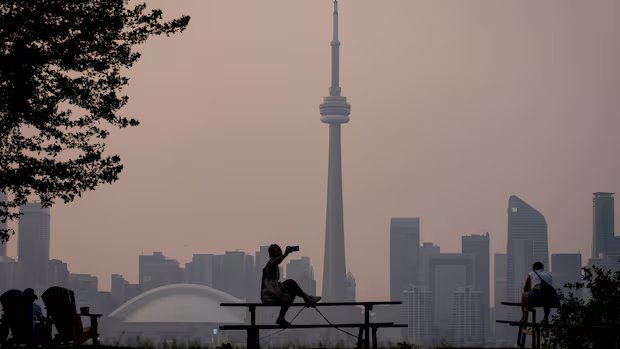
Environment Canada also downgraded it’s air quality warning from orange to yellow across the GTA. The “poor” air quality warning was issued after smoke drifted south from wildfires in northwestern Ontario.
Earlier on Saturday, the weather agency said smoke levels were expected to increase at night.
Showers and thunderstorms are expected to “help sweep out” the smoke temporarily on Saturday, said meteorologist Rob Kuhn on Friday.
On Saturday morning, Toronto topped the list of the world’s most polluted cities, according to a global ranking by IQAir, a Swiss air quality technology company.
The air quality health index (AQHI) at 10 a.m. Saturday was at 8 for “high risk” across Toronto and was at 5 or 6 for “moderate risk” in Brampton, Oakville, Mississauga and Oshawa.
Concentrations of fine particulate matter from the smoke, known as PM 2.5, were at high levels on Saturday morning after they had dropped drastically on Friday. These airborne particles are less than 2.5 micrometres in diameter, smaller than a strand of human hair, and can travel deep into your lungs.
As of 10 a.m. Saturday, here is how much PM 2.5 is in the atmosphere for some GT municipalities:
- Brampton has 43 micrograms per cubic metre (μg/m³).
- Mississauga at 47 μg/m³.
- Oakville at 51 μg/m³.
- Oshawa at 60 μg/m³.
- Toronto ranged from 72 to 80 μg/m³.

The smoke that’s been hovering over the GTA this week is still not in the rearview mirror, with outdoor facilities closing and events being cancelled. CBC’s Naama Weingarten breaks down what people can expect over the weekend and how to stay safe.
Parade postponed, festivals proceed as planned
“During heavy smoke conditions, everyone’s health is at risk regardless of their age and health status. Consider limiting time outdoors,” said the national weather agency.
It urged sports officials and outdoor event organizers to assess conditions when making planning decisions.
Organizers with BIG on Bloor and Beaches Jazz Festival said on social media that events would proceed as planned, despite the air quality warnings.
“Forecasts indicate that conditions are expected to improve as Saturday progresses, and our team will continue monitoring updates,” said the team behind BIG on Bloor.
Meanwhile, Toronto Caribbean Carnival Junior Carnival Parade was rescheduled from Saturday to Sunday due to inclement weather forecasts.
“The decision has been made with the safety and comfort of the thousands of young participants, their families, volunteers, spectators and event staff as the highest priority,” said event organizers in a news release.

Toronto Mayor Oliva Chow said Friday that wading and outdoor pools will stay closed and lifeguards at 10 supervised Toronto beaches are cleared while the orange air quality warning is in effect.
Toronto has six “cleaner air spaces” open at city hall, Metro Hall, North York Civic Centre, Scarborough Civic Centre, York Civic Centre and East York Civic Centre.
Environment Canada warned residents may experience symptoms including headaches, eye and throat irritation, wheezing or chest pains.
Seniors, pregnant people, young children, people who work outdoors and those with existing health conditions are more likely to be impacted by the wildfire smoke. They’re advised to avoid going outdoors and to seek medical attention if experiencing symptoms.