This football World Cup has broken many records since the qualifying stage. But the worst record is undoubtedly that of Americanized ticket prices. This made it impossible for traditional fans to be in stadiums at this World Cup.
I had come to Philadephia, the city we call the “Vlora of Americans”, not to visit it on the 250th anniversary of America’s independence that was announced in this city, but to watch a match of Croatia in this soccer World Cup. The day before the Croatia-Ghana match, the streets were filled with fans.
Those in Croatia jerseys dominated. But, surprisingly, many of them did not speak Croatian. I thought they are from the old Croatian diaspora and the new generations do not speak the language of their ancestors. But no. Many Americans, Japanese, Colombians, Chinese, Mexicans and others wore Croatian jerseys.
It’s just that they had secured tickets for this date for the game in Philadelphia before it was known who would be playing. And when they saw that Croatia was going to play, they decided to feel this unforgettable experience in their lives, that is, to be in a World Cup match, by supporting Croatia.
There were also those who like the small country that won medals in three World Cups, once silver and twice bronze. But in the stadium, despite the good atmosphere, there were no passionate fans, which is usually seen when Croatia plays. Because among the fans there were no real traditional fans for whom the football match is a battle and not just entertainment. And here we come to the difference of this World Cup compared to the previous ones.
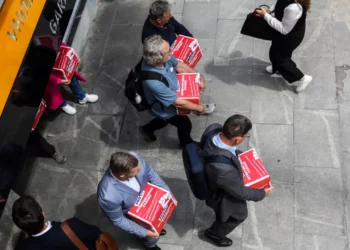
Since it takes place mainly in America, this championship is seen as “entertainment”, that is, as fun. And, following the example of America for the sale of tickets in such events, which are seen as entertainment, FIFA had decided to sell tickets according to the “dynamic pricing” model. So a minimum ticket price is set and then it increases based on demand. This made the tickets for a match go for over 10,000 euros, while the “cheap” ones cost around 800 to 2,400 euros. And these were not the prices on the black market of overselling, but on the official FIFA platform. In response to the criticism, FIFA president Giani Infantino defended himself by saying that “these are also normal prices, or even cheap, compared to the entertainment industry in America.”
What kind of “fans” manage to secure tickets to the stadium can be seen when they scream more when stars like Ronaldo or Messi touch the ball than when any other player scores a goal. Because for them this is entertainment. Millions, if not hundreds of millions of true fans, tear their nails watching the matches on TV.
This football World Cup has broken many records since the qualifying stage. But the worst record is undoubtedly that of Americanized ticket prices. This made it impossible for traditional fans to be in stadiums at this World Cup.
Soccer has become very popular in America as well and there is no doubt about that. Many Americans already know the rules and no longer ask “why the man in yellow (the goalkeeper) can catch the ball with his hand and the others can’t”. But Americans admit that this sport is still more European, and even African and Latin American than American. In New York, there is still more talk about the victory of the Nicks in the NBA in basketball than about the World Cup that is being played in that city.
There was no need for football to be Americanized through skyrocketing ticket prices. Because in this way, football is becoming a sport for the elites and the richest in the stadium, while the real fans are left to watch it on TV.
This method of setting “dynamic” prices for the World Cup has the risk of becoming a rule and being repeated even after four years when the World Cup will take place in Morocco, Spain and Portugal. Because when FIFA gets used to earning billions of euros in this way, it will hardly change the sales method.
That the income and not the interest of the fans is the main principle of this World Cup is also seen by the pause placed in the middle of each part of the game, maybe for “hydration”. Even when it rains, the players take a “hydration” break. This was previously called a “cooling break” and was only referred to when temperatures were high. Now they are regular, they have a fixed duration and they are done at the fixed time even when it rains, or when the game is in a covered and air-conditioned stadium. This is for advertising only. And on American TV, at least they are honest and say “Now we will have Lenovo break” or “Visa break”, i.e. breaks sponsored by the sponsors of the World Cup. This disrupts the dynamics of the game and makes not only the fans nervous, but also the players themselves, because it often loses their rhythm. In one game, the official commentator even said that “this is how the first quarter of the game ends”, even though football is still played in two halves of 45 minutes each. In the past, basketball was also played twice of 20 minutes, but now it is played in four parts. Maybe now even football will be played in four parts, with lots of commercial breaks.
On the other hand, this World Cup, despite the high prices, has already set the record for the number of viewers, there are many other records, such as that of the goals scored by a player in the history of the World Cup.
The teams from Africa also set a record, because 9 out of ten that participated went to the elimination stage, all except Tunisia. This also speaks of how much more equal the national teams are now than they used to be and that today there are no more weak teams. Kosovo was not lucky this time, Albania even less, otherwise they would have had a lot of support. This was also said by some American Albanians that I met at the Croatia match. At least FIFA should be praised for the decision to increase the number of participants in the World Cup. This gave opportunities to teams that few had heard of to prove how strong they can be in football. In this aspect, positive records were recorded. And these records will be surpassed in the remaining part of the championship, which has entered the elimination phase.