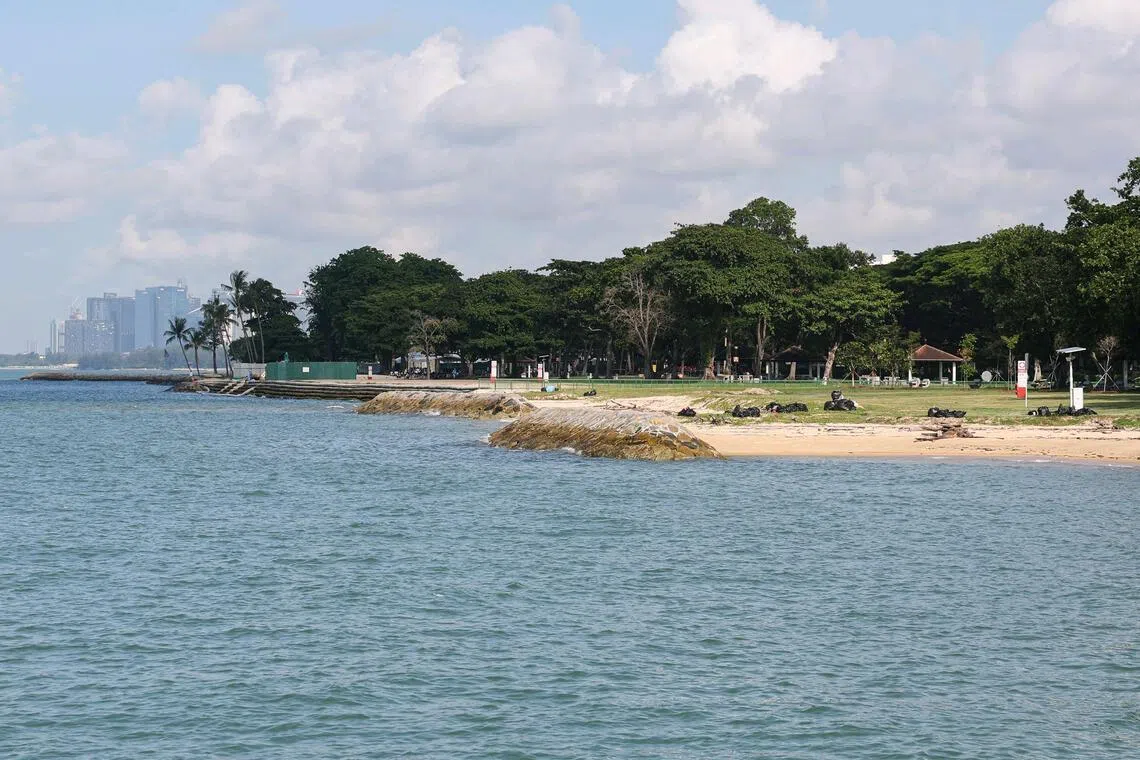
SINGAPORE – Works to prepare for the reclamation of land off East Coast Park will start in end-2026, after which sea sports will be allowed only east of Bedok Jetty.
Some impact on biodiversity, including the critically endangered hawksbill turtle that nests at the park, is expected from the works, said the Urban Redevelopment Authority (URA) and the Housing Board.
Further details about the reclamation project, tentatively dubbed Long Island, were revealed by both agencies on June 30, when a report detailing the environmental impact of the works was released.
The preparatory works will take place in two phases around fishing hot spot Bedok Jetty, said the agencies.
The first phase to the west of the jetty will begin from end-2026, covering an area of about 570ha and spanning some 7km in length.
The second phase to the east of the jetty will start after the completion of major international sporting events hosted by Singapore, including the SEA Games in 2029, to allow for water sports off East Coast Park.
Sport Singapore (SportSG) said in a statement the waters to the east of Bedok Jetty will remain available for sea sports activities until at least 2029.
The government agencies did not reveal when the works will end.
Altogether, the sea space covered by the works amounts to about 725ha, or roughly twice the size of Marina Bay.
An HDB spokesperson told The Straits Times that these works had to be undertaken progressively near the reclamation site to ensure the timely completion of Long Island, which is expected to take decades to plan, design and implement.
“We are phasing the preparatory works to reduce the impact on existing water-based activities off East Coast Park while the works are carried out,” she added.
Unveiled as part of the long-term plan for Singapore’s development in 1991, Long Island has evolved into a large-scale coastal defence against rising sea levels, which will also create an additional reservoir and land for future needs.
The preparatory works include clearing seabed obstructions, constructing temporary sand bunds, and transporting sand for infilling at the site.
The agencies said the date for the second phase, which covers about 155ha, will be shared once the timeline is firmed up.
“There are currently no plans to carry out preparatory works in a third area,” the agencies told ST.
Minister for National Development Chee Hong Tat said on social media that the Long Island project is part of Singapore’s efforts to “plan early and act decisively” to mitigate climate change. People can keep using beaches, exercise paths and tracks along East Coast Park while works are ongoing, he added.
Meanwhile, some sea sports users will be displaced due to the reduction in sea space along the East Coast, with kiteboarding being the most affected, according to URA and HDB.
According to the Kitesurfing Association of Singapore, the sport is allowed at East Coast Park from Bedok Jetty up to Marina South – the area that will be impacted by works during phase one – during the south-west monsoon season.
SportSG said the agencies will work with affected groups to continue their activities at alternative sites. This includes the sea space to the east of Bedok Jetty, as well as other locations like Changi, Pasir Ris, Sembawang and Sentosa.
The agency said it recognises that East Coast Park is an important recreational space with shared memories, noting that ongoing technical studies are assessing if ‘Long Island’ and the new reservoir can support a range of water-based activities and sports.
Harun Talikov, the president of the Kitesurfing Association of Singapore, said the space currently allocated for the sport is already a constraint, not a comfort.
“Hemmed in by wind, height restrictions and competing uses of the shoreline, we have no room to spare,” he added. “Any further loss cuts into space that is already insufficient for a growing, internationally competitive sport.”
He asked for the authorities to factor in the sport during the design process, calling it an investment in Singapore’s standing as a sporting nation.
The association’s vice-president Ong Rong Quan hopes that approvals will continue to be granted to ensure kitesurfing activities and training for the sport can continue with minimal disruption. Such activities currently require annual approvals.
He added: “In the longer term, it is essential that sustainable access to a suitable beach or coastline is secured so that Singapore can continue to train and develop athletes in an Olympic medal-winning sport.”
Meanwhile, anglers will still be allowed to use nearshore fishing areas and Bedok Jetty, although the works could impact fish and reduce catch rates.
Those who swim near the shore of East Coast Park will also be allowed to do so, as the works will take place at least 130m away from the shoreline.
The agencies said land-based park users will experience minimal impact, apart from the potential rise in visible wind-blown dust. This is unlikely to cause significant discomfort or require protective measures.
These findings were based on the first stage of an environmental study by consultancy DHI Water and Environment that commenced in February 2025.
Nature groups were consulted in March 2025 to refine the scope of the study, including suggestions on where and when to survey the presence of seasonal migratory birds, said HDB and URA.
The study anticipated minor impact on some terrestrial and marine biodiversity from the works, as some coral and seagrass beds closer to the site at locations like Marina East and eastern East Coast Park could experience short-term and localised impact from suspended sediments.
However, most of the coral and seagrass in the vicinity, including Sisters’ Islands Marine Park, the likely source of Singapore’s coral diversity, will be largely unaffected, according to the report.
URA and HDB said: “Infilling will be carefully monitored to contain sediment plumes within the work area and away from the shoreline.”
The agencies added that nesting areas to the east of Bedok Jetty will remain accessible to turtles during the first phase of the preparatory works. Ongoing egg relocation efforts to Sisters’ Island will also support the survival of hatchlings.
They said the area used for preparatory works is not reflective of the future land profile for Long Island, and will be clearly demarcated with silt screens or floating barriers.
They added that the second stage of the environmental study, which assesses the potential impact of reclamation works, is ongoing.
The agencies said: “Detailed plans for ‘Long Island’, including its development footprint and final reclamation profile, will continue to be refined through ongoing technical studies, including the environmental study for reclamation works, and the next phase of public engagements.”
In November 2023, then National Development Minister Desmond Lee had said that government agencies will carry out technical studies for the Long Island project over five years, starting early 2024.
The current plan is for three elongated tracts of land to be reclaimed in the area, extending from Marina East to Tanah Merah, with a large tidal gate and pumping station built between each new land mass.
Civil and environmental engineering assistant professor Chew Soon Hoe said the first phase will likely take at least three to four years, while the second phase could last for up to three years.
“These timelines are indicative and could vary depending on the final construction methodology, resource allocation, and the rate at which reclamation materials can be sourced and delivered,” added Chew, who teaches at the National University of Singapore’s College of Design and Engineering.
Actual reclamation works involve much more than the placement of sand, he said, noting that sand infilling alone does not produce land that is structurally ready for development. Reclamation works include seabed improvement, ground treatment and other measures necessary to create land that is stable and suitable for long-term development.
He added: “Given the scale and long-term nature of the Long Island project, which is expected to be implemented progressively over several decades, it is likely that further quantities of additional sand will still be required during the subsequent reclamation phases.
“The preparatory works should therefore be viewed as an enabling step that facilitates and accelerates future reclamation works.”
URA and HDB said the next phase of public engagement for Long Island will begin from end-2026, building on ideas gathered from more than 14,000 people in the first phase.
Topics to be discussed include potential recreational activities along the new coastline and within the future reservoir.

Singapore Sailing Federation chief executive Leslie Tan noted that as the East Coast is Singapore’s last long and uninterrupted stretch of coastline, the Republic should ensure that future generations can still freely walk on the shore, swim in the sea, as well as paddle, row and sail on the open sea, so that they remember Singapore’s island roots.
“If the sea becomes invisible to future generations, we will lose a part of who we are as Singaporeans,” he added.
URA told ST that government agencies have been offering shorter tenancy extensions to businesses at East Coast Park to provide greater flexibility during the works. It did not reveal how many tenants took up shorter leases.
“We will continue to engage with tenants closely and support their transition plans where necessary,” it said.