BEKASI, Indonesia – A women-only carriage at the back of a commuter train was crushed into twisted metal after another train slammed into it on the outskirts of Jakarta, in one of Indonesia’s worst train accidents.
Fifteen people were killed, while 88 were wounded in the crash, state-owned rail operator Kereta Api Indonesia (KAI) said on April 28. All of those killed, and most of those who were hurt, were women.
Among those trapped was textile worker Endang Kuswati, 41. For hours, her family did not know whether she was alive.
Ms Endang was on her way home from her workplace in Pasar Baru, Central Jakarta, when the commuter line train she was travelling on was struck from behind at East Bekasi station in West Java on the night of April 27.
“She was caught in a crush of people, but she was still able to call her aunt,” her cousin, Mr Muhammad Iqbal, told The Straits Times.

Mr Muhammad Iqbal, 32, whose cousin Endang Kuswati was stuck in the crushed train carriage for around 10 hours before being rescued.
ST PHOTO: KARINA TEHUSIJARANA
After receiving the call, Ms Endang’s family members rushed to the crash site at East Bekasi station, arriving there at around 11pm, but chaotic scenes meant it was hours before they could confirm her whereabouts.
“We weren’t sure whether she had been taken to a hospital or if she was still in the train because we weren’t allowed to go to the platform,” he said.
It was only at around 2am, after looking through a reporter’s photographs, that they realised Ms Endang was still stuck inside, underneath a crush of people and twisted metal.
Ms Endang’s husband was then allowed onto the platform and was able to communicate with his wife during the evacuation process.
“She was finally freed from the wreckage and taken to the hospital at around 7am,” Mr Iqbal said.
He added that Ms Endang was conscious and getting X-rays to determine the extent of her injuries.
“Her body is swollen, but we don’t know what internal injuries she has,” he said.
At a press conference the morning after the incident, KAI executive director Bobby Rasyidin said: “The evacuation has taken some time, over eight hours, because we are being very careful.”
The incident occurred at around 9pm local time (10pm Singapore time) on April 27, when a commuter line train stopping at East Bekasi station in West Java was struck from behind by a long-distance Argo Bromo passenger train headed towards Surabaya, East Java.
Videos of the aftermath posted online by bystanders show the locomotive car of the Argo Bromo crushed by the backmost carriage of the commuter train, which is designated as a women-only carriage.

Technicians looking on at the site after a deadly collision between a commuter line train and a long-distance train in Bekasi, on the outskirts of Jakarta, Indonesia, on April 28.
PHOTO: REUTERS
Ms Yunis, 51, who declined to give her last name, received a call from an unknown number at around 10pm on the night of April 27.
She heard a man’s voice saying that her daughter had been in a train accident. Then she heard a young woman crying.
“At first I thought it was a scam call. She was crying out ‘mama, mama’, but it didn’t sound like Laily,” she told ST. “So I said, ‘If you’re really my daughter, then prove it through a video call.’”
She did, and it turned out to be true.
Ms Yunis then rushed to the hospital, arriving there at around 11.30pm on April 27.
Once there, she was able to see her daughter, who had a large bump on her forehead and bruises on her shoulder.
“She told me that she was on her phone sitting in the train when she heard there was an accident up ahead. The train stopped for a while, and suddenly she was thrown upside down,” Ms Yunis said, adding that Ms Laily had been on her way home from her workplace in Tebet, South Jakarta.

Ms Yunis, 51, whose daughter Laily, 27, was a victim of the Jakarta train crash.
ST PHOTO: KARINA TEHUSIJARANA
Ms Laily lost her phone and bag in the accident, but remembered her mother’s number, and a bystander helped her make the call.
Ms Yunis said her daughter was awaiting further X-rays, but doctors said the prognosis was good.
“I hope that the train signalling system is improved to prevent this from happening in the future,” she said.
Another commuter, Ms Gita Septia Wardani, 20, was not so lucky.
The university student had called her father around 10 minutes before the accident, asking him to pick her up at Cibitung station, which is two stops after East Bekasi station, said her grandfather, Mr Rajikun, at the Bekasi Regional Public Hospital where he had gone to look for her.
He told ST that when Ms Gita’s father arrived at Cibitung, he heard an announcement saying that there had been an accident at East Bekasi.
“We went to the station, and we found her backpack at a command post. It had some bloodstains,” added Mr Rajikun, 61, who, like many Indonesians, goes by only one name.
Later, at a press conference at 5pm, police medical bureau chief Nyoman Eddy Purnama named Ms Gita among the dead victims taken to the Police Hospital in Kramat Jati, about 15km away from the Bekasi hospital.
KAI spokeswoman Anne Purba said all 248 passengers of the Argo Bromo survived and have been taken to Gambir station in Jakarta.
“As of now, we are stopping all trains leaving from Jakarta, both from Pasar Senen and Gambir,” she said.
According to a KAI press statement on April 28, 25 train trips had been cancelled because of the accident.
At least 54 victims were being treated at Bekasi Regional Public Hospital on the morning of April 28.

A police post outside the Bekasi Regional Public Hospital in West Java on April 28, with a whiteboard listing the names of the victims of the train accident.
ST PHOTO: KARINA TEHUSIJARANA
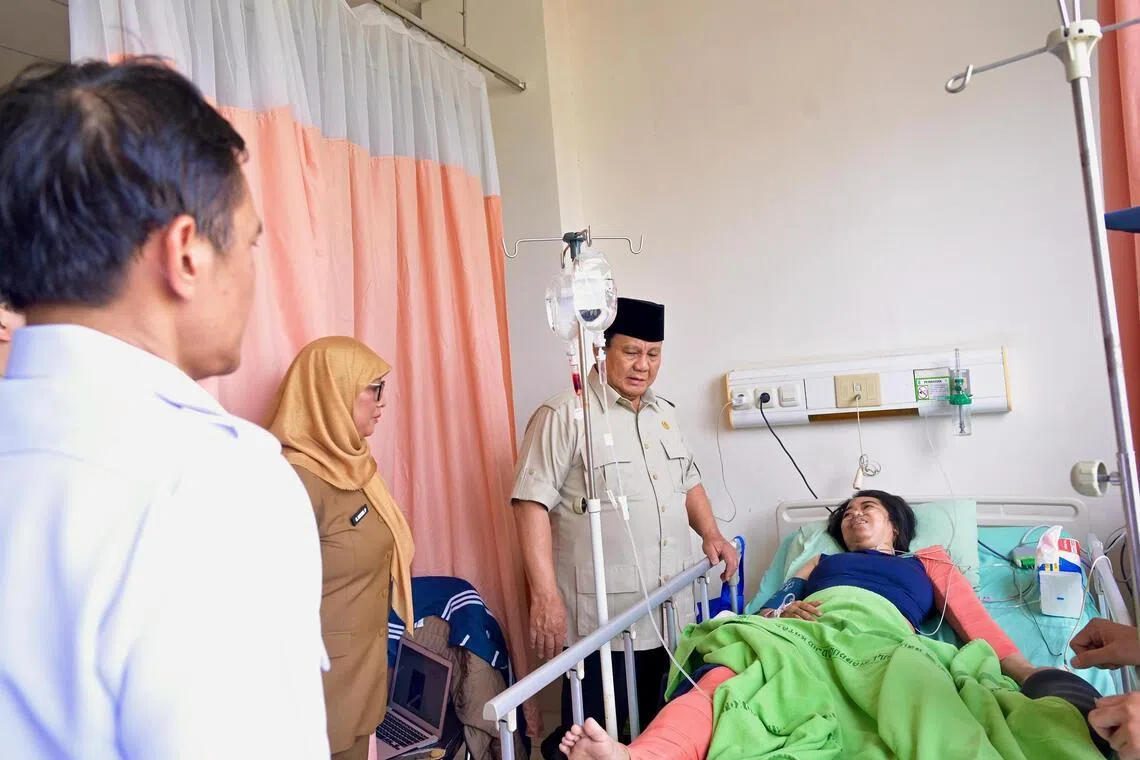
President Prabowo Subianto visited the hospital on the morning of April 28 and pledged to “tidy up” all the railway crossings on the island of Java.
“In Java, there are 1,800 railway crossings like this. They date back to Dutch colonial times,” he told reporters at the hospital. “I have ordered all of them to be tidied up… We have done the calculations, and it will cost almost 4 trillion rupiah (S$296 million).”
He added that the victims of the crash would receive compensation from the government.
Women’s Empowerment Minister Arifah Fauzi visited the hospital at around 11am on April 28. After the visit, she told reporters that her ministry would work to ensure that the women victims received adequate medical treatment as well as psychological care.
“Because from what we saw, a lot of the victims were very traumatised by this incident,” she said.
She had also discussed the placement of women-only carriages, which are currently at either end of the train, with KAI.
The carriages had been put in place since 2012, because of a large number of sexual harassment incidents on trains.
“We have asked KAI to move the women-only carriages to the middle of the train,” she said.