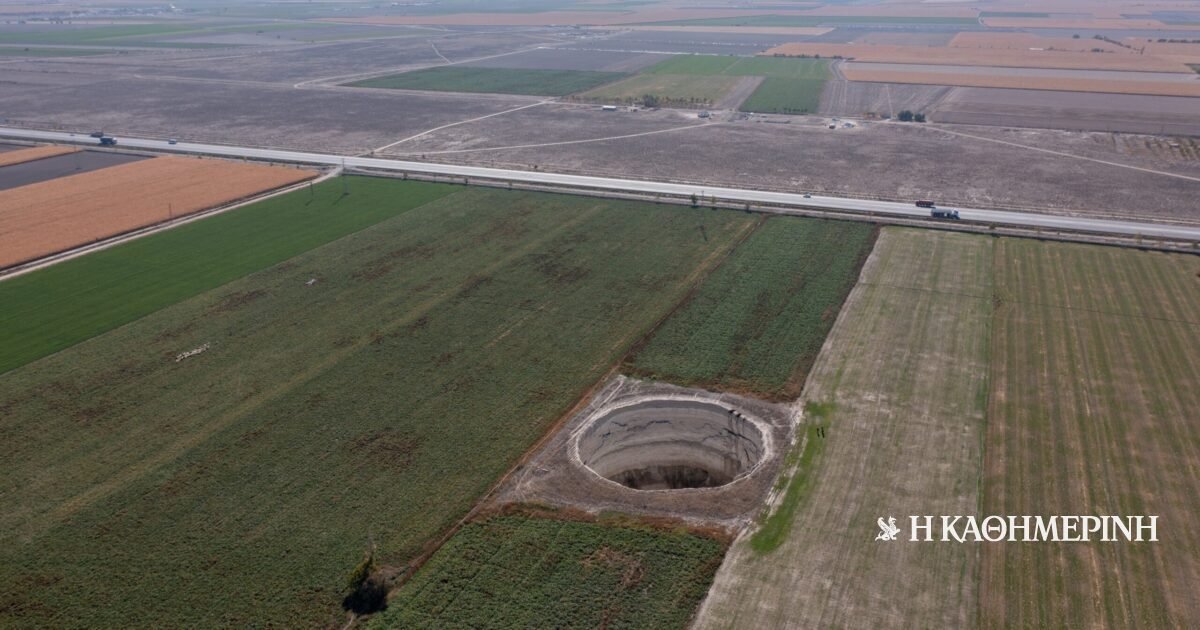
The appearance of hundreds of huge sinkholes in the central Turkey radically transforms the geographical relief of the area, with the phenomenon affecting mainly the plain of Iconiuma zone of vital importance for the country’s agricultural production.
Although the subsoil of the area is inherently vulnerable due to the limestone and soluble rocks, the rapid deterioration is mainly due to human activity. Water scarcity (with plummeting rainfall) forced farmers to turn to intensive and uncontrolled groundwater pumping. To irrigate crops such as sugar beets and corn, deeper boreholes are constantly being drilled.
As the water table recedes dramatically—in some areas the water is now three times as deep as in the past—subterranean caverns previously supported by water pressure are emptying. Without this physical support, the roof of the cavities collapses, suddenly creating huge craters in the ground.
“Water, and for that matter underground rivers, acts as an internal structure that maintains the moisture, stability and strength of these areas,” he says. Güven Eken, founder of Doğa Derneğian environmental organization based in Turkey. “Water sufficiency is decreasing in the region due to uncontrolled irrigation. These underground rivers have virtually dried up. Thus, the water that once flowed under the plain of Iconium no longer exists. The whole system has dried up.”

The effects on the area
Sinkholes have always been a feature of the Iconium plain. “Such formations were created in the area thousands of years ago. The plateau where the Kizoren sinkhole is located is already known as Obruk Plateauas the word “obruk” is the local Turkish name for the sinkhole,” he says Fethullah Arik, head of the Department of Geological Engineering at the Technical University of Iconium.
However, their numbers have increased rapidly in recent years: when the Inoba sinkhole formed in 2008 right next to a village and the Yarimoglou sinkhole appeared in 2009 near the Iconium-Adano highway, some began to realize the magnitude of the threat.

Scientists have recorded hundreds of sinkholes in the province, some of which exceed 30 to 40 meters in diameter and depth. These craters destroy arable land, threaten infrastructure and put the lives of residents and animals in immediate danger. Beyond the sinkholes, the wider area faces severe problem of desertificationas dozens of natural lakes have completely dried up in recent decades.
The need for change
“It is extremely important for our food security… as a country we depend on fisheries, forestry and agriculture, so we need to preserve these resources. People’s livelihoods rely on them,” says Eren Atak, executive at WWF Turkey. “I never blame farmers or local communities. They were born into a traditional living system. It is the government’s duty to plan, inform, guide and incentivize.”
“Currently, actions are underway to create hazard maps,” says Arik. “The Sinkhole Risk Map for the province of Iconium was created by a group in which we also participated. These maps are taken into account in spatial plans. In addition, in urban planning studies, special research is carried out on the problem of sinkholes and specific measures are determined.
Ultimately, however, if the broader issue of water use and agricultural practices is not addressed, the problem will grow. It’s easy to blame the drought, but it just brought to the fore an issue that’s been simmering for a while.”
“The conditions we observe in the plain of Iconium, these sinkholes… are one purely man-made problem. We created it. The climate crisis has obviously accelerated the situation, but it is not the root cause,” points out Ehren, referring to the drought affecting the region. “Sinkholes are really only the tip of the iceberg.”
Source: BBC