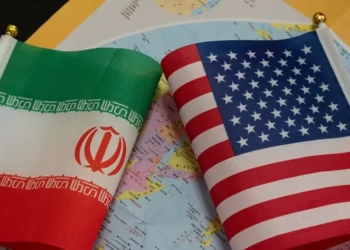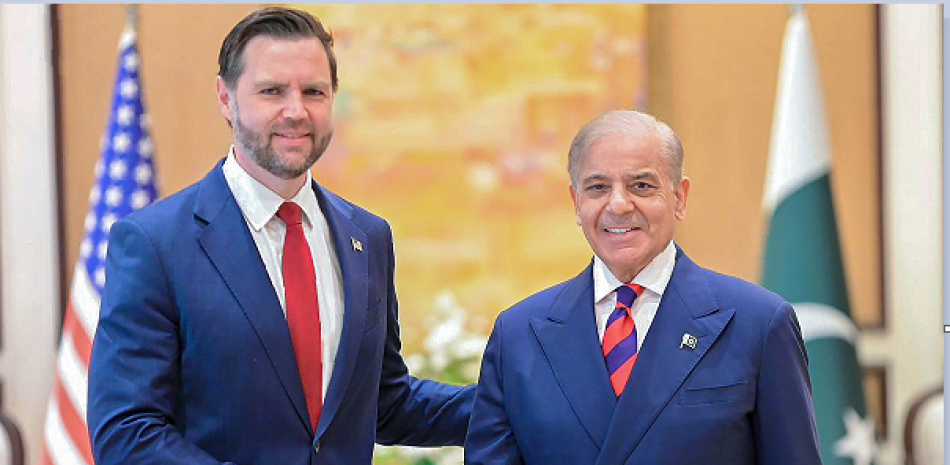
The White House announced this Wednesday negotiations to hold a second cycle of talks with Iran in Pakistan, after Tehran threatened to cut off transit through the Red Sea if the United States does not lift the naval blockade of its ports.
Iran reaffirmed its willingness to continue talks in a context of global expectation about the continuation of the ceasefire that has been in force since April 8, with a view to ending a war that shook the world economy.
“Those conversations are taking place,” but there is nothing official yet, declared White House spokeswoman Karoline Leavitt, who specified that the United States government is “optimistic about the prospects for an agreement.”
The spokesperson reported that “most likely” the new negotiations will be held in Pakistan, which already hosted the first cycle of dialogue.
Iranian Foreign Minister Abbas Araqchi welcomed a Pakistani delegation led by army chief Asim Munir on Wednesday, days after failed talks between the United States and Iran in Pakistan to end the war in the Middle East over the weekend.
Iran’s Foreign Ministry reported this Wednesday that it maintains contacts with the United States through Pakistan since the return of its delegation that traveled to Islamabad for negotiations.
The main obstacle is the differences over Tehran’s nuclear program, and Iran’s Foreign Ministry reiterated this Wednesday that the country’s right to enrich uranium is “indisputable” but that the level of this process is “negotiable.”
US Vice President JD Vance says a “grand deal” has been proposed to Iran.
Trump started the war by arguing that Iran was moving closer to building an atomic bomb, a claim not backed by the U.N. nuclear watchdog. For its part, Tehran defends that its nuclear program has civilian purposes.
Vance claims that Trump promised to “make Iran prosper” if it commits to “not having a nuclear weapon.”
Regarding the ceasefire, a senior U.S. official said the United States “has not formally agreed to a two-week ceasefire extension” with Iran, following reports that negotiators were getting closer to reaching an extension to the truce that expires in a week.
– Double lock –
The United States intensified pressure on Iran on Wednesday with a naval blockade, but the Islamic republic threatens to obstruct Red Sea exports in retaliation.
U.S. Central Command declared overnight on social media that the blockade was “fully enforced” and that U.S. forces “completely stopped economic trade in and out of Iran by sea.”
However, the picture based on Tuesday’s maritime tracking data was less clear. Several ships sailing from Iranian ports reportedly crossed the Strait of Hormuz despite the blockade.
This strategic step has been blocked by Iranian forces since the start of the war, on February 28 after the Israeli-American attacks against Iran.
Iran threatened on Wednesday to block the Red Sea, to which it has no territorial access.
If the United States maintains its maritime blockade and “creates insecurity for Iran’s commercial ships and oil tankers,” that will mean “the prelude” to a violation of the ceasefire, in force since April 8, estimated General Ali Abdollahi Aliabadi, head of the central command of the Iranian armed forces.
– “Extermination zone” in Lebanon –
On the other front of the war, Washington is pushing for an end to the conflict between Israel and the Lebanese pro-Iran group Hezbollah, fearing that it could jeopardize the ceasefire with Iran and a solution to the conflict.
Lebanon was drawn into the war on March 2, when Hezbollah opened a front against Israel.
Israeli Prime Minister Benjamin Netanyahu affirmed that the first objective of the negotiation with Lebanon is to guarantee the “dismantling” of the Islamist movement Hezbollah, after the ambassadors of both countries met on Tuesday in Washington, in the first direct high-level talks since 1993.
Earlier, Israeli government spokesman David Mencer said this was a “historic opportunity to end Hezbollah’s decades of rule over Lebanon.”
However, the spokesperson insisted that “no ceasefire is being negotiated” with the Shiite Islamist group.
The chief of staff of the Israeli army declared that he ordered that an area of about 30 kilometers from the southern border of Lebanon to the Litani River be converted into an “extermination zone” for Hezbollah, within the framework of an intense offensive by its troops.
Israel occupies parts of southern Lebanon and has resisted any truce in fighting with Hezbollah, arguing that the pro-Iran movement remains the main obstacle to peace.
Furthermore, Netanyahu stated that the United States keeps Israel constantly informed about its contacts with Iran and that the two countries maintain the same objectives, adding that they want the country’s enriched uranium removed, its enrichment capacity eliminated and the Strait of Hormuz reopened.