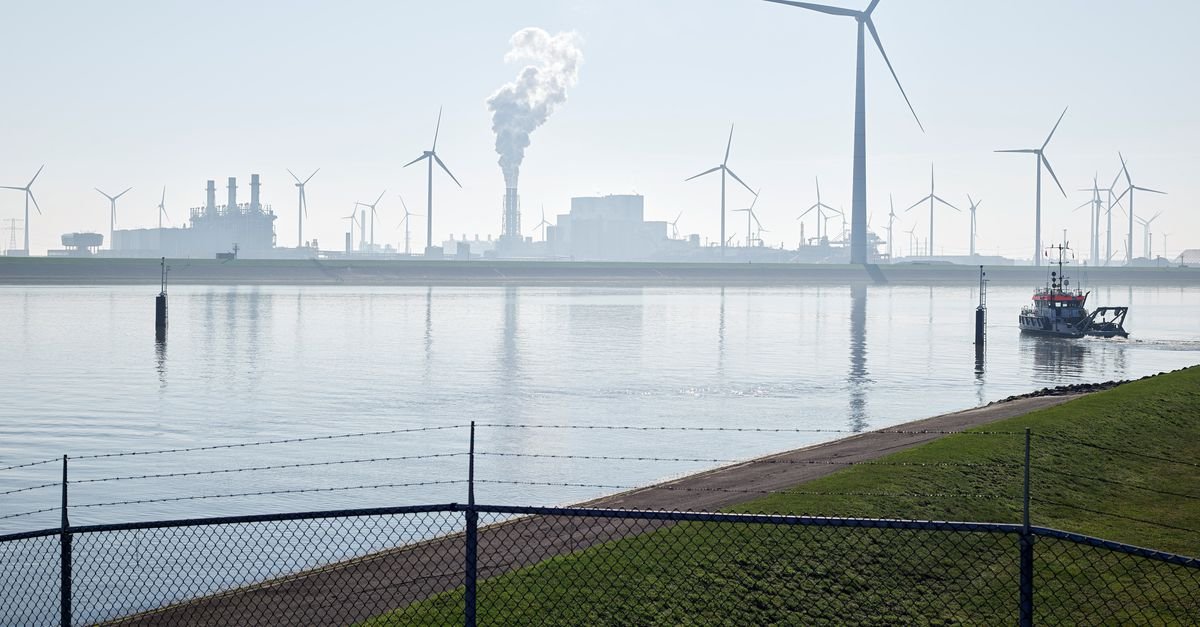
The waste race for the location of two new nuclear power stations has begun. The cabinet is expected to announce on Friday that it will ignore the Rotterdam Maasvlakte and Borssele. This means that the new nuclear power stations will either end up in Eemshaven in Groningen or in Terneuzen in Zeeland, sources confirm. NRC after reporting PZC.
It is striking that Eemshaven remains in view, despite Groningen’s earthquake history. The regional authorities have previously said that they absolutely do not want the construction of two nuclear power stations. A majority in Parliament also spoke out last year against the construction of a nuclear power plant in Eemshaven. Then-minister Sophie Hermans (Climate and Green Growth, VVD) said she put Groningen on the list to cover legal risks in the future.
But from research by Tennet, true de Volkskrant writes about on Thursday, it would appear that Eemshaven is the preferred location from the high-voltage grid. It would be the only place where the power stations could be installed technically and without much additional cost.
Also read
Eemshaven is back in the picture as a location for nuclear power plants
:format(webp)/s3/static.nrc.nl/images/gn4/stripped/data124444761-be573d.jpg)
Tennet does not want to comment on the research conclusions until the government letter is published on Friday. A spokesperson said that the study, carried out on behalf of the Ministry of Economic Affairs and Climate, only concerns integration into the high-voltage grid. There is more to the final choice of a location, including environmental issues.
The plan is to place two nuclear power stations next to each other. The government would like to do this in order to be able to build as cost-efficiently as possible. The power stations require seawater for cooling, which is why from the start only locations near the sea were considered. Furthermore, the choice also plays a role in how offshore wind farms, including large power generators, develop. An important limiting factor is the capacity of the high-voltage grid with which the power is transported to other parts of the Netherlands or abroad.
In both Zeeland and Eemshaven, electricity generated at sea comes ashore. There is currently more space on the power grid in Eemshaven than in Zeeland, sources confirm to NRC. This does not necessarily mean that Terneuzen as a location is impossible, but then the high-voltage grid there would have to be expanded.
That’s where the problem lies. Zeeland has drawn up a number of its own conditions. This includes the fact that the province absolutely does not want any additional high-voltage pylons or cooling towers.
Also read
Some Zeelanders say: bring on that new nuclear power plant
:format(webp)/s3/static.nrc.nl/wp-content/uploads/2025/09/19160430/data137604121-2ff7ff.jpg)
Different course
There is annoyance in Groningen about the state of affairs. “Don’t do this to us, there’s enough going on here,” says councilor Eltjo Dijkhuis (Municipal Interests) of the municipality of Het Hogeland. He is surprised by the developments and “functionally” angry. His province has agreements with the government about bringing power from offshore wind farms to land and the production of hydrogen, he says. “Here too, space is scarce and Groningen has a different (energy) course than nuclear energy.”
We are the province with the most knowledge and a lot of support
On the other hand, Zeeland administrators are in principle happy to welcome the new nuclear power plants. “We are the province with the most knowledge and a lot of support,” says Johan Aalberts (CDA), deputy for economy and energy. Yet it is not a done deal in Zeeland either.
Councilor Laszlo van der Voorde (Pro) from Terneuzen emphasizes that if the nuclear power stations end up there, many additional investments in the power grid will be required, which is especially logical if there is also a demand for power, for example from industries that are becoming more sustainable. “A nuclear power plant is already a gigantic task. We also have to consider what is in proportion to our 55,000 inhabitants.” Van der Voorde calls it “a major dilemma” for the municipality and the government.
It should come as no surprise that the Maasvlakte is no longer a preferred location. The Port of Rotterdam Authority previously indicated that it was not interested in nuclear power plants. A setback was also already known at Borssele: in 2024 it became apparent that a lack of space would become a possible problem. When investigated Tennet has the option for two new nuclear power stations near the current power station. But the grid operator concluded that one nuclear power plant would be just fine, not two.
Puzzle
The final location will be a complicated puzzle for State Secretary Jo Annes de Bat (Climate and Green Growth, CDA). The government has great ambitions with nuclear energy. By 2050, no less than 7 GigaWatts of nuclear energy should be available in the country. This means that the construction of two new nuclear power stations, which together will have a maximum capacity of 3.2 GW, is not yet sufficient. For comparison, the current nuclear power plant in Borssele has a capacity of 485 MW. 1 GigaWatt can power approximately one million homes, and 1 GW is equivalent to 1000 MW.
How much does Groningen’s natural gas history weigh?
In addition to regular nuclear power stations, the government also wants to work with so-called SMRs. The promise of this type of nuclear reactor is that it can be built in a factory and therefore cheaper. The government will announce plans for this on Friday. These types of nuclear reactors seem to have attracted a lot of political enthusiasm for the time being.
Now that the government wants to speed up the construction of two regular nuclear power stations, it will have to keep friends with both the Zeelanders and the Groningen residents. It is above all a political choice where the two nuclear power plants will end up. How much does Groningen’s natural gas history weigh? How much should additional investments in the power grid cost? The cabinet wants to decide on the final location in September.
The Ministry of Climate and Green Growth did not want to respond on Thursday.
Also read
‘Small’ nuclear power stations are the future, many politicians think. But is that really the case?
:format(webp)/s3/static.nrc.nl/wp-content/uploads/2026/05/26163626/280526DEN_2033841832_SMR.jpg)