
June 21, 2026 at – 01:00
Between 2002 and 2025, the Current Legal Minimum Wage (SMLV) and the average salary of private sector employees showed an upward trajectory in Paraguay. However, the most relevant data is not only in the nominal increase in both incomes, but in the close relationship that exists between them. The SMLV/S_average ratio remained at high levels throughout almost the entire period, with values that ranged between 84% and 109%, according to the Ministry of Labor, Employment and Social Security (MTESS).
In the early years of the series, the ratio was particularly high. Between 2002 and 2007, the legal minimum wage was above the average wage. The proportion went from 101% in 2002 to 109% in 2007, with records of 102% in 2003, 103% in 2004, 106% in 2005 and 108% in 2006. This means that, during that period, the minimum wage exceeded the average income observed in the private salaried sector.
From an economic perspective, the behavior shows a strong salary compression. When the minimum wage is above or very close to the average, the labor market has little room to differentiate remuneration by productivity, experience, training or type of occupation. It may also reflect a high concentration of workers at low or medium-low salary levels, where the legal minimum acts as the main reference.
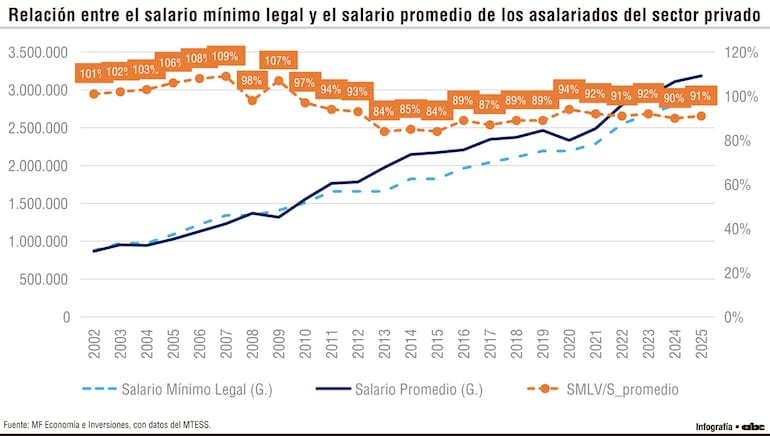
Starting in 2008, the relationship began to decline. That year it stood at 98%, although it rose again to 101% in 2009. Then a clearer correction was observed: 97% in 2010, 94% in 2011, 93% in 2012 and 84% in 2013. This last value was one of the lowest in the series and marked a greater distance between the average salary and the minimum wage. Still, even at that point, the minimum wage represented more than four-fifths of the average private wage.
Between 2014 and 2019, the ratio remained relatively stable, between 84% and 89%. It was 85% in 2014, 84% in 2015, 89% in 2016, 87% in 2017 and 89% in 2018 and 2019. This stage suggests a more balanced relationship than that observed in the first years, although still with a very high minimum wage compared to the average wage.
In recent years, the proportion has returned to close to 90%. In 2020 it reached 94%, then fell to 92% in 2021, 91% in 2022, rose to 92% in 2023, fell to 90% in 2024 and closed at 91% in 2025. In parallel, the average salary exceeded G. 3,000,000 towards the end of the period, while the minimum wage also continued with nominal increases, a trend which will be maintained in 2026 with the recent readjustment of 5% of the minimum wage.
The economic challenge is in balance. A high minimum wage relative to the average can help sustain the income of lower-paid workers. However, when placed too close to the average wage, it can also raise the cost of formal hiring for companies with low productivity, especially in small units or labor-intensive sectors.
For this reason, the salary discussion cannot be separated from productivity, labor formalization and the payment capacity of companies. Therefore, salary policy not only affects income, but also the structure of incentives to hire, formalize and sustain employment over time.
*This material was prepared by MF Economía e Inversiones