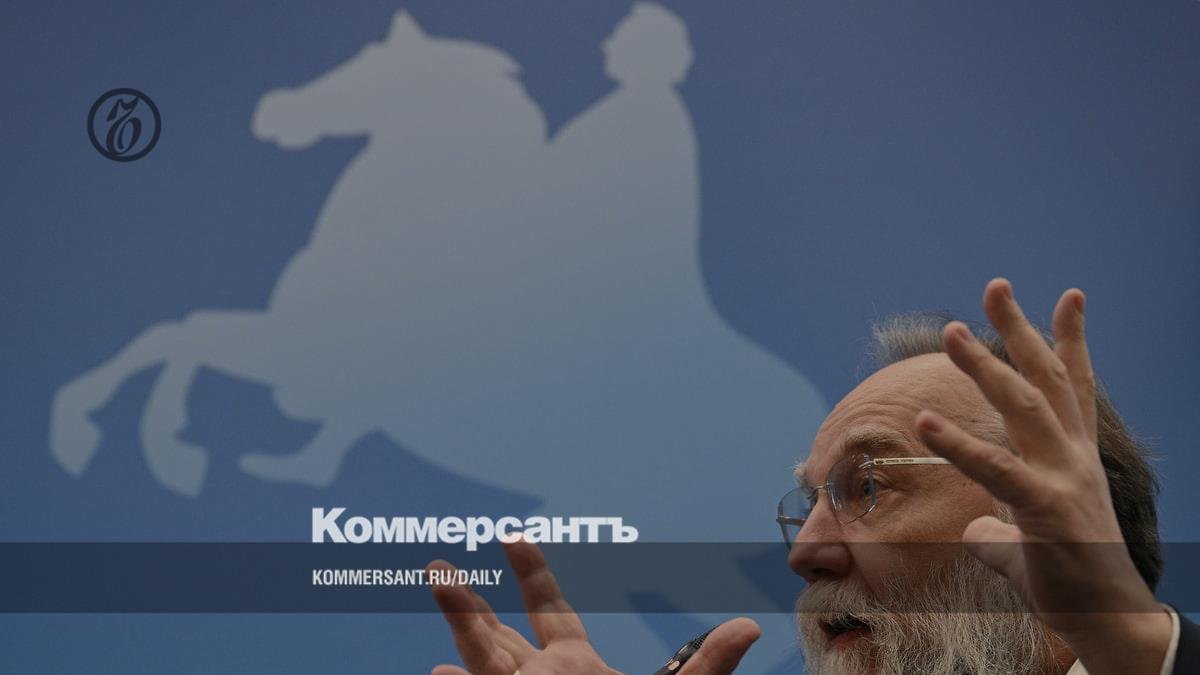
The first day of the St. Petersburg International Economic Forum (SPIEF) was marked by discussing civilizational threatsfacing Russia. Well-known conservatives, including the founder of the Tsargrad TV channel Konstantin Malofeev, Vologda governor Georgy Filimonov and philosopher Alexander Dugin, decided to present their vision of a potential “path to salvation.” Mr. Malofeev formulated the key thesis almost immediately: a positive scenario for the Russians is the early use of nuclear weapons.
“This is a scientific report that was prepared by a whole group of experts,” Konstantin Malofeev prefaced his speech, clarifying that the “cooperators” of the work were himself, Alexander Dugin and a professor at MGIMO, in the past illegal intelligence officer Andrey Bezrukov. But other panel participants also contributed to this work, including Deputy Secretary of the Public Chamber of the Russian Federation Alexander Galushka and Rector of the Presidential Academy (RANEPA) Alexei Komissarov, the speaker added.
It followed from the report that Russia’s path to a serene future in 2050 faces threats that can be divided into five areas: geopolitics, ideology, demography, economics and technology. All of them have been hanging over Russia since the beginning of the 21st century, although their relevance changes over time.
For example, from 2000 to the present day, the threat of “collapse of the country” has dropped by nine points, but the chance of its “death in war” has increased by the same amount.
Mr. Malofeev did not limit himself to thoughts about the distant 2050, but also assessed the prospects for the interim 2036. The report presented three scenarios: “bad”, “good” and “inertial”. The likelihood of the first two depended on the specific steps of the Russian leadership, the main one of which was “strengthening defense consciousness.” The third scenario assumed that everything would go as it is now. The slide presented stated that the “inertial scenario” would lead Russia to the use of nuclear weapons, but Konstantin Malofeev saw an error:
“I remember what we wrote. We do not consider the use of nuclear weapons to be an inertial scenario, we consider it a good one.”
Well, to a “good” nuclear strike, we must also add several important measures in the sphere of government that should save the country, the speaker noted: de-Westernization, nationalization of the elite, autocracy, state planning, the cult of the family, urban settlement, a new Constitution, etc.
After this, Mr. Malofeev gave the floor to Georgy Filimonov, asking him to speak not from the region, “but from the Russian soul in general.” The governor was not able to fully realize this wish: his speech in some places resembled a report on official successes. But he did not forget to mention that the Vologda region is ethnically the “most Russian” region of the Earth. This allowed Mr. Filimonov to make generalizations: “It’s time for many representatives of different levels of the elite to stop being embarrassed to say the word “Russian.” And SVO really helped to awaken these righteous meanings, to reveal this dormant potential.”
Konstantin Malofeev introduced the next speaker as “our man in Washington,” hinting at his spy past. Andrei Bezrukov began by outlining the disappointing present: “We understand that a drone can fly to almost any region of the country via Starlink and fall in the exact place where it should fall.” He also proposed to “add in” the threat of biological warfare. But the answer to the eternal “what to do?” The professor said: “We need to stop being good. Many, many red lines that we talked about remained on paper.” The audience reacted with cautious applause. “Even without going into a nuclear war, we actually have a huge range of possibilities,” Mr. Bezrukov moved on to specifics. “Let’s simply take the fact that all of Western Europe now depends on imported gas. Do you know what a gas carrier explosion is? This is the equivalent – if detonated correctly, of course – of a small nuclear explosion. They must understand this. And that means someone should tell them about it.”
Alexander Dugin, who closed the session, immediately reassured the audience that some of the steps proposed by his colleagues were already being implemented by the authorities: they just need to be bolder. In the presidential administration, the philosopher assured, there is only talk about ideology and de-Westernization: “Everyone has already forgotten this stupid article (Article 13 of the Constitution, which prohibits the establishment of a state ideology in the Russian Federation.— “Kommersant”)!” But there are also some shortcomings, Mr. Dugin continued:
“We have autocracy, but it is not recognized. Its legitimation is slow. The new Constitution is being worked on, but has not even begun to be discussed yet. There is no state planning here at all. It’s like the third volume of Braudel’s “Material Civilization” (Fernand Braudel, French historian of the 20th century.— “Kommersant”) no one here reads it at all!”
This fact was especially depressing for the philosopher, because Fernand Braudel at one time clearly explained that capitalism is “not a market at all.” “Urgent Braudel!” – Alexander Dugin formulated the main requirement of the current moment.