Tamil Nadu’s rich epigraphical wealth demonstrates how ancient temple inscriptions serve as definitive blueprints for heritage conservation and restoration. During a lecture hosted recently by the Tamil Nadu Archaeology Department, at the Tamil Virtual Academy, K. Sridharan, former deputy superintending archaeologist, shed light on what these stone records reveal about the preservation and renovation of sacred structures.
Royal and public patronage
The Chola dynasty actively preserved sacred architecture by converting vulnerable brick temples into permanent stone structures, known as katrali. The dowager queen Sembian Madevi was responsible for many such temples. However, conservation was not the exclusive domain of royalty; even ordinary people actively participated in such efforts. For example, an inscription at the Adavalleswarar temple in Thalaiyalangadu reveals that an individual named Kalingaraja independently undertook the reconstruction of the original brick temple into a katrali.

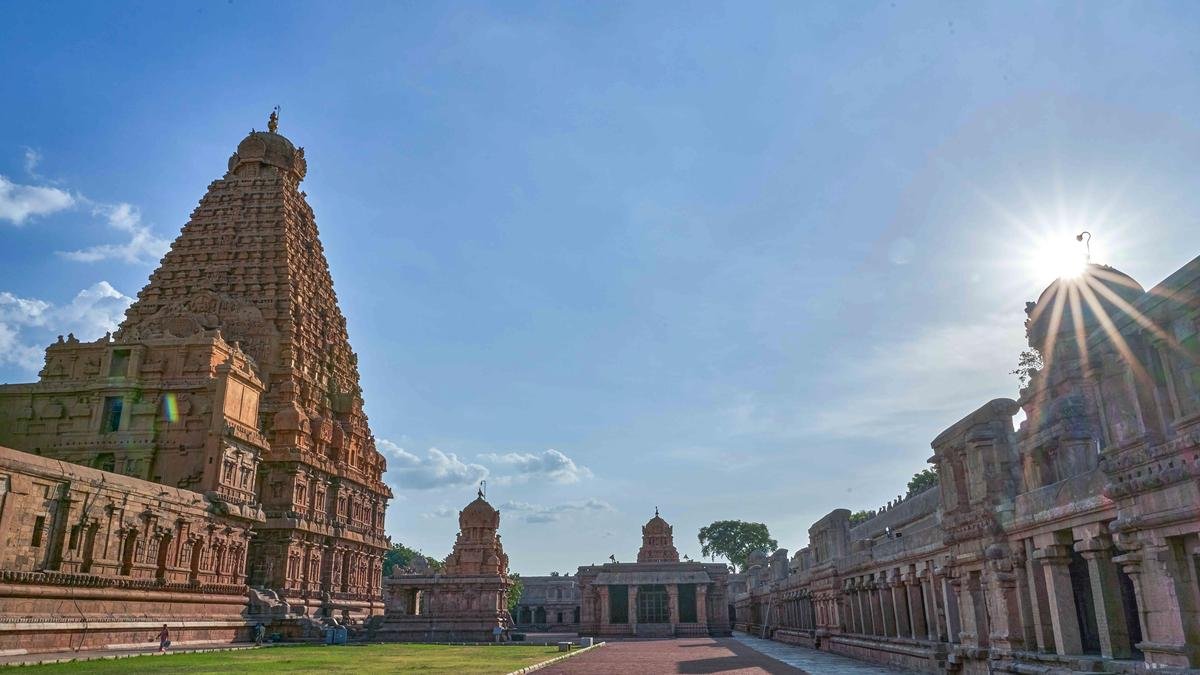
Inscriptions are a rich source of information that offers details about a region’s political, social, economic and cultural past.
| Photo Credit:
B. Velankanni Raj
Sometimes, conservation was a joint effort of the local community, an example of what might be described as crowdfunding in the past. At the Vadakadu Koyilur Mantirapureeswarar temple, an inscription records that local residents pledged a fixed portion of their agricultural income for repairs. The inscriptions at the Thenkarai Moolanathaswamy temple even record the names individual contributors alongside the exact extent of their donations. One such was Kalaiya Mangalamudaiyaan Sootri Udhaiyan, who funded the repair of a single muzham. However, structural changes required prior approval. An inscription in the Thiruvaigavur temple substantiates this point: It notes that royal permission had to be obtained before converting a brick temple into a katrali.
The rulers exhibited humility and generosity in their approach to construction and conservation work. Parakrama Pandya (1423–1463 CE), who initiated the construction of the Tenkasi Kasi Viswanatha temple, which was completed later by his younger brother, left a poignant inscription displaying deep humility. He declared, Thenkasi aalayam deiva cheyalaale samaindadu; yen cheyal alla (the Thenkasi temple was created by divine intervention; it is not my doing). The king concluded with a direct appeal to future generations, imploring them to repair any structural damage the temple might face over time.

An inscription at the Tiruvottiyur temple mentions the name of an architect who used black stone to construct a decorative three-tiered vimanam.
| Photo Credit:
Courtesy: K. Sridharan
Temple construction also involved technocrats, who had varied skills. For example, the sutragrahi took measurements; a thachan was a stonecutter or carpenter; the vardhaki, an expert in intricate joinery, brought the physical structure together and the sthapathy was the chief architect. Many artisans also left their marks on history. Inscribed on a rock on the way to Mamallapuram from Thirukazhukkundram are names such as Kevatha Perunthachan. They were, perhaps, sculptors who worked in Mamallapuram. Sometimes, we also find images of the sculptors, besides the names, left behind, like the one in Konerirajapuram. The Konerirajapuram sculptor was honoured with the title ‘Raja Kesari Moovenda Velaan’.
Stone records were also kept of architectural additions. An inscription belonging to the regnal year of Rajendra Chola I, seen at the Thiruvottriyur temple, notes that an architect named Veera Chola Thachan used black stone to construct a decorative, three-tiered vimanam.

The thachu muzham scale engraved on the walls of Ulagalantha Perumal temple, in Kanchipuram.
| Photo Credit:
Courtesy: K. Sridharan
There are records to highlight how the artisans used different regional variants of the measuring scale: Thanjavur muzham (2 ft 9 inches), Chidambaram muzham (2 ft 10 inches) and Madurai muzham (2 ft 8 inches). Standardised scales were carved in quite a few temples. The Ulagalanda Perumal temple in Kanchipuram features an engraved 32-inch thachumuzham with vertical markings at intervals of 1, 8, 16, and 24 inches. A similar scale is engraved at the Kanchi Varadarajar temple.

An image of the sculptor alongside an engraved measuring scale is seen on one of the pillars at a Madurai temple.
| Photo Credit:
Courtesy: K. Sridharan
Meticulous restoration methods
To ensure long-term preservation, kings established permanent land endowments for future repairs, designated as Thiruppanipuram or Pudukkupuram (as recorded in a Tiruvarur inscription). While some restorations utilised stone, an inscription at the Thiruppugalur temple indicates that repairs there were carried out using ittikai (bricks). An Achuthamangalam inscription mentions the appointment of a Thiruppani Kankaani — a dedicated officer tasked with supervising repair works.
Ancient builders approached structural restoration with forensic precision. A 15th-century inscription details the comprehensive restoration of the 12th-century Bhoolokanatha Swamy temple in Thirumangalam, near Mayiladuthurai. Every part of the temple was systematically labelled, and each stone was numbered. Door frames were distinctly marked ‘South’ and ‘North,’ while structural beams were catalogued as either akavanai (interior) or puravanai (exterior) to ensure accurate reassembly.

Kasi Viswanathar temple in Tenkasi.
| Photo Credit:
Courtesy: K. Sridharan
Preservation of historical records
Ancient conservators treated original historical records with the same reverence as the physical architecture. When Queen Sembian Madevi renovated the Thirukkodikaval temple, she ordered all pre-existing inscriptions to be carefully re-engraved, adding the words idhuvum oru pazhankarpadi (this too is an old inscription). Similarly, when a portion of a stone bearing a Rajadhi Raja inscription was damaged at the Jwarahareshwara temple in Melapathi, it was replaced in the 16th century. The newly carved stone had the phrase kal azhivu (stone damaged).

The statue of a sthapathy at the Konerirajapuram temple.
| Photo Credit:
Courtesy: K. Sridharan
Beyond lithic records, a specialised genre of literature known as Thiruppani Maalai preserves the technical details of past restoration works. The Madurai Thiruppani Maalai, for instance, describes an expensive (vegu rokkam kuduthu) restoration project at the Meenakshi Amman temple. It documents the scientific methods of ancient construction and preservation, and records the replacement of pillars and beams. Bricks were laid using a mortar made of slaked lime mixed with a cocktail of fermented kadukkai (myrobalan), jaggery, and gooseberry.
Collectively, these epigraphical records prove that ancient Tamil Nadu possessed a highly organised, sophisticated and deeply reverent culture of heritage conservation.
Published – September 02, 2026 05:21 pm IST