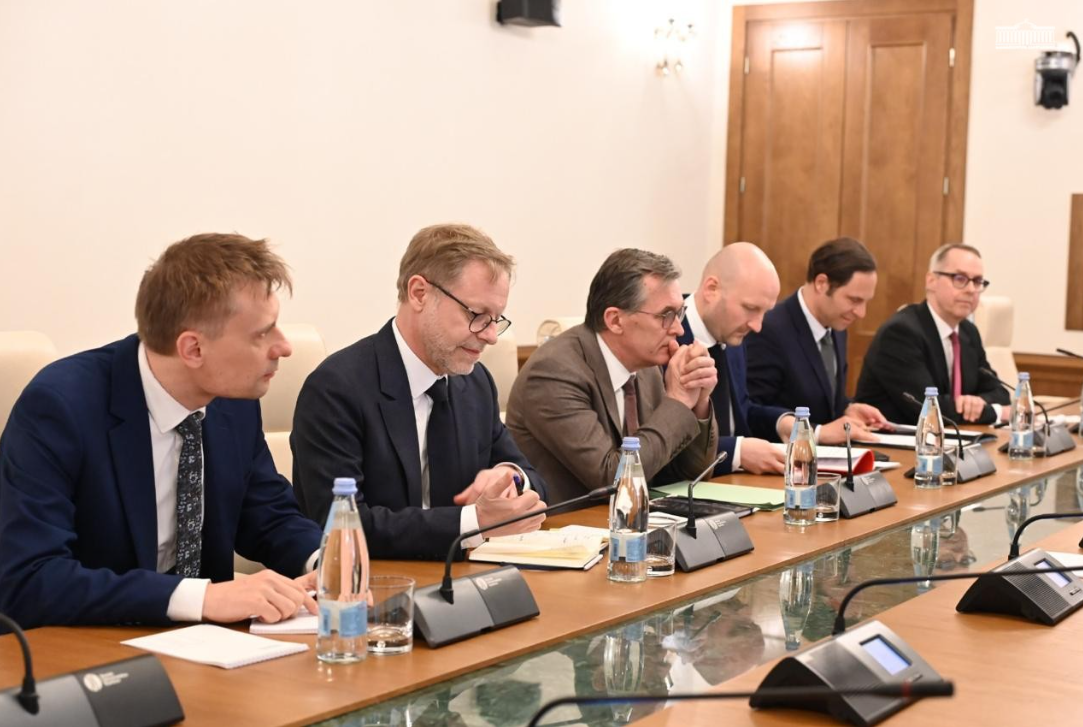
A delegation from the ministries of foreign affairs of the Weimar Triangle countries – France, Germany, and Poland – visited Tbilisi on April 16 and met with the ruling Georgian Dream party officials, as well as with opposition politicians and civil society representatives.
The delegation included Brice Roquefeuil, Director for Continental Europe at the Ministry for Europe and Foreign Affairs of France; Niklas Wagner, Director for Eastern Europe, the Caucasus, and Central Asia at the Federal Foreign Office of Germany; and Michał Giergoń, Deputy Director of the Department for Eastern Neighborhood Policy and Enlargement at the Ministry of Foreign Affairs of Poland. Their respective ambassadors to Georgia were also seen attending the meetings.
The visit came amid deteriorating relations between Tbilisi and Brussels, as well as between Tbilisi and Berlin, Paris, and Warsaw, marked by Georgian Dream’s continued anti-democratic actions, a lack of high-level engagement, and GD officials’ verbal attacks on Western ambassadors, whom they have accused of meddling in the country’s internal affairs.
In one of their latest statement on Georgia on March 10, the foreign ministers of the three countries decried the adoption by the disputed parliament of further restrictions to Georgia’s Law on Grants, calling it “proof of a further repressive approach by the Georgian authorities toward civil society.” They added that the Georgian authorities, through the new regulations, “consciously breach commitments undertaken by Georgia vis-à-vis the European Union, in particular under the Association Agreement.”
Meetings with Georgian Dream Officials
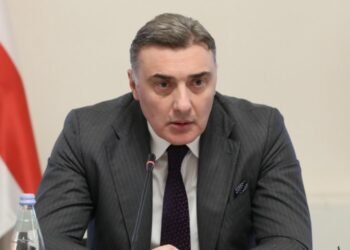
From Georgian Dream officials, the delegation met with Head of the Government Administration Levan Zhorzholiani, disputed parliament’s European Integration Committee Chair Levan Makhashvili, and Foreign Minister Maka Botchorishvili. EU-Georgia relations were reportedly discussed during the meetings.
The Government Administration press release said Levan Zhorzholiani and the delegation “reviewed EU-Georgia relations and emphasized the importance of constructive dialogue.” It added that “Georgia once again confirmed its readiness for dialogue with EU institutions and for cooperation with member states based on mutual respect.” The release further quoted Zhorzholiani as saying the Georgian government “will continue implementing the reforms envisaged under the Association Agreement with the European Union (AA) and the Deep and Comprehensive Free Trade Area (DCFTA).”
The disputed parliament press release said Levan Makhashvili and the delegation “discussed issues of mutual importance, including EU–Georgia relations, ongoing developments in Georgia, challenges on the bilateral agenda, and future steps in the relationship.” It added that “the sides also emphasized the importance of maintaining a constructive dialogue.”
Speaking with reporters, MP Levan Makhashvili described the discussions as “interesting, constructive, and detailed,” saying the sides addressed “all the issues that concern both the Georgian side and the EU, and, specifically, these three countries.”
“However difficult the issues may be, dialogue is necessary so that on matters important to both sides, we can find common solutions,” he said. “It is a fact,” Makhashvili claimed, “that in the European Union, political forces in several countries have such interests and desires for certain actions to be carried out by Georgia that would inevitably bring Georgia into confrontation with Russia.” He did not name any countries.
The Georgian Foreign Ministry press release said FM Maka Botchorishvili and the delegation also discussed EU-Georgia relations as well as “current issues of bilateral cooperation,” and “exchanged views on regional developments, highlighting the critical need for stability and security.” It added that Botchorishvili “drew particular attention to the security challenges and priorities of Georgia as well as future cooperation perspectives,” while the delegation members “reaffirmed their steadfast support towards Georgia’s sovereignty and territorial integrity.”
Meetings with Opposition, Civil Society
The delegation also met with opposition and civil society representatives, following the meeting with Levan Zhorzholiani at the Government Administration.
Representatives of the Opposition Alliance of nine parties, as well as Lelo and former Prime Minister Giorgi Gakharia’s For Georgia party, reportedly attended the meeting. Some of the politicians spoke to reporters after the meeting.
Grigol Gegelia of Lelo said “all the key issues currently posing challenges to our democracy” were discussed. “If the Georgian Dream regime wants any kind of normalization, whether with the EU or the international community, they will have to take concrete steps,” he said, adding that these would include “calling new elections, releasing political prisoners, and ending a policy aimed at mutual destruction.”
The meeting with civil society representatives reportedly included Levan Natroshvili of the International Society for Fair Elections and Democracy (ISFED), lawyer Saba Brachveli of the Civil Society Foundation, and Zaza Abashidze of the Realpolitika online media outlet.
Also Read:
This post is also available in: