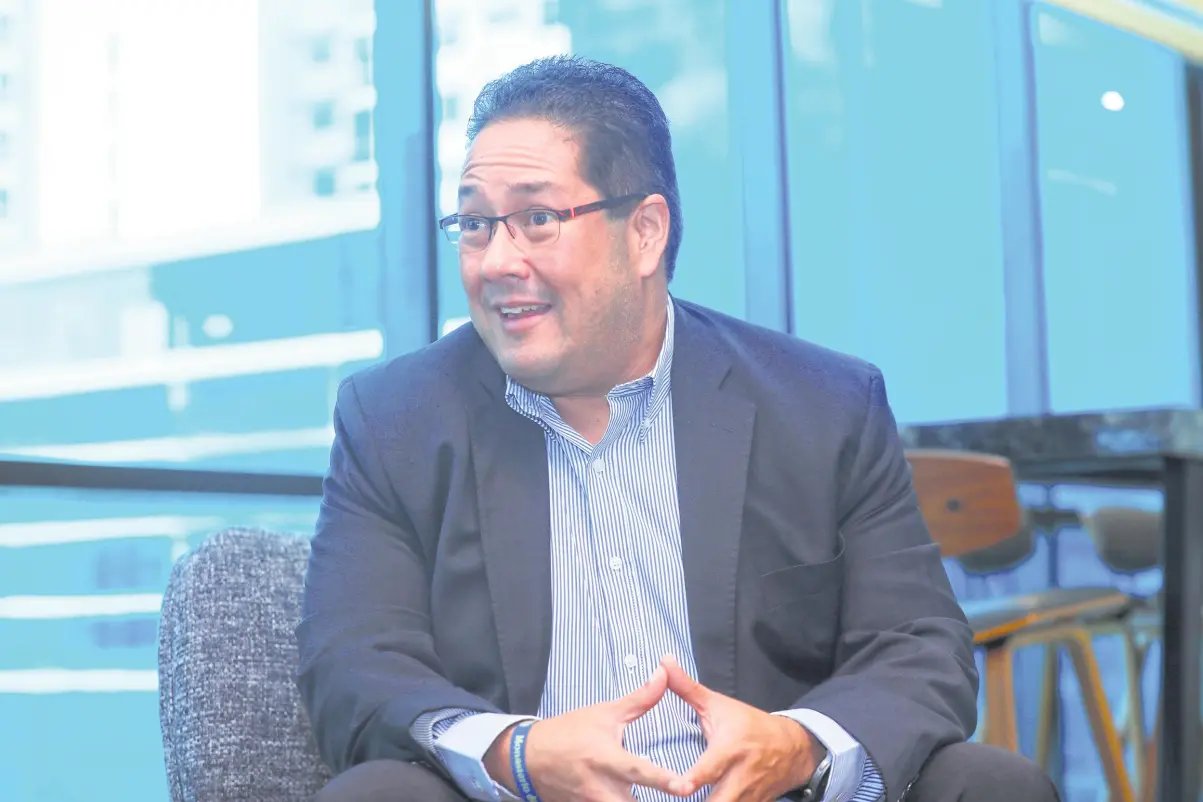
The president of the Panamanian Association of Business Executives (Apede), Alberto López Tom, spoke with The Star of Panama on the prospects of the national economy, the role of private business, education, mining and responses to the earthquake and the El Niño phenomenon.
What are the priority issues for the union at the moment?
First, contribute to the development of the interior of the country, particularly in the creation of new sources of quality employment in the interior. Provide support to producers so that they try to join the agroindustry, so that they make that change from the agricultural sector to the agroindustry.
In the summer it will be a very difficult situation, which is December, January and February, because both situations occur: the damage obviously generated through the earthquake, plus the first drastic effects of the El Niño phenomenon.
The important thing here is that we as the private sector provide support to the government, to the population in matters of educating, raising awareness, trying to find solutions, seeking solutions, channeling information, channeling resources and maintaining that level of communication with the government.
And on the other hand, education, which is also one of the most important pillars for national development. Those are our main priorities.
Under the state of emergency, direct contracts are being made for hundreds of millions of dollars. How important is it to guarantee transparency?
This is a balance, we need quick solutions and unfortunately, when you enter the Public Procurement law, it is not the fastest mechanism.
With this I do not mean that transparency must be ignored. We have been very emphatic that the state of emergency should not replicate the bad experience we had during the pandemic, where we also had a state of emergency that lent itself to many mismanagements that we are seeing in the courts today, all these cases of purchases of respirators, modular hospital ventilators and all these things that left us with a very bad experience.
On that basis we are also aware that we need agility and speed. So we have been very, very emphatic that speed cannot ignore transparency and subsequent control. And I think that on that basis we quite like that the Comptroller’s Office has ruled in the same sense.
What are the expectations of the private sector for 2027?
As everything indicates, I believe that we are going to have a better 2027 than this year. That’s good news. Let’s hope that there are no international factors that affect us.
If everything remains well, 2027 should be a year where we begin to see a more palpable effect of an economic improvement on the population. Right now Panama’s economic indicators show an improvement, but the population still says well, but I’m the same, I don’t feel that improvement.
I believe that in 2027 we should begin to feel the effects of this improvement in the population.
What changes in 2027?
This is going progressively. First it starts at a higher level and then that economic improvement permeates, mostly due to access to credit and execution of projects.
When we begin to execute projects that have been announced, that will reactivate the economy. There is a very important issue on which Panama as a country has to make a decision and obviously it is going to have a very large economic implication, which is the issue of the mine.
There we have to see what we decide and I believe that that decision has to be based on arguments, it has to be based on technical, scientific criteria and not based on absolute emotional impositions. I know that there is a sector of the population that does not sympathize with this industry, but what we cannot do is make decisions based on emotions that are not the best for the country.
There is a lot of uncertainty about the mining project. The population does not know what mechanism is going to be used, if it is going to be reactivated, or closed for 30 years, if the contract is going to be renegotiated, or under what terms. What message do you think the government should send?
Precisely there is where we see that there is a breaking point and that is that the environmental issue is directly linked to the economic factor.
We are clear that a mining industry causes environmental damage. The issue is whether this environmental impact is somehow remediable and how much this environmental sacrifice represents in terms of economic benefit for the country.
And when I talk about economic benefit I don’t just mean GDP growth. The idea is that this economic growth will translate, for example, into better communication routes, a better health system, and better schools.
The audit presented is based largely on data provided by the mining company itself. Do you consider that the government has the capacity to supervise this project?
Precisely so that there was no question about the government’s ability to supervise, an audit was hired by a third party. The company is a world-class company, an international company, one of the largest in the world and most recognized.
I believe that a supervision mechanism by a third party could perfectly well be agreed upon. That is not ruled out and that is why I say, what decision is Panama going to make as a country?
It will largely depend on what the government proposes. How long will this closure of the mine take, how much will the country gain in economic benefits during this activity that will finance the closure? We have to see exactly what we are talking about to see if it suits us or not.
Should the government negotiate better terms?
That is inherent to the scheme that the government has to agree on with the company, because obviously we also have legal risks due to arbitrations that have been established for us. So the idea is that there is a good solution for everyone.
The ACP has announced that it is working on megaprojects such as ports, gas pipelines, Río Indio and the extension of the Logistics Corridor. What do you consider to be the main pending challenges to develop the logistics sector?
We have two great challenges. The first is to try to capture some of that cargo that passes through Panama. Panama has established itself as a hub for transshipment of merchandise. We want to take the next step. We have to make part of that merchandise stay temporarily in Panama to add value. With that we generate income and sources of employment.
The second challenge is to integrate the rest of the country into our logistics platform. We have a canal axis, a logistical axis that runs along the Panama Canal, parallel to the Panama Canal. And to a certain extent we have not integrated the rest of the country into this logistical axis. So our second challenge is to see how we connect the rest of the country with this logistics axis, how we can create processing zones in the interior, in Chorrera, in Capira, in Santiago.
Maybe the train, we will have to look at the studies, but maybe the train is not the best option. But we can consider two or three logistics corridors, Northern Corridor along the northern coast of Colón, one intermediate, another here in the Pacific, connecting regions where processing zones can be established.
Panama remains in the middle of the geopolitical war between the United States and China. What position do you think we should assume when evaluating contracts and concessions?
The important thing is always to ensure the national interest. I believe that if a company is European, if it is from the US or if it is from China, it is to a certain extent dependent on what that company offers for the country.
I am not specifically referring to a payment only, but to the presence of the company in Panama. Because there are companies, and I’m not talking about any one in particular, but there are companies that engage in questionable business practices to some extent.
We had the Odebrecht case here, for example, which was a bad company. Not only do you have to see what the economic benefit is of that company operating in a country, but also what business practices that company brings.
Today, a big part of what goes into doing business is knowing who you’re doing business with, the process of due diligence. That excuse that you hired someone and you didn’t know, is finding less and less support. You have to verify who you are doing business with and I think that is part of the policies that Panama is going to implement when it contracts who is going to operate the port terminals.
In educational matters we continue to get a bad grade, what do you consider to be the way to guarantee quality education throughout the country?
In Panama we have studies, we have analyses, we have diagnoses made all over the world. Obviously there is an interest in educational matters and yet, despite so many studies, so many, many recommendations, education does not improve.
I believe that a large part of that is the degree of centralization that education has in Panama. Here we want to have an egalitarian education. And by egalitarian I do not mean that it is discriminatory, but that it has to adapt to the situations of each region. The educational curriculum that I give to a student from Colón is not necessarily the same as what I give to a student from Los Santos.
Teachers must also be evaluated. Here in Panama every time you talk about teacher evaluation, that lights up the ranch. I believe that teacher evaluation has to be necessary, it is a demand of the times. You cannot have teachers who are out of step with the current educational needs of the youth population.
Alberto Lopez Tom
President of Apede
“The state of emergency should not replicate the experience we had during the pandemic, where it lent itself to mismanagement that we now see in courts,”