
Welcome to our weekly newsletter where we highlight environmental trends and solutions that are moving us to a more sustainable world.
Hi, it’s Emily. Last week, I took the training to use new e-bikes at my workplace. And I’ve decided to do some stories on the growth of e-bikes too.
- What do you use an e-bike for—or what’s stopping you? We want to hear from you. Click “Join the conversation” at the top or bottom of this story. On the app? Click here.
This week:
- Want an EV for under $5,000? How about this option?
- The Big Picture: CBC’s e-bike fleet
- What happens to e-waste in Iqaluit? How one program is diverting laptops from landfills
Want an EV for under $5,000? How about this option?

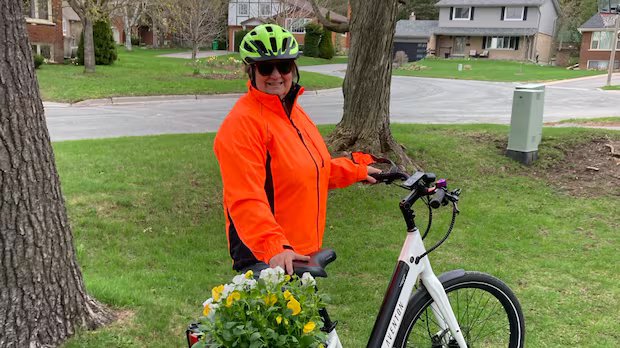
Gaynette Friesen’s electric commute to work is fun, fast and costs next to nothing to run.
Friesen, who lives in Peterborough, Ont., used to ride an ordinary bike. But about three years ago, she got a new job at Fleming College, and the route there was “wicked hilly,” she said. So she bought herself a new Aventon e-bike.
“The e-bike is a game changer,” she wrote in response to a reader callout about e-bikes in last week’s What on Earth newsletter. “It eats up the hills and spits out speed bumps. It makes me feel like I am in the Tour de France.”
Friesen is one of a growing number of Canadians who have bought a much more affordable kind of electric vehicle than any car or truck on the market; entry-level e-bike models start around $1,000, and even deluxe models top out close to $5,000.
Alex Bigazzi, a civil engineering associate professor at the University of British Columbia who has been studying e-bike trends in B.C., said the share of e-bikes on Vancouver multi-use paths quadrupled between 2019 and 2023, from 4.5 per cent to 16.4 per cent of the traffic.
There has been huge growth in other parts of the country too, partly due to provincial and municipal incentives, which are often effective at boosting e-bike adoption.
Burnaby, B.C.-based electric mobility company Envo reports that Canadian e-bike imports quadrupled from $131 million to $530 million between 2019 and 2022, although they have slipped in recent years due to inflation, rising interest rates, and post-COVID spending shifts.
And bike share programs like Toronto’s are finding e-bikes hugely popular – the city’s e-bikes delivered more than twice as many trips per day as its regular shared bikes in 2025, and are believed to be one of the main drivers of ridership growth for the service.
Bigazzi said surveys show people are using e-bikes for commuting, taking kids to school (some models have built in child seats and rails for the kids to hold onto), running errands and shopping, as well as for recreational use. Some are also used for work like deliveries, but Bigazzi’s research suggests they’re a minority of e-bike traffic.
When e-bike users are asked about the benefits, “what we hear the most is the money savings,” he said. But people also talk about the time savings, reduced effort and convenience compared to a conventional bicycle: “It’s easier to get up hills, it’s faster, they can go farther and they don’t arrive as sweaty…. That’s a big one.”
They also talk about how enjoyable it is: “‘It feels good to get outside and move my body.’ Freedom, flexibility, these kinds of experiential things…. That’s something we [engineers] don’t quantify very well and we don’t think about that much, but it actually appears to be a big motivator here.”
Bigazzi’s research found 40 per cent of e-bike trips replace car trips – more than any other form of transportation – especially in smaller communities without good transit. That’s the case for Friesen, who said the local transit is “quite awful,” but used her car so little last summer that mice moved in.
Bigazzi said e-bikes displacing cars is good for cities, as it reduces pollution and congestion, while potentially saving money on transportation infrastructure, since roads for cars and trucks cost a lot more than cycling lanes to install and maintain: “The more people are using these… the cheaper it is to deliver a well-functioning transportation system.”
He added that e-bikes – especially ones available through bike-sharing programs – help with the “last mile” problem, allowing people to get to and from a transit station that may be inconveniently far from their home or destination.
That’s why Divya Jyothi Sangathala wants to buy an e-bike. Sangathala, whom I met at the EV and Charging Expo in Toronto a few weeks ago, sold her car after it became too expensive. But she worried about how she would get to her new job in Ajax, east of Toronto, from her home in Mississauga, west of Toronto.
She estimates that using an e-bike to get to the commuter GO Train on each end instead of slow, unreliable bus service would shave an hour per day off her commute. She’s currently doing research to ensure the model she purchases will be allowed on the train.
Bigazzi said he expects “robust growth” in e-bike adoption over the next five to 10 years, but there are some potential barriers. People say the biggest reasons for not using e-bikes are bad weather, the risk of e-bike theft, and fear of riding in traffic with cars and trucks. He said cities can do a lot to address the last two, especially through better infrastructure such as separate lanes for cars, bikes and pedestrians.
—Emily Chung

Old issues of What on Earth? are here. The CBC News climate page is here.
Check out our podcast and radio show. In our latest episode: She became famous for her work that said trees communicate through a forest web. But Suzanne Simard’s research also faced backlash. Not only is she defending her work as a scientist, she’s back with a new book expanding on it. Together with Tsimshian scientist Teresa Ryan, Kwakwaka’wakw artist and hereditary chief Rande Cook, and lawyer Chris Rusnak, she takes to the stage at UBC with our own Laura Lynch to talk about forests, trees and how to combine western and Indigenous science, along with the law, to make the case for change that helps the climate.
What On Earth27:18Suzanne Simard says it’s time for a fresh look at forestry
What On Earth drops new podcast episodes every Wednesday and Saturday. You can find them on your favourite podcast app or on demand at CBC Listen. The radio show airs Sundays at 11 a.m., 11:30 a.m. in Newfoundland and Labrador.
Check the CBC News Climate Dashboard for live updates on record-breaking weather and current conditions across the country. Set your location to find out how today’s temperatures compare to historical trends.

Reader feedback

Last week, we asked readers to share their experiences with e-bikes. Brian Kennelly of Quesnel, B.C., shared these photos and wrote: “I have been a cyclist most of my 76 years. Since I retired I have mountain biked and bike-packed in many places including Taiwan and Ireland. Last year I acquired a e-mountain bike with a geometry similar to my beloved bike-packing steed to assist with climbs and to encourage more spontaneous bike trips. So far it’s been a very worthwhile addition.”

Write us at whatonearth@cbc.ca (and send photos there too!)
The Big Picture: CBC’s e-bike fleet

(Oksana Shtohryn/CBC)
Here’s a picture of me on one of two new Tern e-bikes that just became available to CBC employees at the Toronto Broadcast Centre. I’m hoping to use them in some of my field reporting in the future.
CBC’s first e-bike launched in Halifax in 2022. My colleague Andrew Leitao came up with the idea, arguing that it could be an environmentally sustainable way to get to stories in traffic congested city centres, while saving on parking and reducing the number of vehicles needed in the CBC fleet. He thought it would also show CBC’s commitment to lowering its carbon footprint in a very visible way.
Montreal was the next location to get e-bikes – many journalists there had been using their own regular bikes in their reporting (as I do), but felt e-bikes would help them cover longer distances and hills while carrying a load of recording gear.
CBC now has e-bikes in Moncton, Quebec City, Rimouski, Vancouver and Whitehorse too.
– Emily Chung
Hot and bothered: Provocative ideas from around the web
- Rooftop gardens in cities have been shown to boost biodiversity and reduce temperatures and flooding. Here are some examples.
What happens to e-waste in Iqaluit? How one program is diverting laptops from landfills

In an overcrowded office, Joseph Kanayuk-Driscoll pulls out a screwdriver and begins to dismantle a laptop.
It’s one of dozens he’s worked on this week as a computer refurbisher in the Ampere office in Iqaluit. He’s part of a computer distribution program that takes old donated laptops and repairs them to give to students and people across Nunavut in an effort to keep e-waste out of Iqaluit landfills.
“What excites me is actually being able to give lots out to the community and making sure the laptops that are completely available to use and still work keep out of the dump,” he said.
A 2023 University of Waterloo study found that Canadian e-waste is growing steadily and has tripled since 2000. In Iqaluit, Kanayuk-Driscoll says this increase looks like a lot more old laptops being donated to this program, instead of being thrown out.
Bryce So, another refurbisher in the program, said he estimates Iqaluit makes around 200 pounds of e-waste a year. He noted he’s seen a big increase in the number of laptops they refurbish from 100 devices a year to now more than 1,000 devices.
“We’re back-loaded on computers right now,” So said, smiling. “It’s honestly a lot to take care of because we also have to put them into inventory. We have to put them onto a shelf. We have to sort them one by one.”
The Ampere office is full of stacks and stacks of laptops. So said it didn’t always used to look like this.
However, in recent years, more laptops have been donated with So estimating the office now refurbishes 20 to 30 laptops a day.
“It’s only growing more and more as our Iqaluit population is growing more and more,” So said. “Some people just can’t afford or procure their own devices. I’m really glad that we’re able to have this program up and running to give them out to those who are in need.”
Even if a laptop can’t be refurbished, Kanayuk-Driscoll said nothing goes to waste. Instead, he says the laptop would be stripped for parts to be used to help repair other devices and any remaining material would be shredded to be disposed of properly.
As the amount of e-waste continues to grow around the world, Kanayuk-Driscoll said more people should look to repurposing their old devices to not create more e-waste.
“Give ‘em down to the next generation of either a family member or a friend,” he said. “If you have a perfectly good laptop that can be one repaired [or] two upgraded you could definitely give that to a friend.”
So said he’d also like to see more programs, like this one, teach people how to refurbish or repair their own devices so nothing ends up in landfills.
— Bianca McKeown
Thanks for reading. If you have questions, criticisms or story tips, please send them to whatonearth@cbc.ca.
What on Earth? comes straight to your inbox every Thursday.
Editors: Emily Chung and Hannah Hoag | Logo design: Sködt McNalty