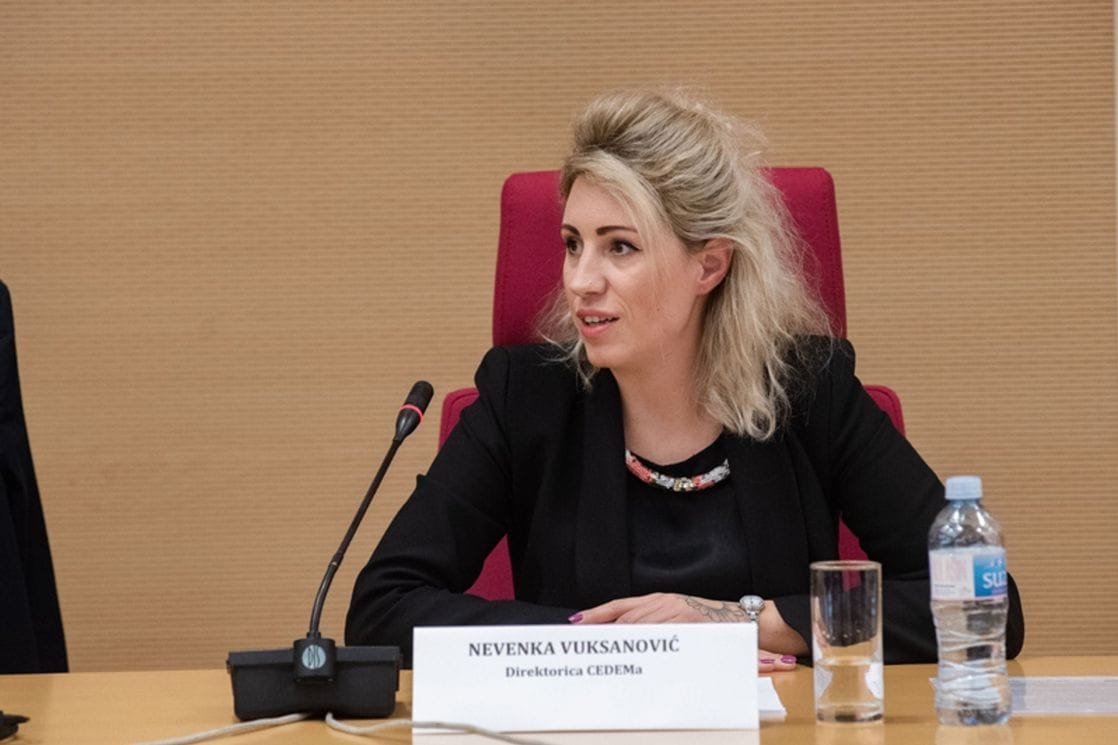
What we are currently seeing in Podgorica is not a dispute over one function, but a manifestation of deeper changes within the parliamentary majority, which is actually already being reflected at the national level and anticipates something that will be an obvious struggle at the national level, he assessed in a statement for Anten M director of the Center for Democracy and Human Rights, Nevenka Vuksanović.
She said this while commenting on the harsh tone in the announcements of the Democratic People’s Party, directed towards the holder of the list for the future of Podgorica, Jelena Borovinić Bojović, towards the New Serbian Democracy, and the Europe Now Movement.
“I would also say that the candidacy of Mr. Perić has already opened up space for political positioning of different actors and has shown that the previous decision-making patterns are no longer unquestionable, that is, that we have another angle, some other actors, and that this can certainly be expected at the national level when we enter 2027,” Vuksanović says.
It seems to her, as she adds, that part of the political subjects clearly wanted to send a message about their own autonomy.
“About its own negotiating power, that is, that the DNP raised the price of its political consent, so to speak, and the reactions of other partners are actually an effort to preserve the existing structure of relations and the existing structure of political influence. That is why I say that the question of the president of the Capital City Assembly is not only a symbol of the local level, but of a broader discussion about who will make key decisions within the majority, but with the intention of actually starting a discussion, that is, of reading a discussion at the national level,” she pointed out.
He believes that from yesterday’s political dynamics, Perić is the biggest winner, regardless of the final outcome of the vote.
“His candidacy managed to impose itself as a relevant option and to put the idea of getting out of the blockade through perhaps some broader political agreement in the center of political attention in the coming period,” says Vuksanović.
The outcome of the process of electing the President of the Assembly will show, he adds, whether it is a temporary negotiation misunderstanding or a calculation.
“I would say that it is the beginning of a more serious realignment of political relations in Podgorica, and actually a more serious realignment of political relations at the level of Montenegro,” she added.
Asked how realistic it is for Perić to be Borovinić Bojović’s successor, the director of CEDEM says:
“If we’re just talking about calculation and projection, we can say it as a percentage – there is a 50% chance of reaching an agreement and electing a candidate from the existing majority, possibly Mašković or someone else. About 30% that Perić will really be elected as a temporary technical solution, and about 20% that the crisis will further deepen and open space for a completely new majority on certain issues in the Podgorica parliament,” said Vuksanović.
As I point out, we cannot claim any of this with certainty at this moment.
“But it seems to me right now that the DNP has achieved what it wanted, even if Perić is never elected. They have shown that without them there is no stable majority and that they are no longer ready to follow the decisions coming from the NSD. We will see how it will unfold, who will be the first to receive the invitation of the other party to sit down at the table and under what conditions. The one who succeeds in this will prove to be a stronger negotiator, potentially as one of the more important ones in the calculations at the state level,” concludes Vuksanović.