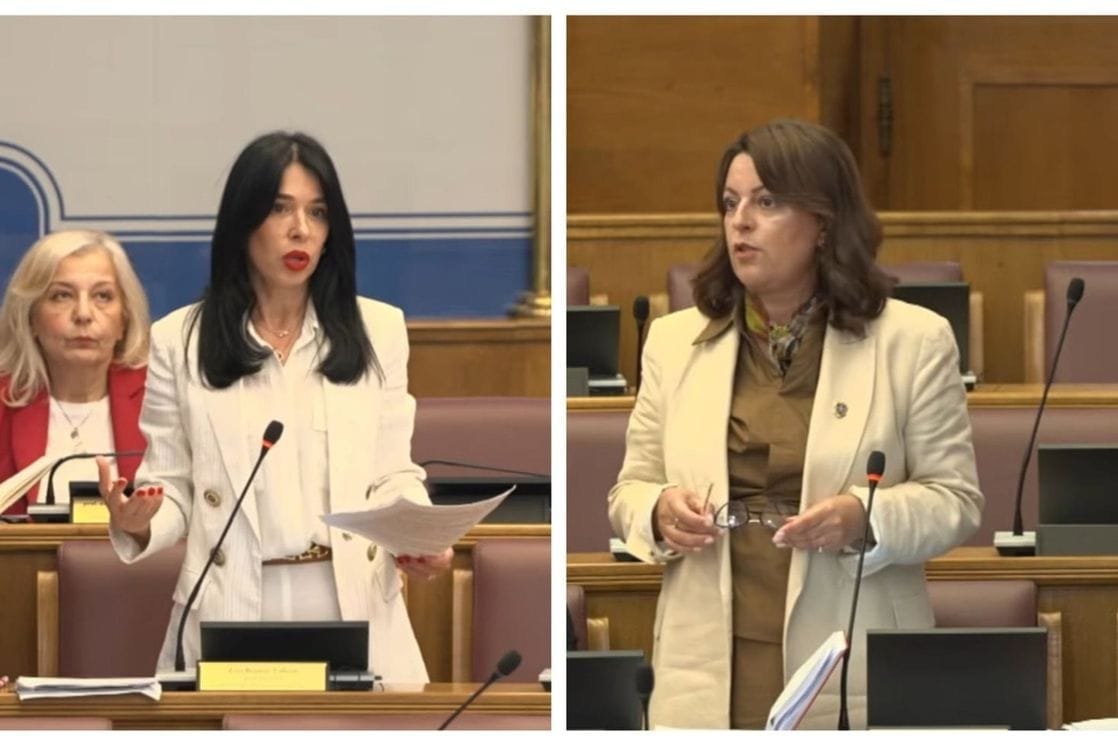
DPS MP Zoja Bojanić-Lalović addressed several questions to the Minister of Culture and Media, Tamara Vujović, during the session of the Assembly.
“You have constantly insisted that the election of directors of cultural institutions is non-transparent. It’s time for this law, you haven’t changed anything,” said Bojanić Lalović.
According to her, the role of the Minister of Culture and Media is not only a question of the Budget, laws, procedures, but also of values.
“Culture, minister, is not a neutral area when it comes to language, identity, and state and national. Your reaction cannot be the reaction of someone who reacts only after everyone else has reacted. You cannot be neutral,” Bojanić-Lalović pointed out.
The DPS member of parliament reminded the minister that during her mandate, Andrej Nikolaidis’ doll was burned and asked if the fact that cultural creators freely express a critical attitude was the reason for burning it.
“Last week we talked about the 13th of July award. A group of citizens expressed their revolt and we had the same police reaction as we had. The same police did not react in Zaostra, around the monument to Pavlo Đurišić. The screening of the film Roda at the Džada film fest in Podgorica was interrupted due to citizens’ protests. The Ministry of Culture and Media announced that it was surprised and worried, not you either. You cannot remain neutral, you have to have a stance,” said the DPS MP.
She pointed out that theater, film, literature and language are not decorations of the state, but a proctor in which freedom is defended.
“If your answer remains at the level of an administrative reaction, it shows that the department of culture does not have a value compass, but rather political caution. I would rather say that you are talking about party caution, which is not good,” Bojanić-Lalović pointed out.
She also recalled the lack of reaction from Minister Vujović regarding the VAT on the press, books, and tickets for cultural events.
“You must not be silent. You must not be worried, but you must react,” said Bojanić-Lalović.
Speaking about the burning of the Nikolaidis doll, Vujović quoted statements made on that occasion.
“I took a qualitative look at what some NGO or group of citizens thought was funny, cute, or allowed by the carnival procedure. Party caution did not exist in that case, but I expressed myself absolutely clearly,” said Vujović.
She asserted that the state and the Ministry of Culture reacted promptly in the case of erecting a monument to Pavlo Đurišić.
“You can’t say that the Police Department, the President of the Municipality and the Ministry of Culture and Media with the inspection services did not react. I have no intention of making excuses for anyone to believe me. These are incidents. As for the film Roda at the Jada Film Fest, there was an incident that we all immediately condemned. I received the most beautiful message from the Albanian ambassador precisely because of the reaction. Even the incidents where you want to call me not to be trusted do not support the thesis that I have caution towards anyone, except according to the Constitution and according to the law,” Vujović said.
“There is no reason to abolish VAT on the press”
As she stated, when looking at the revenues of the Ministry of Finance from VAT on the press, the question arises – are there any arguments for its abolition.
“The press is already threatened, not because the VAT has increased. We all read portals and digital forms of print media. It’s about thousands of euros. It’s not something that can cause an argument, except in a political debate,” Vujović said.
She stated that books have been the cheapest in Montenegro for years.
“There we came to an average amount. The price of books, fiction, which until now might have been 10 euros, if they were now available in retail stores, might be 11 euros. Our idea is that books should be as cheap as possible. But we are developing a library system. No one has to buy a single book. We have free membership fees for young people, many promotional programs. It’s an economy. I thought I shouldn’t react, because it’s not a big business barrier. The number of sales has not decreased books, the number of printed media that are read has decreased”, claims Vujović.
In her reply, Bojanić-Lalović said that politics is a serious activity.
“I drew your attention to the fact that you have a narrow party profile. What your party colleagues are commenting on – you don’t react. They are quite pale reactions. Don’t forget that you are here, from that very place you said that you have nothing against another flag standing on Gavr Vuković’s house. Do you know what is expected of you – to say that that flag has a place in the Historical Institute, and that there can only be one national flag on Gavr Vuković’s house, in accordance with the law. it’s not your party, ideological position, you cover a state function, you should be the minister of all citizens”, Bojanić-Lalović pointed out.
She also asked whether the use of pepper spray at the protest near Villa Gorica can be called an adequate response by the police.
“We know that nothing like that happened in Zaostro. Then don’t react, if you won’t act on one or the other situation as a matter of principle. These are not incidents, minister, they are dangerous phenomena in our society”, said the DPS MP.
Bojanić-Lalović: You should promote books
She emphasized that a minister cannot say that she did not find it appropriate to react when it comes to VAT.
“You should do what they do in other European countries, to promote books, to promote reading, and not to consider and not find it appropriate. Two tickets to the cinema cost 25 or 30 euros, do you think that is a little. Do you think that books should not be exempt from VAT. We must keep young people away from the portal. We must put the book in their hands. Today you say that we read more and more portals – You must not send such a message”, she pointed out Bojanić-Lalović.
DPS deputy Oskar Huter asked the minister whether by increasing the VAT for part of the cultural services, we achieved benefits for Montenegrin cinematography.
“As a member of the government, were you in favor of such a measure? I did not hear your position. It is important that we hear your position, because it would be an example of an unsynchronized, scattered orchestra, in which the relevant minister has a position contrary to the legal solution, which primarily refers to his department. I am saying hypothetically, if you are against this measure. If you are not, tell us,” Hutter said.
He reminded that there were ministers who expressed disagreement.
“Your colleague from the Ministry of Tourism took exception to the opinion when there was VAT for the hospitality industry. Also, here I heard from the Ministry of Diaspora that they are not familiar with the legal solution that concerns the very department they deal with. I am talking about a government that functions on the basis of a fiefdom, where no one interferes with anyone for the general evil, and not for the good of this nation,” Hutter emphasized.
He pointed out that in the impact analysis he did not find any indicators that solutions related to VAT brought any benefits to our cinematography. “There was no increase in the production of films. It was not reflected in the increased number of viewers, and you tell us – did this increase investments in our cinematography. I have a feeling that the answer will be negative. Of course, everything is the opposite, because in the case of cultural activities, the increase in VAT ultimately increases the price for the user. Also, I have not been able to figure out which changes will significantly affect the increase in the volume of film production, i.e. the sustainability of the Film Center”, emphasized Huter, adding that it is evident that there is no systematic approach in optimization of legal solutions.
Huter also spoke about the non-transparent distribution of funds.
“Who allocates the funds and under what conditions, how do you ensure the independence of the commissions. All of this could find its footing in the motherly relationship of the Ministry of Culture in relation to organizations from the Montenegrin cultural circle. I am also talking about creators who do not belong to the regime, and are not in collaboration with Greater Serbia and Great State policies and ideologies,” Guter pointed out.
He asked whether the proposed legal solutions have the support of the professional public, and not just the proponents.
“As you yourself said, a certain country or destination is recognized by that director. And then in this House it is necessary to mention the name of Milo Đukanović – don’t just jump now, the director who made Paja and Jaret. We have that truck that is broken, but how is it moving forward? I’m afraid that our Ministry of Culture is going downhill. And again, don’t forget Veljko Bulajić. Because he is a great creator, but above all a partisan and anti-fascist, who immortalized the national liberation struggle of the Yugoslav peoples. Of course, if we had Živko Nikolić, who, when he saw all that is our reality, would create masterpieces today, inspired by what is happening in our government. He would be internationally recognized and immortalized with the world’s greatest awards,” said Huter.
Vujović said that Živko Nikolić died forgotten, ostracized from artistic trends, because, as she stated, he looked critically at all the injustices suffered by a small man in the era when he created.
“We can only imagine what the oeuvre of Živko Nikolić, Milo Đukanović or Veljko Bulajić would have been like in the 1990s or 2000s, while the factories were closed, and the little man from the movie In the Name of the People lived at the level of social misery. We can imagine what kind of black wave would have occurred if those authors had lived,” Vujović said.
She thanked Huter for the metaphor of the truck going downhill.
“Many would disagree with you, especially from international addresses. It was in that broken truck that the commemoration of Veljko Bulajić was held,” said Vujović, adding that this is how Free artistic expression is created.
She stated that the incentive measure will not affect domestic production, except in the case of employment of domestic staff during the arrival of international producers who will film in our country.
“There is no need for analysis. If multimillion-dollar projects come to Montenegro, it is clear what a benefit it is for the economy and that it is not an expense that we will return, but we will generate a much higher income. This is for foreign producers,” Vujović said.
She stated that there are no privileged individuals at the competitions, which she considers one of the greatest achievements of the department she manages.
“What they told you that I have a negative attitude towards things with a Montenegrin sign is not true. Associations and projects receive funds. The difference is that they are not the exclusive winners,” Vujović said.
Hutter said that he did not know what was disputed in his questions.
“I asked you what your position is on the increase in VAT on services related to cultural activities. I asked you what the formal proposals were, you came to me to bid when and in what year the Film Center took, how much money is decided. I did not ask that. I asked what the formal proposals of film professionals are. What are the specific objections that have been adopted. You are bidding here on who told me something. That is the respected minister in the field of fairy tales,” he pointed out. is Hooter.
He also commented on the alleged prompt reactions regarding the monument to Pavlo Đurišić.
“Do you know what Živko Nikolić would do with this fugitive and this Chetnik”, said Huter.
Omeragić: One of the roles of the Film Center and all of us in society is to cultivate a culture of memory
Bosniak Party MP Adel Omeragić recalled that the 2024 Film Center commission did not support the film “The Man Who Couldn’t Be Silent”, which refers to the crime in Štrpci.
“One of the roles of the Film Center and all of us in society is to cultivate a culture of memory, and it seems to me that film is the best way to express it. Even today, it is incomprehensible to me that the commission did not have the sensibility to recognize such a film. A film that vividly depicted how the kidnapping of innocent victims from a train in Štrpci took place, by the state at that moment, was not recognized as worthy of the state standing behind it, and lo and behold, just a few months later, it won that title the world’s biggest awards on the pedestal of the world industry”, Omeragić pointed out.
He also recalled the rebroadcast of the film Srebrenica, the anatomy of deception, and he also spoke about the film Referendum – a story of fictional freedom, emphasizing that the reactions of state authorities are commendable.
Vujović replied that she did not know who the members of the Film Center committee were, adding that she was convinced that the members who have credibility and autonomy today regret not supporting the film The Man Who Couldn’t Be Silent.