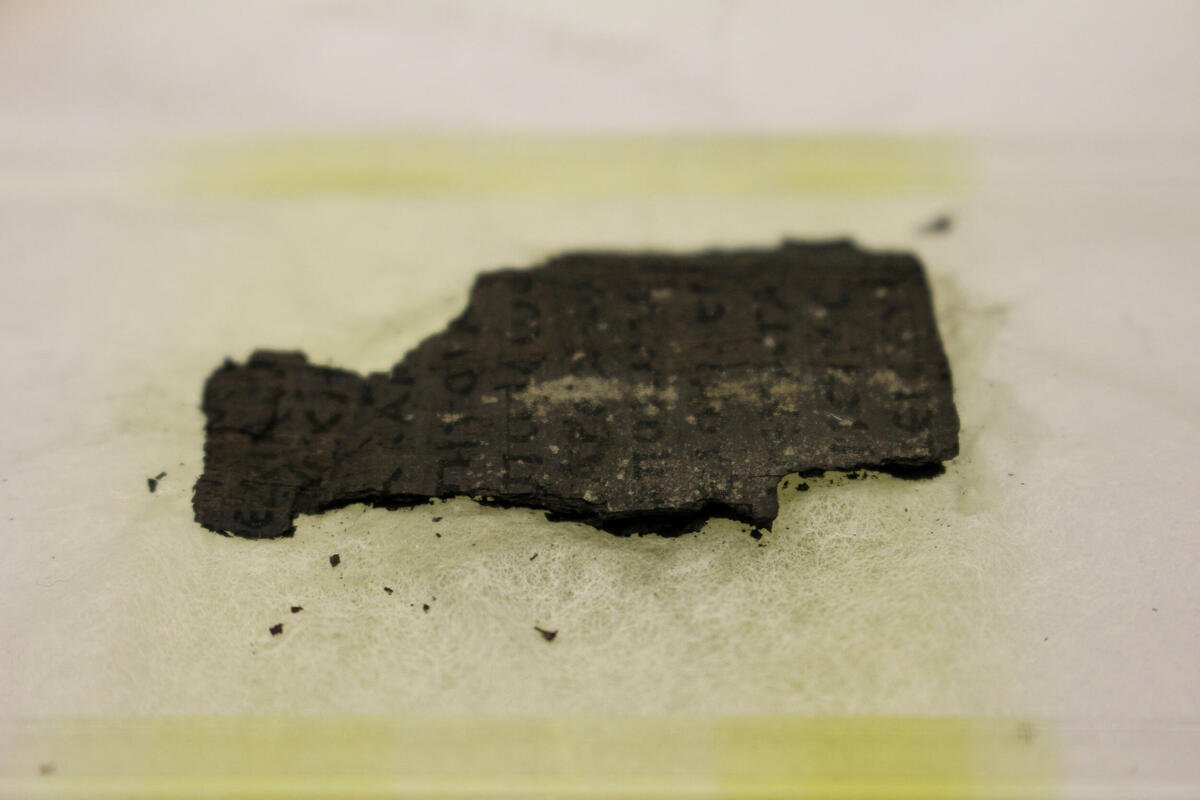
Researchers using artificial intelligence and advanced imaging methods have announced that for the first time they have succeeded in completely reading a sealed scroll from Herculaneum, charred during the eruption of Mount Vesuvius nearly 2,000 years ago.
The breakthrough is a major step toward deciphering hundreds of ancient manuscripts found in Herculaneum, the Roman city that, along with Pompeii, was destroyed in the 79 AD disaster.
To speed up research, the organizers of the Vesuvius Challenge project, which promotes new technologies for understanding charred texts, announced that they will publish all the data, code and models of the papyrus online and offer a $1 million reward to the first person or team to fully read any other scroll, reports Reuters.
“Just a year ago, it would have been crazy for any of us to believe that an entire scroll would be read completely non-invasively, with hundreds of columns of text,” said Brent Sills, a professor of computer science at the University of Kentucky and one of the founders of the project.

“Today we showed you that it is possible,” he said at a conference broadcast from Naples. “I believe we will read every single scroll in the collection.”
The discovered text talks about ethics, art and human behavior
Blackened and brittle scrolls cannot be physically opened without serious damage. The researchers therefore used high-resolution imaging and computer techniques to “virtually unroll” them and identify the ink on the papyrus layers.
About 45 papyrus scrolls and fragments have been scanned so far. More than 600 unopened scrolls are still waiting, and large parts of the villa where they were found have not yet been excavated, which leaves the possibility that more will be found.
The Vesuvius Challenge has already awarded $1.8 million in prizes for work related to the discovery of the Herculaneum texts, but Nat Friedman, an American technology entrepreneur and one of the project’s founders, said the new findings would allow for major progress.
“We think it’s possible to dramatically improve the algorithms we have … and we believe the ink detection techniques we use could probably be greatly improved,” he said, urging more computer science experts to get involved.
Among the new material unveiled Thursday were 70 columns of text from “On the Vices, Book 1,” attributed to the Epicurean philosopher Philodemus.
Almost 1.5 meters of legible text, arranged in 20 columns, was also extracted from a document dated from 200 to 300 BC – the oldest scroll from Herculaneum that has been virtually unrolled so far – which talks about ethics, art and human behavior.
Federica Nicolardi, the leading paper researcher of the Vesuvius Challenge project, said that new technologies are changing the rules of the game.
“Even with the most successful methods to date, physically unrolling the scrolls and reading them meant you had to damage them. But with virtual unrolling, we are no longer forced to choose between preserving and reading these extraordinary artifacts. We can do both,” she said.
Nicolardi added that progress is accelerating and that in the last 24 hours researchers have virtually unrolled the entire length of one scroll, obtaining about 140 columns of new text. Until recently, she said, they managed to discover only about 10 percent of the columns.
“Literally last night, in front of Vesuvius, something – or rather everything – changed,” she said.
Download the application and follow the news


FOLLOW US ON

News