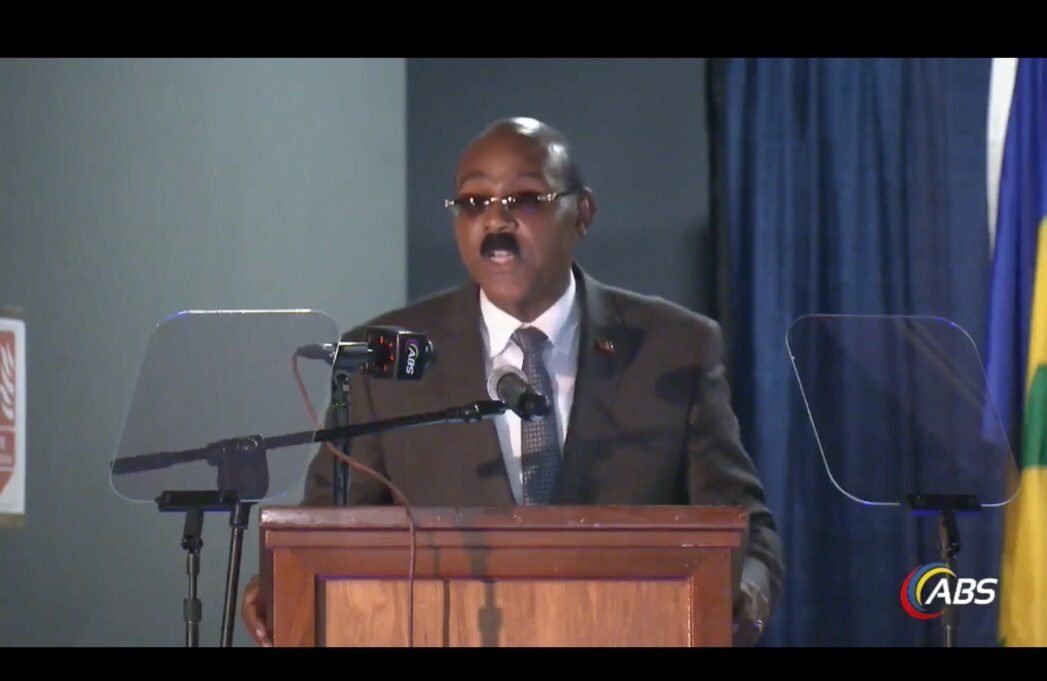


Prime Minister Gaston Browne says Antigua and Barbuda has rejected a proposal that could have seen significantly larger numbers of deportees sent to the country from the United States, revealing that his administration has countered with a limit of 10 individuals per year.

Browne made the disclosure Sunday while delivering his first address as chairman of the Organisation of Eastern Caribbean States (OECS) Authority, using part of his speech to discuss growing geopolitical pressures facing small island states and the need for regional cooperation in responding to them.
The prime minister said Antigua and Barbuda has resisted efforts that would result in the return of large numbers of deportees, particularly individuals with criminal backgrounds.

“We have been coerced to take these deportees,” Browne said, referring to discussions with the United States. “Encouraged by the great United States. And if we don’t cooperate, they punish us.”

He said his government has made it clear that it is unwilling to accept arrangements that could threaten public safety.
“As the Prime Minister of Antigua and Barbuda, I cannot willingly cooperate with any other power, any country, to destroy our beautiful twin-island state,” Browne said. “And we have insisted that we will not accept any criminal elements.”

The prime minister disclosed that Antigua and Barbuda had been asked to consider accepting far more deportees than the government considers reasonable.
“We want to limit the amount of individuals who they send to this country,” he said. “Again, we want to be cooperative, so we are not being uncooperative here. But this idea that they could send us 120 individuals, we’ve said to them that is totally unacceptable.”

Browne said his administration has already submitted an alternative proposal.
“We have sent them a counterproposal. We said that we’ll accept 10 annually, no more than 10,” he said. “So I hope that this will not result in any acrimony and further restrictions, but that they will respect our position and respect our sovereign right to determine how many of those individuals we accept.”
While maintaining a firm stance on deportations, Browne emphasized that Antigua and Barbuda remains committed to cooperation with the United States and recognizes Washington’s right to establish its own immigration policies.
“We acknowledge the sovereign right of all states to determine their border security policies,” he said later in the address. “We ask only that such rights be exercised with due regard for a historically close and mutually beneficial relationship.”
The prime minister argued that restrictions affecting Caribbean countries could have economic consequences for both sides, noting that the United States enjoys a significant trade surplus with the region.
“Our people purchase American goods, use American financial services, and send their children to American universities,” Browne said. “We are beneficial partners for the American economy, not adversaries to be restricted.”
He also raised concerns about the impact of travel restrictions on Caribbean nationals and diaspora communities with family ties in the United States.
“Our largest diaspora is in the United States,” Browne said. “We need to ensure that the diaspora here in the Caribbean and certainly our people in the United States can move freely.”
Browne said Antigua and Barbuda remains committed to working with the United States on matters of mutual interest, including security and the fight against organized crime.
“We particularly stand with the U.S. in opposing drug trafficking and organized crime,” he said. “That is our mutual interest. We too want to make sure that we have safe and secure societies.”
The comments came as Browne assumed the chairmanship of the OECS Authority for the next 12 months, during which he is expected to focus on regional integration, economic resilience and collective responses to challenges facing small island developing states.
Advertise with the mоѕt vіѕіtеd nеwѕ ѕіtе іn Antigua!
We offer fully customizable and flexible digital marketing packages.
Contact us at [email protected]