
The Hungarian national kayaking and canoeing team concluded the European Championships in Montemor-o-Velho, Portugal, with a clear demonstration of their strength. Thanks to two gold medals and one silver medal won Sunday, the delegation brought its total medal count to fourteen. With four gold, five silver, and five bronze medals, Hungary secured first place in the medal count of the championships, which also served as an important Olympic qualifier.
The haul in the Olympic disciplines proved particularly valuable, with a podium tally of 1-3-2.
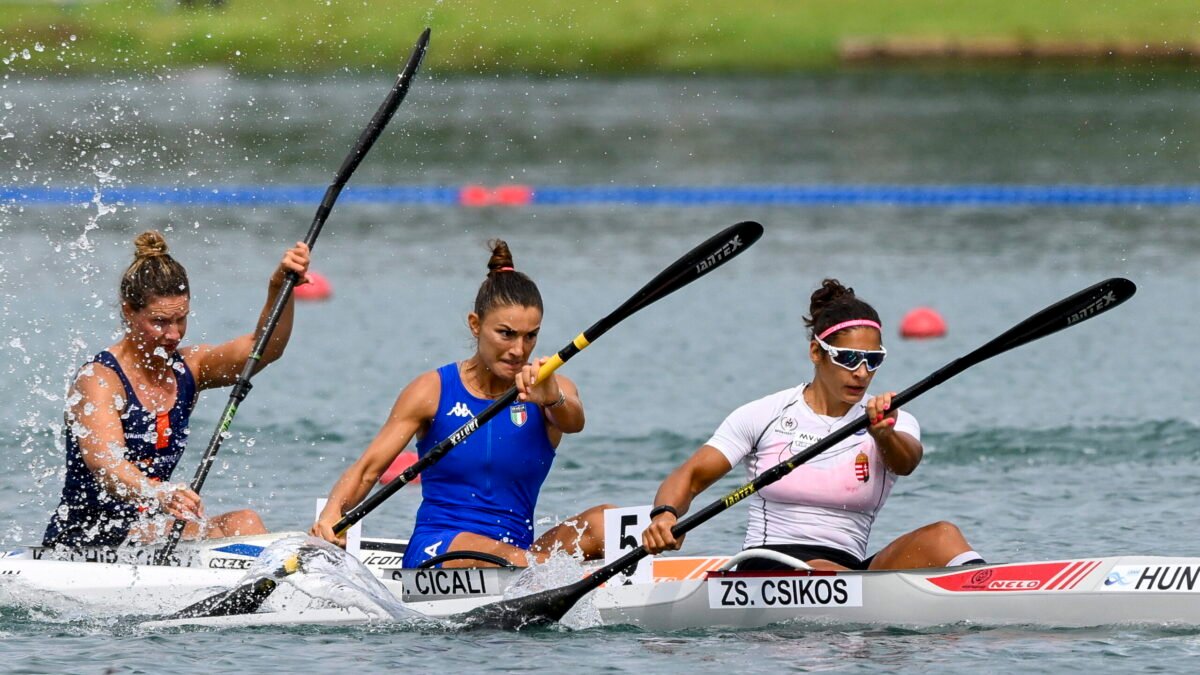
The star of the weekend was Emese Kőhalmi. Following her victory in the 1,000-meter race on Saturday, the athlete left the assembled European elite behind on Sunday in the single kayak (K1) 5,000-meter race and was crowned double European champion. There were also notable successes in the shorter distances. Zsóka Csikós secured the bronze medal in the K1 500 meters after a thrilling duel, while Gergely Balogh also raced to third place in the K1 200 meters.
In the Olympic doubles disciplines, the Hungarian team also claimed two silver and one bronze medal.
Réka Opavszky kicked off Sunday’s competition in the C1 500-meter event. The 22-year-old athlete, who had already won bronze in the mixed fours on Saturday, got off to a courageous start in difficult wind conditions right next to Ukrainian world champion Ludmila Luzan. While Luzan pulled away, Opavszky successfully defended her third-place position in the second half of the race against her Italian rival Olympia Della Giustina. “The day started pretty early, but that left little time to think. The left-side tailwind came a bit unexpectedly, but I tried to give it my all. I’m overjoyed to be back on the podium,” Opavszky explained after the race.
Real drama unfolded in the women’s K1 500-meter final. Zsóka Csikós, who had shone in the heats, faced a rampant Pauline Jagsch from Germany in the final. While the German cruised to a start-to-finish victory, Csikós engaged in a thrilling battle with Polish world champion Anna Puławska for silver. In the end, the Hungarian fell two hundredths of a second short of second place.
To be honest, I am not entirely satisfied. In the end, I could not push as hard as I usually do. It bothers me that Anna is always a few hundredths ahead of me. But what is important is that the World Championships at the end of August go perfectly,” Csikós summed up.
The men’s K1 200-meter final featuring Gergely Balogh was similarly dramatic. The 24-year-old athlete had set a historic all-time best time in Portuguese waters during the heats. In the final, he led for almost the entire race, but faltered during the decisive final push in the home stretch, lost his rhythm, and had to settle for bronze behind Spain and Portugal. “I am sorry about the finish: either I wobbled or my strength was gone. I almost capsized. Of course I am happy with bronze, but gold was within reach. Maybe at the World Championships,” explained Gergely Balogh.
In keeping with tradition, the focus of attention was on the highly competitive Olympic doubles events over 500 meters. In the women’s C2, Ágnes Kiss and Bianka Nagy redeemed themselves for their disappointing sixth-place finish in the 200-meter race the previous day. In a tactically astute race, they kept pace with the top Ukrainian boat and overtook the favored Spanish team in the final sprint to secure the silver medal.
In the men’s C2, Dániel Fejes and Jonatán Hajdu delivered a strong performance. The newly formed duo kept pace with the Russian world champions and fought their way to third place in a hard-fought finish against Spain. “The podium was our minimum expectation,” Jonatán Hajdu summed up afterward.
The men’s K2 final provided the crowning finale of the doubles competitions. Levente Kurucz and Bence Fodor, the newly crowned European champions in the four-man event, shot out of the starting gate like a rocket. Although they had to let the German Olympic champions pass them during the race, they defended second place against the charging Czechs and Portuguese with flying colors and capped off their strong European Championship weekend with silver.
According to the official final tally from the Hungarian Federation, the team finished the European Championships with four gold, five silver, and five bronze medals.
Here is the detailed breakdown of Hungary’s medals by discipline and event:
Gold Medals (4)
K4 500 m (Men’s Kayak Four): Bence Nádas, Bence Fodor, Levente Kurucz, Sándor Tótka
K1 1000 m (Women’s Kayak Single): Emese Kőhalmi
K1 5000 m (Women’s Kayak Single): Emese Kőhalmi
C1 5000 m (Canoe Single – Women): Zsófia Csorba
Silver Medals (5)
K1 1000 m (Kayak Single – Men): Bálint Kopasz
K2 500 m (Kayak Double – Men): Levente Kurucz, Bence Fodor
K1 200 m (Women’s Single Kayak): Anna Lucz
C2 500 m (Women’s Double Canoe): Ágnes Kiss, Bianka Nagy
C1 5000 m (Men’s Single Canoe): Balázs Adolf
Bronze Medals (5)
K1 200 m (Men’s Kayak Single): Gergely Balogh
K1 500 m (Women’s Kayak Single): Zsóka Csikós
C1 500 m (Women’s Canoe Single): Réka Opavszky
C2 500 m (Men’s Double Canoe): Dániel Fejes, Jonatán Hajdu
C4 500 m (Mixed Four-Canoe): Zsófia Csorba, Réka Opavszky, Kristóf Kollár, Dániel Fejes

Via MTI; Featured image: MTI/Czeglédi Zsolt