Madrid/“There will be elections, all those mandated by our Constitution, organized by a renewed electoral authority and with the world as a witness.” This vague commitment from the president in charge of Venezuela, Delcy Rodriguezcontrasts with the statements, shortly after this Thursday, of the opposition leader María Corina Machado, in her first and massive press conference since he arrived in the country: the “system of repression is still in power” and its “dismantling” is “a priority.”
The leader of Vente Venezuela and Nobel Peace Prize winner was forceful: “the country needs justice and not impunity.” It has been asked how those responsible for the destruction of the country dare to say “now they are going to build a system where there is justice.”
The interim president did not specify a date for the elections, which she asked “to be a solution and not a generator of unreconciled conflicts.” Rodríguez, whom the United States put at the head of the Venezuelan Government after capturing the then President Nicolás Maduro in Caracas, defended that the political horizon of his country “is not measured as a date on the calendar”, in a veiled allusion to the opposition’s demand to call elections as soon as possible, “but from a sequence of objectives” to be achieved.

/ Capture
As part of the measures taken for change in Venezuela, Rodríguez claims to have included “the valuation of non-essential assets in the hands of the State that can be offered to the private sector or returned to their former owner.” And he asserted: “This is already advanced. Private property is a protected right guaranteed by our Constitution.”
Likewise, he promised an increase in workers’ salaries and to continue opening information portals, although he did not assume the responsibility of the regime in censoring them. “We continue to restore access to information portals that were subject to administrative measures as a result of the confrontation experienced,” he said, while asking “the country’s communicators for responsibility and respect for the rights of citizens” and “for both national and international media to not stigmatize the image of Venezuela, nor its name, nor its national identity.”
The designated president also spoke about Venezuelan emigrants – without giving the number, nine million people in recent years. Thus, he addressed “those who are far from home” to assure them that “the return will always be voluntary, firm and with guarantees. Whoever decides to return will find a country that welcomes them with open arms and respect, with their documents in order and with job opportunities. We are building the country to which it is worth returning.”
“I have instructed the security forces that no person be detained without a court order, except in cases of flagrant commission of a crime.”
At no point did Rodríguez specifically mention María Corina Machado, but it was inevitable to think about the opposition leader in special passages of the speech. For example, by declaring that “we all have the right to think differently, without fear of reprisals of any kind,” and then emphasizing: “I have instructed the security forces that no person be detained without a court order, except in cases of flagrant commission of a crime. The responsible exercise of politics is guaranteed for everyone. The doors are open.”
Peaceful protest, the president insisted, “is a constitutional right and the exercise of that right must be accompanied by respect for the physical and moral integrity of our security officials.”
He also planned the figure of the opposition leader when Rodríguez justified his role in the transition: “Whoever is out of power can ask for these reforms that we have been promoting and has the right to ask for them, but signing a reform, moving an institution, sitting at the same table those who for years did not sit or speak, that can only be done by someone who knows the State in depth.” And she argued: “I know it from the inside. I have been minister in different areas, chancellor, executive vice president, and today I am acting president. I know what I am talking about. a transformation of this magnitude if it is not led by someone with experience and real capacity to execute it, it remains a role.”
Regarding this aspect, he continued: “I come from the system that we are transforming and changing, I do not hide it. I turn that origin into a strength to promote the changes that Venezuela needs. And the measure of that is not my words, they are concrete and verified actions.”
“Mrs. Delcy Rodríguez says that she is going to rebuild the institutions, justice, trust, harmony, peace, seriously?”
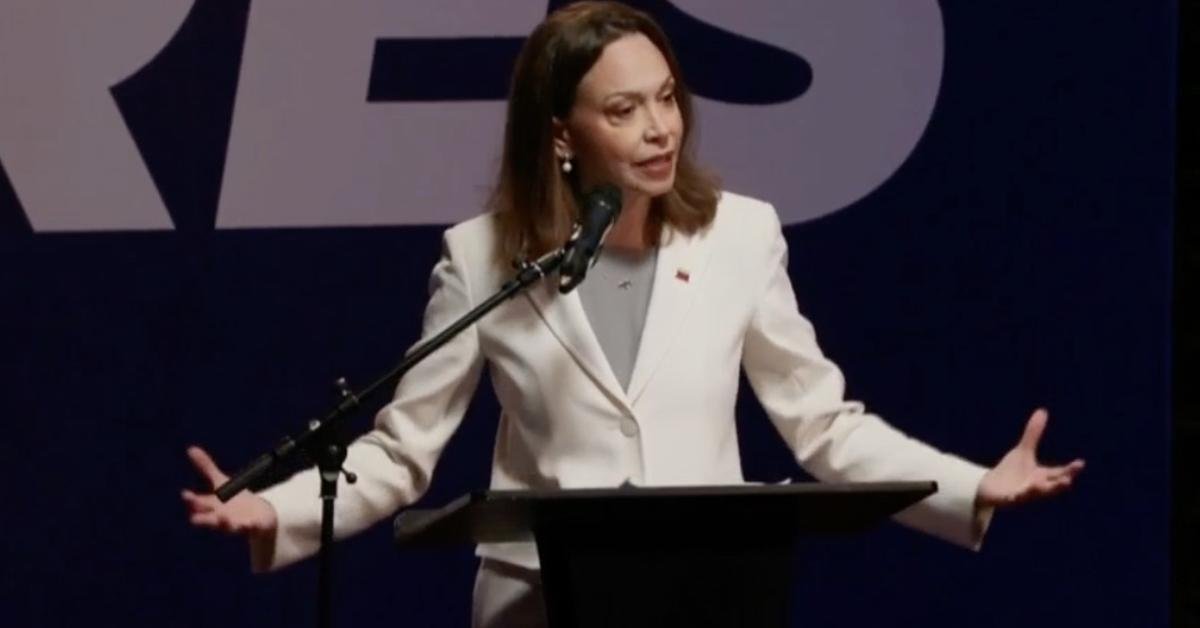
Machado specifically referred to the fact that Chavistas are leading the transition in his press conference, which began with applause and cheers from the students and professors of the Andrés Bello Catholic University, where the leader of Vente Venezuela was received. “Mrs. Delcy Rodríguez says she is going to rebuild the institutions, justice, trust, harmony, peace, seriously?” he asked. “Those who have destroyed what was not only one of the richest nations in this hemisphere but also its most stable democracy, who have turned Venezuela into the sanctuary of criminal groups and the international mafia, who have expelled more than nine million Venezuelans, destroyed families, subjected them to hunger and pain, say that now they are going to build a system where justice exists,” he listed. And he stated: “We Venezuelans learned. We Venezuelans already know who is who, we know what we want and what we don’t want.”
For Machado, “the plan of the three phases that President Trump has presented It is moving forward and after a few hours the deadlines have become clearer.” And he continued: “Secretary of State Marco Rubio has proposed a sequence of events in order to move towards a democratic transition that makes clear the holding of presidential elections in 2027.”
Regarding the fact that his team is not part of the dialogue tables between Chavismo and opposition groups, led by Dinorah Figuera, he indicated: “We are not part of this table and not only do we not hinder but we are very interested in it achieving its objective.”
Likewise, he denounced that the “system of repression is still in power,” so its “dismantling” is “a priority.” She defined herself as “the antithesis of Hugo Chávez and Delcy Rodríguez.”
Furthermore, he asserted: “The democratic transition is irreversible.” The opposition leader, who thanked the Andrés Bello University, where she graduated as an engineer when she was young, narrated how she arrived in the country on October 25, when society reacted “simultaneously, in every corner of the country, without there being a call, a call or an instruction.” He related: “Hundreds of thousands of citizens, from Santa Rosa to Caracas, 335 kilometers. I only heard one word, the same: freedom.” For the opposition leader, it was a sign of “a society that has matured, that has learned and that is ready for freedom.”
Machado thanked the United States “on January 3,” the date on which he intervened in Caracas and captured Maduro. Thanks to that, the opposition leader insisted, “Maduro now faces justice and the floodgates of Venezuelan freedom have been opened.”
After an hour of submitting to questions from various Venezuelan and foreign media, Machado concluded by telling an anecdote that happened to him in his visit this Wednesday to La GuairaAntigua Vargas, epicenter of the deadly consecutive earthquakes last June. A woman asked her: “Promise me that you will never leave again,” and she replied: “Never again. This is our country. We are ready. We know what we have to do, we came to finish the task. Venezuela will be free, prosperous and sovereign.” Amid shouts from the public of “freedom, freedom,” he concluded: “Venezuela will be free forever.”