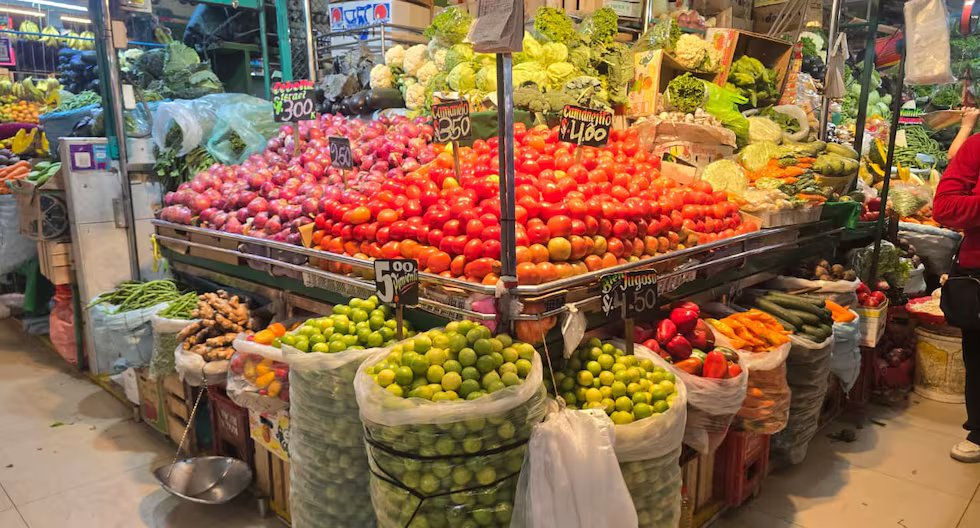
Vegetables, legumes and tubers, along with fish and seafood, recorded the highest annual price increases among food categories in Metropolitan Lima. According to the National Institute of Statistics and Informatics (INEI), the first group accumulated an increase of 23.33% as of October 2026 and the second, 23.30%, compared to the same month of the previous year.
Both increases exceeded the increase in food as a whole, which was 6.33% in the last twelve months. Prices rose in eight of the nine INEI food categories compared to October 2025. They only decreased in oils and fats, with a drop of 0.56%.
After vegetables and fish were sugar and other presentations (which includes products such as brown and white sugar, chocolates, candies and ice cream) with an increase of 6.32%; other food products such as salt, condiments, sauces and diced foods; with 5.84%; and milk, cheese and eggs, with 3.72%. Fruits (2.36%), meat (1.80%) and bread and cereals (0.26%) also rose.
In the Great Wholesale Market, the records of the Midagri Supply and Price Information System (SISAP) showed that the average price of white potatoes went from S/0.95 per kilo in 2025 to S/1.21 so far in 2026, an increase of 27.37%. The long olluco went from S/1.75 to S/2.90 (+65.71%); the red head onion, from S/1.31 to S/1.86 (+41.98%); and Cusco-type corn, from S/2.66 to S/3.71 (+39.47%).
On the other hand, the average wholesale price of carrots fell from S/1.04 to S/0.97 per kilo, a reduction of 6.73%. The SISAP data corresponded to the average for all of 2025 and the partial average available for 2026, reviewed on November 5.
consulted by The CommerceStephani Maita, senior economist at the Peruvian Institute of Economics (IPE), explained that the annual increases are due to the fact that climatic conditions affected both agricultural production and the availability of fishing resources. In the case of fishing, he pointed out that high sea temperatures reduced the availability of some species and put pressure on their prices.
“The lower availability of these fish basically translates into a higher price,” he said.

Prices of fish and seafood increased 23.30% in the last twelve months to October in Metropolitan Lima, according to the INEI.
For agricultural products, Maita explained that the high temperatures that had been recorded on the coast affected the maturation of the plants and the yield of the crops. He explained that the impact was also manifested in the characteristics of the products, such as their size, and not only in the volume produced.
Added to these difficulties was the increase in transportation costs. The IPE economist pointed out that an important part of the food consumed in Lima came from other regions, so the increase in fuel prices increased transportation costs and ended up having an impact on prices.
The monthly detail of the INEI showed differences between products. In October, compared to September, corn rose 45.29%, tuna rose 26.90%, carrots became more expensive by 24.56% and green peas, 24.31%. The increases in mackerel (17.48%), colored potatoes (14.38%), olluco (13.87%) and yellow potatoes (13.54%) also stood out.
The Israel apple fell 10.65%; the pickle, 9.79%; mango, 7.72%; and tomatoes, 6.80%. Likewise, the prices of prickly pear (5.93%), basil (5.91%), papaya (5.85%) and chicken eggs (5.34%) decreased. These variations compared the prices of October 2026 with those of September of the same year.

In October, the prices of Israel apples, mangoes and papayas decreased compared to September in Metropolitan Lima.
/ NUCLEO-PHOTOGRAPHY > RENZO SALAZAR
In Metropolitan Lima, food prices increased 1.74% during October. However, some categories that became more expensive in annual terms showed a monthly decline: meat fell 0.60% and milk, cheese and eggs decreased 1.23%.
Regarding the coming months, Maita warned that the conditions associated with El Niño could maintain pressure on agricultural and fishing production. For the coast, he identified risks linked to high temperatures, while for the central and southern mountains he indicated that the lack of rain could affect the development of crops such as potatoes and corn.
The economist explained that the difficulties during the agricultural campaign could have an impact on the harvests of the first and second quarters of 2027. Under this scenario, she considered it likely that the prices of the affected products will remain high during that period.