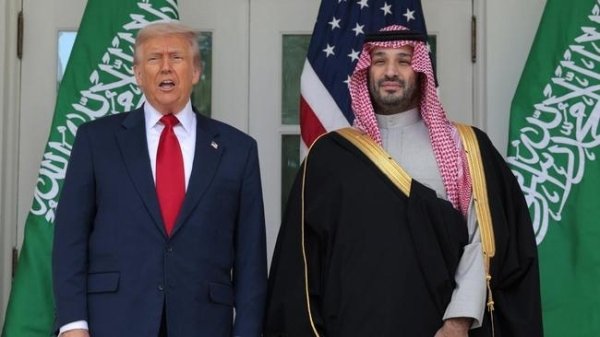
The United States and Saudi Arabia have signed a civilian nuclear cooperation agreement aimed at helping the kingdom develop a nuclear energy programme, the US Department of Energy said on Wednesday.
“U.S. Secretary of Energy Chris Wright and Saudi Minister of Energy His Royal Highness (HRH) Prince Abdulaziz bin Salman signed a peaceful nuclear cooperation agreement, commonly known as a 123 agreement, alongside an accompanying bilateral safeguards agreement,” the department said in a statement.
“Together, these two agreements lay the legal foundation for a decades-long, multi-billion-dollar partnership that advances several priority economic and strategic objectives, including nuclear nonproliferation.”
The United States hopes to benefit economically by exporting nuclear technology and creating US jobs. For Saudi Arabia, the agreement is intended to help meet the country’s energy needs, the department said.
“Rest assured, these agreements uphold the highest standards of nuclear safety and nonproliferation,” Wright said.
The precise contents of the deal were not initially published. The agreement will now be submitted to the US Congress for review, where it could face opposition.Possible uranium enrichment
Many lawmakers oppose the expansion of nuclear technology in the politically unstable Middle East, particularly amid the ongoing US conflict with Saudi Arabia’s long-standing regional rival Iran.
It was also initially unclear to what extent international inspectors would be granted access to Saudi nuclear sites to guard against their possible military use.
The Wall Street Journal had earlier reported, citing US officials, that President Donald Trump had approved a 30-year nuclear agreement with Saudi Arabia worth billions of dollars.
According to the report, the deal would give US companies a leading role in building Saudi Arabia’s nuclear infrastructure while excluding foreign competitors.
The newspaper also reported that US companies could build a uranium enrichment facility in Saudi Arabia if a joint US-Saudi study concluded that such a step was justified.
It was not immediately clear whether the agreement announced by the Energy Department contained such a provision.Talks with China and Russia
Saudi Arabia, one of the Middle East’s largest energy consumers alongside Iran, has no known nuclear weapons programme but has pursued civilian nuclear power for years under Crown Prince Mohammed bin Salman.
The kingdom has also held talks with China and Russia, and the Trump administration is likely seeking to curb their influence through closer nuclear cooperation with Riyadh.
Saudi Arabia is a signatory to the Nuclear Non-Proliferation Treaty and has a safeguards agreement with the International Atomic Energy Agency.
However, it has not signed an additional protocol that would give the UN nuclear watchdog broader powers to search for undeclared nuclear activities.Fears of a regional arms race
Crown Prince Mohammed said in 2018 that Saudi Arabia did not seek nuclear weapons but would follow “as soon as possible” if Iran acquired them. He reiterated that position in 2023.
Riyadh and Tehran were long-standing regional rivals and have only cautiously improved relations since 2023.
Experts fear that closer nuclear cooperation with Saudi Arabia could encourage other countries in the region, including the United Arab Emirates, Turkey and Egypt, to pursue nuclear weapons capabilities.
Saudi Arabia has also strengthened its security ties with nuclear-armed Pakistan. The two countries signed an agreement after Israel attacked Hamas representatives in Qatar last year, with Pakistan saying Riyadh would also gain access to its nuclear programme under the deal.