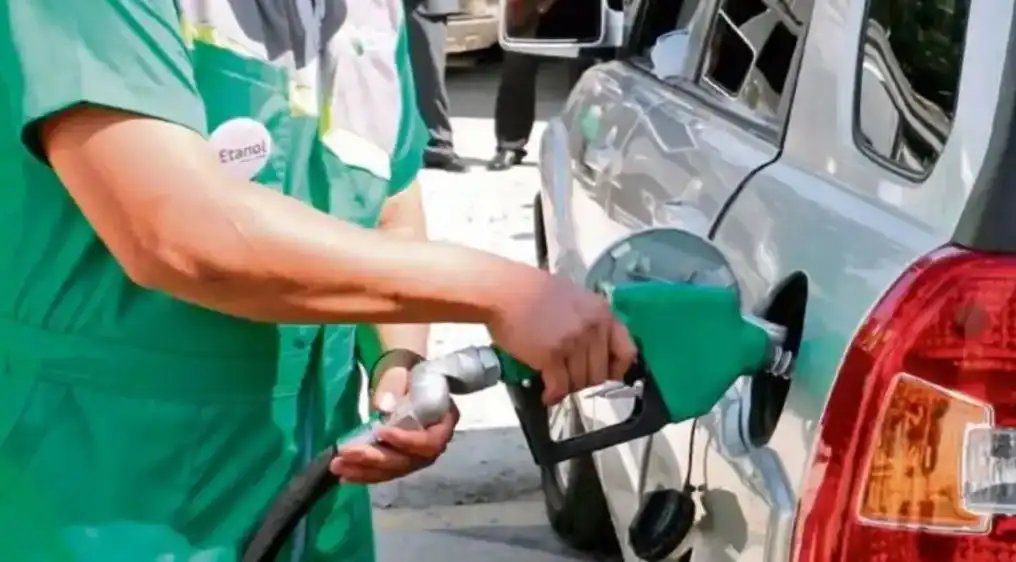
Ryan LeGrand, CEO and president of US Grains & BioProducts Council affirms that his country produces 15 billion gallons of ethanol annually and is prepared to supply the demand that is not covered by the Guatemalan industry, when the mixture of that product with gasoline is implemented in Guatemala.
According to the Ministry of Energy and Mines (MEM), The demand for ethanol in the country for blending is estimated at 100 million gallons annually. and that according to the registration requests of national producers to provide the mixture, around 37% can be provided by the local industry, but the rest will come from the foreign market.
In this regard, LeGrand explains the US experience in ethanol production, prices and approaches to supplying Guatemala. The United States Grains and Bioproducts Council is an organization that promotes the development of export markets for barley, corn, sorghum and related co-products, including distillers dried grains with solubles (DDGS) and ethanol, from the United States, as explained on its website.
The United States has years of experience using ethanol. What percentage do they currently apply?
In the United States, throughout the country, gasoline is blended with 10% ethanol. In some states they are starting to increase it to 15%. We also have an offer of up to E20, E30 and E85.
As producers of basic grains, when did you begin to enter that market?
We produce mainly from corn (95%) and with sorghum around 5%. As corn producers, we entered the market when blending began to be implemented in the US, in the 1990s. In the early 2000s, one of the toxic additives that was mixed into gasoline called MTBE began to be banned, a replacement was needed, and ethanol was the best option. More began to be produced, there was more construction of ethanol plants and we began to use much more of the corn harvest to produce it.
How much do they produce and where do they distribute it?
At this time, in total We produce 15 billion gallons in the United States (about 60 billion liters) per year.
It is distributed throughout the country and to more than 60 countries in the world that have some policy or regulation that allows the use of ethanol.
In the case of Guatemala, what do they have planned, taking into account the signed Reciprocal Trade Agreement, in which, according to the Minister of Economy, the country committed to making efforts to buy ethanol from the United States?
There are clauses that talk about the use of ethanol, that Guatemala is going to implement an E10 program in the country, and for us it is very important. Guatemala is the leader in Central America in many aspects, and I think that in ethanol it will be the same.
CONTENT FOR SUBSCRIBERS
Over time, we have been working with the local Guatemalan industry, to find a way to work together. It is very important to have local production, to have a strong and robust industry here in Guatemala, and then, what they cannot contribute to the gasoline mix, is complemented with imports from the United States. That’s the idea we’ve been working on.
Why was there a need to include the issue of ethanol in a reciprocal trade agreement between the US and Guatemala?
I don’t know, I wasn’t in the negotiation room, but in those agreements one thing is being exchanged for another. So, Guatemala received some concessions to export products to the United States tariff-free.
Read also: Mineco says that Guatemala committed to “make efforts” to buy ethanol from the US.
Do you see the possibility of starting to import ethanol from the US soon?
That depends on the current hydrocarbon importers.
You can start importing as soon as the regulations are in force. We are ready and the local producers of Guatemala are ready to contribute their production.
With the issuance of the quality specifications and the announcement by the government of the start date of July 1, in the coming weeks there will be progress in these discussions by the companies that are going to distribute it, both national, domestic, and international purchases.
The approaches and searches for quotes have already begun, preparing for this process, because the mandate mentions that the mixing begins in July. The actors are preparing in that sense. Companies from the United States and Guatemala are also open to consider and propose, and since it is a free market, they are open to any bidder and any buyer.
In these quality standards there are two types of ethanol, what do you think?
They are talking about two types of ethanol. Advanced ethanol, whose carbon footprint is lower, and there are other ethanols that are in the range of 50% less in carbon emissions than gasoline, but the emissions are not so low compared to what is produced in Guatemala, which has a very low carbon footprint. So, we have to guarantee in some way that production from here (from Guatemala) will be used. We completely agree with that.
U.S. production derived from corn could be classified as which of the two ethanols?
We have both: advanced and conventional. And in the advanced, two types were established, calling them type A and type B, which depends on the carbon intensity in the reduction of emissions.
The United States industry has the capacity to produce all types of ethanol and is already exported to markets that require all three types. It is the most developed and advanced industry in the world in terms of production, and there is production of this type in both countries.

To adapt the US product to the characteristics requested by Guatemala, do they need to do any extra processes that could increase the price of ethanol?
No. The idea is to lower gasoline prices by applying ethanol because it is the most affordable octane in the world, that is, it is well below the price of gasoline, and on the other hand, it brings more octane. For example, gasoline has octane ratings of 87 or 91, and ethanol has 113 octane points. So, that allows refining companies to produce a base gasoline that is lower in octane, and they blend the ethanol that has more to raise the average.
In Guatemala there are sectors that support the inclusion of ethanol in the gasoline mix, but there are others that oppose it. Do you think it will be able to be applied?
I hope and believe so. They are saying that motorcycles here are not going to run on ethanol, but it is not true.
In India, where they manufacture many of the motorcycles that are here in Guatemala, they are already using 20% ethanol, that is, E20 without problems, even they are motorcycles up to 20 years old. In Colombia, the E10, and in Vietnam, 75% of the vehicle fleet is a motorcycle, and they all use ethanol without any problem. I don’t see any problem, we haven’t seen it anywhere else in the world.
Around 100 million gallons of ethanol will be needed per year in Guatemala to supply the 10% ethanol mixture in gasoline, state authorities said. @MEMguatemala in a summons to the Vos Bench in Congress @prensa_libre pic.twitter.com/SV0cU4Vk4y
— Rosa María Bolaños (@rbolanos_pl) February 10, 2026
In the United States, how were vehicles and motorcycles adapted for ethanol?
For E10 or 10%, The car does not have to adapt or change anything. In fact, the Department of the Environment has already said, and it is in its policy, that every car from 2001 onwards – that is, cars from 25 years ago – can handle up to E15 or 15% ethanol without problems. We are not talking about those levels here. Here it will be 10%.
We didn’t have to change anything. What we did have to do was clean the tanks at the gas stations, but after that there was no problem.
CONTENT FOR SUBSCRIBERS
What is the price of ethanol?
In the United States, the price was (last week) at 42 cents per liter. Around Q3.20 per liter or Q12 per gallon, depending on the price in the United States, without transportation cost to Guatemala. It would increase due to freight, but it will not reach Q35 or more per gallon.
Other doubts are whether it is a very volatile market or whether it could cause increases in the gallon of gasoline. What behavior is observed?
It is very rare for the price of ethanol to rise above the price of gasoline. That has happened once or twice in the last 20 years. And, in a crisis like the current one, it is better, because gasoline rises much faster than ethanol. So, that difference becomes bigger.