Donald Trump said late on Tuesday night he would pause a US-led effort to help stranded ships exit the Strait of Hormuz to see if an agreement with Iran to end the war could be finalised.
“Project Freedom (The Movement of Ships through the Strait of Hormuz) will be paused for a short period of time to see whether or not the Agreement can be finalized and signed,” the US president said in a social media post.
The president said he was taking the action at the request of Pakistan and other countries, but that the US blockade of ships transiting to and from Iranian ports would “remain in full force and effect”.
Earlier, Iran launched missiles and drones at the United Arab Emirates (UAE) for the second consecutive day, leaving the Middle East braced for a possible resumption of full-scale war.
The threat to a precarious ceasefire came as the United States said there was a “lane of safe passage” for commercial shipping through the Strait of Hormuz and warned Iran against further attacks in the strategic waterway.
Speaking a day after the US began “Project Freedom”, defence secretary Pete Hegseth said the four-week-old ceasefire with Iran is not over but warned that renewed attacks on shipping would trigger a forceful response.
“Iran will face overwhelming firepower if it attacks commercial shipping,” he said, adding that Washington is not seeking confrontation but is maintaining a temporary security mission to protect maritime traffic.
He stressed that the operation to break Iran’s blockade of the shipping channel is separate from the broader war against Tehran, but said American forces remain “locked and loaded” if Iranian attacks on ships persist.
The US military said it had destroyed six Iranian small boats, as well as cruise missiles and drones, after the navy was sent to escort stranded tankers.
Iran fired missiles at US ships on Monday and attacked the UAE, a key regional ally of Washington, with missiles and drones. Shortly after Hegseth spoke on Tuesday, the UAE’s defence ministry said its air defences were again dealing with Iranian attacks.
The UAE’s foreign ministry said the attacks posed a direct threat to the country’s security. It said the UAE reserved its “full and legitimate right” to respond.
Late on Tuesday night, UAE president sheikh Mohammed bin Zayed Al Nahyan received calls from regional leaders, including Israeli prime minister Binyamin Netanyahu, condemning what they described as Iranian attacks on civilians and civilian facilities in the UAE, the state news agency WAM said.
The leaders “affirmed their countries’ solidarity with the UAE and support for measures it takes to safeguard its security and stability and ensure the safety of its citizens,” WAM added.
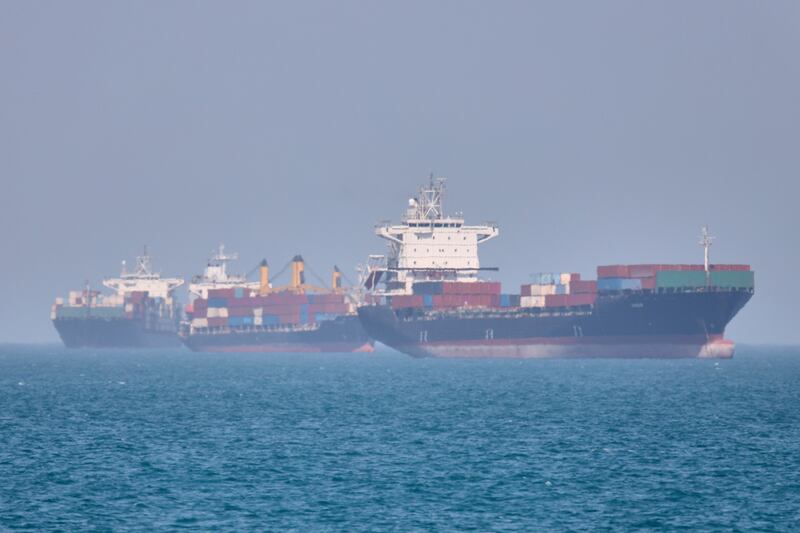
The narrow Strait of Hormuz has been virtually shut by Tehran since the US and Israel began attacks on Iran on February 28th, triggering disruptions that have pushed up commodity prices around the world.
Speaking about the crisis at the White House, Trump said Iran should “wave the white flag of surrender”.
Trump has said the US-Israeli attacks in February aimed to eliminate what he called imminent threats from Iran, citing its nuclear and ballistic missile programmes and its support for Iran-backed regional militants Hamas and Hizbullah.
“Iran never had a chance,” he said on Tuesday. “We cannot allow Iran to possess nuclear weapons. You can’t let a bunch of lunatics hold nuclear weapons, or the world will be in trouble.”
Iranian parliament speaker Mohammad Bagher Ghalibaf warned that US actions are jeopardising the security of shipping and marked a violation of the ceasefire.
But even as the conflict intensified, the sides reportedly continue to exchange proposals to resolve the crisis.
Iran is insisting, in public at least, on separating negotiations over freedom of navigation in the Gulf from other core issues, such as uranium enrichment on its soil, the removal of uranium enriched to 60 per cent, its ballistic missile programme and its support for regional proxies Hamas and Hizbullah.
Meanwhile, US intelligence assessments indicate that the time Iran would need to build a nuclear weapon using enriched uranium has not changed since last summer, when analysts estimated that a US-Israeli attack had delayed its capabilities by up to a year.
The UN’s nuclear watchdog, the International Atomic Energy Agency (IAEA), has been unable to verify the whereabouts of some 440kg of Iranian uranium which has been enriched to 60 per cent.
Nuclear weapons usually require a uranium enrichment of 90 per cent.
The IAEA believes that about half of the uranium was stored in an underground tunnel complex at Isfahan, but it has been unable to confirm that since inspections were suspended by Iran. – Additional reporting: Reuters/Bloomberg