Lawrence Vale is a professor of urbanism and urban design at the School of Architecture and Planning at the Massachusetts Institute of Technology (MIT) in Cambridge, United States. He opened the symposium “Architecture & National Identity,” organized by the Society of Architectural Historians, on March 21 and 22 in Washington.
With the National Garden of American Heroes, the monumental Triumphal Arch, a massive ballroom at the White House and giant banners bearing his image on public buildings, Donald Trump wants to leave his mark on Washington, DC. Are there other examples of this kind in American history?
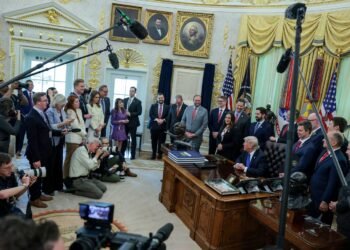
What Donald Trump is attempting is largely unprecedented for an American president. It’s not so much the scale of the changes as the range of spaces he is trying to influence. There has been much discussion about the gold embellishments in White House offices, the dramatic demolition of the East Wing and the conversion of the Rose Garden into a terrace. But outside, Lafayette Square is currently under construction and fenced off − even though it has traditionally been a site for protests and public gatherings. At present, new fencing and security checkpoints installed since 2025 to facilitate construction projects now make it impossible to come even remotely close to the White House. The “People’s House” currently stands fully insulated from “the people.”
No previous president has allowed their image to be displayed on federal buildings or had their name attached to them while still in office. Yet this is now the case for at least three buildings, including the departments of labor and justice, where large banners depicting Trump have been installed. More broadly, naming a building after oneself, or even placing one’s name on it, as he did with the Kennedy Center, is typically a prerogative of Congress. In this case, Congress had explicitly intended the building in memory of Kennedy. It would be as if Georges Pompidou had decided to name the Beaubourg center after himself while still alive, whereas it was renamed in his honor by his successor. Or as if, following current renovation works, the French president had renamed it the Macron-Pompidou Center. Trump obtained approval from the relevant review boards after appointing loyal figures to lead them. Instead of the checks and balances provided for in the Constitution, we now have individuals signing checks for donations.
You have 78.79% of this article left to read. The rest is for subscribers only.