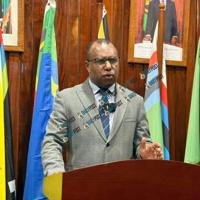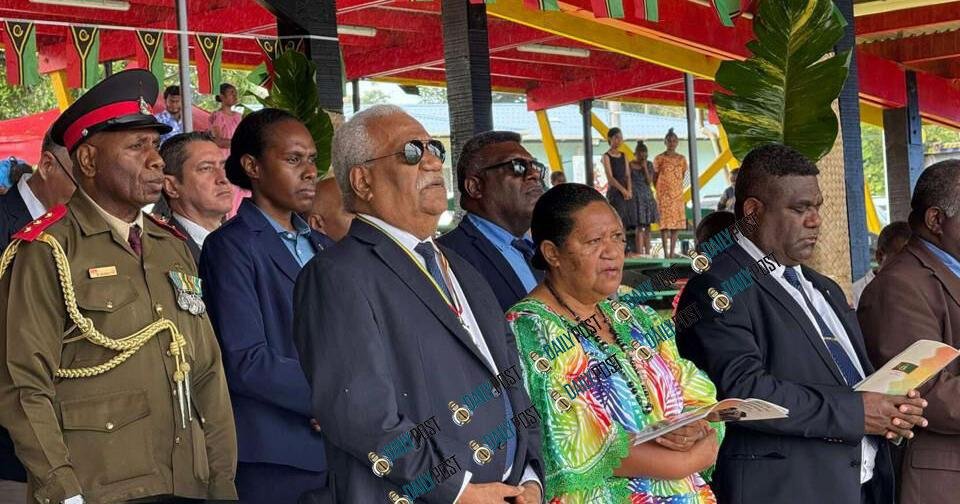
President Nikenike Vurobaravu has called on all leaders and citizens of Vanuatu to renew their commitment to the Constitution and uphold democracy, the rule of law, national unity and responsibility.
In his message marking Vanuatu’s 47th Constitution Day on October 5, President Vurobaravu called on political leaders, chiefs, church leaders, public servants, members of the judiciary, community leaders and civil society to respect and uphold the Constitution.
He called on Parliament to fulfil its constitutional responsibilities, the Government to govern in accordance with the Constitution and the law, and the Judiciary to safeguard justice and the rule of law.
The President also called on traditional leaders to continue guiding communities through the wisdom of kastom, while urging churches to promote peace, forgiveness, reconciliation and moral responsibility.
He said every citizen, both in Vanuatu and abroad, has a responsibility to respect and uphold the Constitution.
“The Constitution is not only the responsibility of government. It is the responsibility of all of us,” President Vurobaravu said.
October 5, 2026, marks 47 years since the Constitution was signed and adopted on October 5, 1979.
President Vurobaravu said the country’s founding leaders, representing the people of the New Hebrides, established a constitutional framework upon which Vanuatu’s independence, sovereignty, democratic institutions and common future would be built.
The Constitution subsequently came into force on July 30, 1980, when Vanuatu became an independent nation. He said Constitution Day was therefore not simply a commemoration of a document, but an opportunity to honour the constitutional foundation of the Republic and the vision, sacrifices and determination of those who fought for freedom.
The President said political independence would only have lasting meaning if it was supported by a system of government founded on law, justice, freedom, democracy and respect for the people.
Constitution belongs to the people
President Vurobaravu described the Constitution as the fundamental law of the nation, establishing the identity and character of the State, defining the powers and responsibilities of government institutions, protecting fundamental rights and freedoms, and providing the framework for exercising and transferring political authority.
He said government itself is subject to the law.
Article 1 of the Constitution declares Vanuatu a sovereign democratic state, while Article 2 establishes the Constitution as the supreme law of the Republic.
“This means that every institution of government, every public office and every person exercising public authority must act within the Constitution and the law,” he said.
The Constitution, he said, does not belong to one Government, Parliament, political party, President or generation.
“The Constitution belongs to the people of Vanuatu,” he said.
Protecting Vanuatu’s values
Vurobaravu said the Constitution reflects Vanuatu’s national identity and recognises the country’s ethnic, linguistic and cultural diversity, as well as its common destiny.
He referred to the Constitution’s recognition of traditional Melanesian values, faith in God and Christian principles.
He said Vanuatu’s constitutional democracy must be understood within the country’s unique context as a nation deeply rooted in kastom and community.
Vanuatu must remain connected to its traditions while continuing to develop as a modern State, he said.
He also spoke of Christian values such as forgiveness, reconciliation, compassion, service and respect for the dignity of every person.
Democracy requires responsibility
Vurobaravu said democracy is more than elections and requires responsibility, respect for the law, tolerance of different opinions, respect for institutions and peaceful political competition.
Those entrusted with public office must remember that public authority is a responsibility and not a personal possession, he said.
Citizens must also understand that their rights come with duties to their country and to one another.
The President spoke of the Constitution’s protection of fundamental rights, including the rights to life, liberty and security, protection of the law, freedom from inhuman treatment and forced labour, freedom of conscience and worship, and freedom of expression.
However, he said rights must be exercised responsibly and with respect for the rights and dignity of others.
President Vurobaravu referred to the constitutional roles of the Executive, Legislature and Judiciary, as well as constitutional offices and institutions including the Office of the President and the Malvatumauri National Council of Chiefs.
Each institution has its own constitutional responsibilities, he said.
Parliament makes laws and represents the people, the Executive administers government affairs and implements policy, while the Judiciary interprets and applies the law and safeguards justice.
The President, as Head of State, has constitutional responsibilities to uphold and protect the Constitution and the unity of the Republic.
The Council of Chiefs also has an important constitutional role in matters concerning custom and tradition, he said.
“These institutions must work together, but each must also respect the constitutional responsibilities and limits of the others,” he said.
President Vurobaravu warned that any consideration of constitutional change must strengthen rather than weaken the country’s democratic safeguards.
Constitutional changes should not result in the concentration or abuse of power, he said.
Constitution must be lived every day
The President said the Constitution can only remain strong if the people and institutions of Vanuatu respect it.
Celebrating Constitution Day once a year is not enough, he said, as its principles must be lived every day.
He called for children and young people to be taught about their constitutional rights and responsibilities, while public institutions must remain strong, professional, independent and accountable.
President Vurobaravu said the Constitution has endured through periods of political and social change, economic challenges, natural disasters and other national difficulties.
However, he warned that its endurance should not lead the country to take it for granted.
“Every generation has a responsibility to protect it,” he said.
President Vurobaravu acknowledged that Vanuatu’s Constitution is not frozen in time and provides mechanisms for constitutional change.
Where constitutional reform is considered necessary, it must be undertaken carefully, lawfully and transparently, with proper respect for the constitutional process, he said.
He referred to constitutional changes approved by the people in recent years, including reforms arising from the 2024 national referendum, as evidence that Vanuatu’s constitutional order continues to develop in response to the needs and aspirations of its people.
However, he warned that constitutional reform must not be undertaken merely for political convenience.
“Constitutional change must always be guided by national interest,” he said.
Reforms should strengthen democracy, improve the stability and effectiveness of institutions, protect the rights of the people and preserve the fundamental values upon which Vanuatu was founded, he said.
Call for unity and reconciliation
The President said Vanuatu’s challenges, including economic pressures, climate change, natural disasters, social pressures and development demands, must not divide the country.
He called for unity, reconciliation and national responsibility.
Unity does not mean everyone must think alike, he said, noting that Vanuatu’s Constitution recognises the country’s ethnic, linguistic and cultural diversity.
“Our islands, our languages, our kastom and our communities are diverse. But beneath that diversity is one national identity,” he said.
“We are ni-Vanuatu. We share one sovereign Republic. We share one Constitution. We share one national destiny.”
President Vurobaravu said kastom teaches the importance of reconciliation and restoring relationships, while Christian faith teaches forgiveness, love and compassion.
He urged citizens to learn to disagree without becoming enemies, debate without destroying relationships and accept political differences without allowing them to weaken national unity. Responsibility to future generations
Looking ahead, President Vurobaravu said the country must consider what kind of Vanuatu it will leave for future generations.
He said the founding leaders gave the nation its Constitution and it is now the responsibility of the current generation to protect and strengthen that inheritance.
He called for a Vanuatu where the rule of law is upheld, fundamental rights are protected, democracy is respected, kastom and Christianity continue to contribute to national identity, public institutions serve the people and political differences are resolved peacefully.
Marking 47 years since the Constitution was signed, President Vurobaravu said Vanuatu should be proud of its progress while recognising that its constitutional journey is not yet complete.
“Let us uphold our sovereignty. Let us protect our democracy. Let us respect the rule of law,” he said.
The President urged all citizens to work together to build a peaceful, just, prosperous and inclusive Republic of Vanuatu.
He said the Constitution was given to the people by previous generations, entrusted to the present generation and must be protected for generations to come.
“May those words continue to unite us as one people, one nation and one sovereign Republic,” President Vurobaravu said.