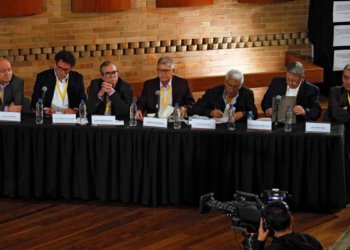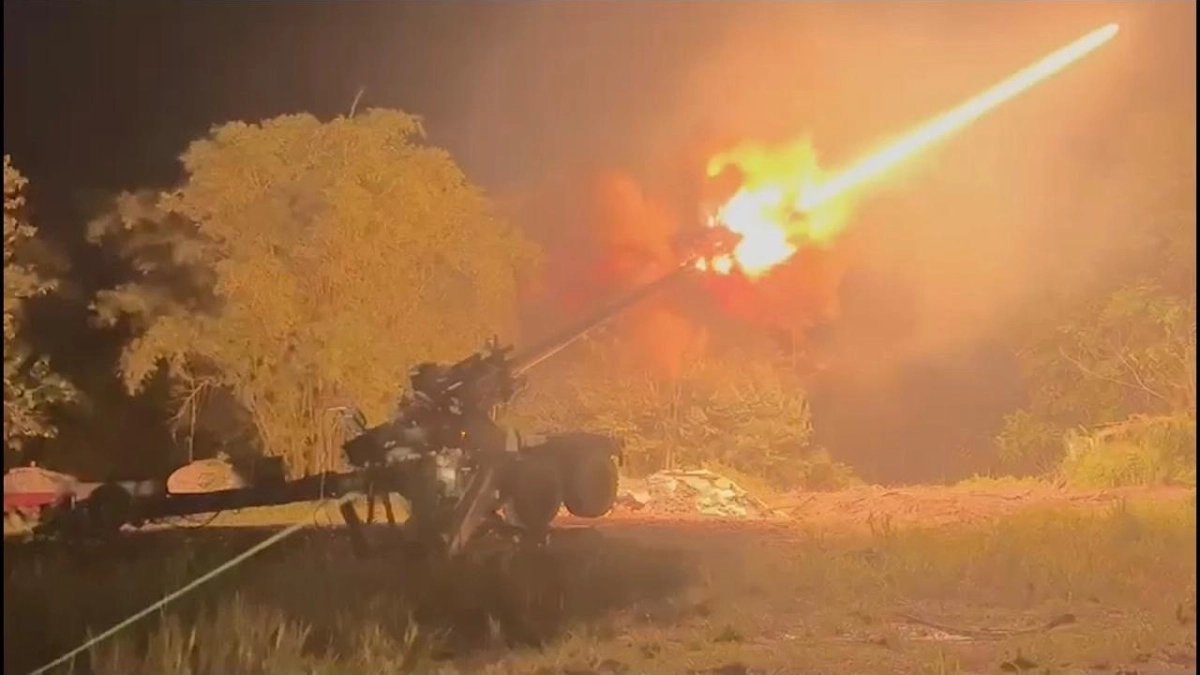
EL TIEMPO knew exclusively that the 34th Family Court of Bogotá resolved in substance the guardianship in which proceedings had been ordered to stop the bombings against targets with the presence of recruited minors. The decision lifts the precautionary measure that suspended air operations, but conditions them to a reinforced standard of precaution when information exists about the presence of boys, girls or adolescents.
The guardianship It was filed by lawyer Ower Jimmy Borda Parra for the bombing carried out on August 27 this year against alias Calarcá dissidents in Guaviare in which three minors died.
Weapons seized in the bombing operation against ‘Calarcá’. Photo:Courtesy
The bombings of this Government
The action It was based on a series of military operations executed in the first weeks of the government of Abelardo de la Espriellawho assumed the Presidency on August 7:
- August 10: a bombing against the ELN in Catatumbo leftaccording to the Ombudsman’s Office, a minor under 16 years old died.
- August 27: in the “Operation Amon”directed against the camp of the FARC dissident in command of alias Calarca in The Return (Guaviare), three minors died —two 15 years old and one 16 years old—, as confirmed by the National Institute of Legal Medicine.
- August 30: a third bombing in Guaviareagainst the dissidence of Iván Mordisco, left two people recovered who stated that they were minors, whose identity and age have yet to be established.
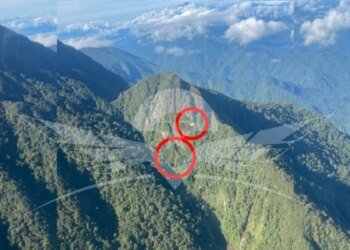
Bombing in Catatumbo against the ELN. Photo:Courtesy
The Court decision does not prohibit bombings
While the case was being resolved, the court had ordered to stop any bombing in areas where there was reliable information about the presence of recruited minors. That suspension generated strong opposition from the Government and of the Military forceswho warned that such a restriction could end up encouraging armed groups to use children as a kind of shield to avoid being attacked.
In the sentence, the judge decided to lift that suspension. That is, the bombings against military targets can continue to be carried out even if it is known that there are recruited minors present. He failure was explicit in clarifying that it is not about prohibiting military operations nor to give armed structures a kind of immunity for recruiting children.
“It will not be possible to establish an absolute prohibition of offensive air operations when there is the presence of minors, because an order of that nature would exceed the constitutionally admissible weighting and could disproportionately affect the state’s duty to protect the population, in addition It is up to the constitutional judge to declare abstractly that every minor (boy, girl and adolescent) found in an armed structure retains protection against direct attack in any circumstance, since the IHL requires analyzing the specific conditions of participation in hostilities,” he says in the ruling.
Besides, military authorities were ordered to apply a higher standard of precaution than the one they had been using. That involves better verifying intelligence information available, more carefully evaluate the real risk for the lives of these minors, check if there is any operational alternative that allows achieving the same military objective with less risk, and only after that analysis decide if the attack is justified.
“However, Yes, it will be ordered that the mere presence in a camp or the mere material connection with that does not automatically lead to bragging that a minor can be a legitimate target of attackyour situation must be assessed in accordance with IHLunder the reinforced standard derived from your age and victim status. Likewise, when there is certain, objective or reasonably verifiable information about the presence of minors, the Responsible authorities must take all precautions feasible, intensify intelligence verification, evaluate less harmful operational alternatives and carry out the corresponding specific proportionality judgment,” the ruling reads.
Weapons seized in the bombing of ‘Mordisco’ in Guaviare. Photo:Courtesy
The ruling also prohibited the authorities from automatically presuming that a minor who is inside a guerrilla camp is, for that reason alone, a legitimate military objective.
“The Constitution does not force the State to choose between protecting children and protecting society, but rather imposes on it the duty to pursue both goals and when there is a specific tension between them, requires adopting the alternative that allows the constitutional objective of security to be achieved, causing the least possible impact on the fundamental rights compromised.“said the judge.
The judge pointed out that the physical presence in an armed structure, or even the use of a uniform, is not enough to conclude that this minor is actively participating in combat; Their situation must be analyzed on a case-by-case basis, always recognizing their status as a victim of illicit recruitment.
“Specify that none of the orders contained in this ruling may be interpreted as authorization, prohibition or advance assessment of the legality of a specific military operation, the planning and execution of which corresponds to the constitutional and legally competent authorities and must be subject, in each case, to the Political Constitution and International Humanitarian Law.“, says.
In addition to those orders directed to the Presidency, the Ministry of Defense, the General Command of the Military Forces and the Aerospace Force, the court asked the ICBF and other entities in charge of the protection of minors to strengthen the programs that already exist to serve those who manage to disassociate themselves from armed groups, and commissioned the Ombudsman’s Office and the Attorney General’s Office to follow up on compliance with everything ordered.
Three entities—Legal Medicine, Military Criminal Justice and Congress—were left out of the process, as the judge considered that they had no direct relationship with the events.
This is one of the four protections filed against the bombings. Those filed in Popayán, San José del Guaviare and Cúcuta, that raise different requests.
The sentence can be appealed within the next few days. If none of the parties does so, the file will automatically be reviewed by the Constitutional Court, which could confirm, modify or revoke what was decided by the Bogotá court.
News in development…
Juan Diego Torres
Dielas@eltiempo.com
Justice Editorial