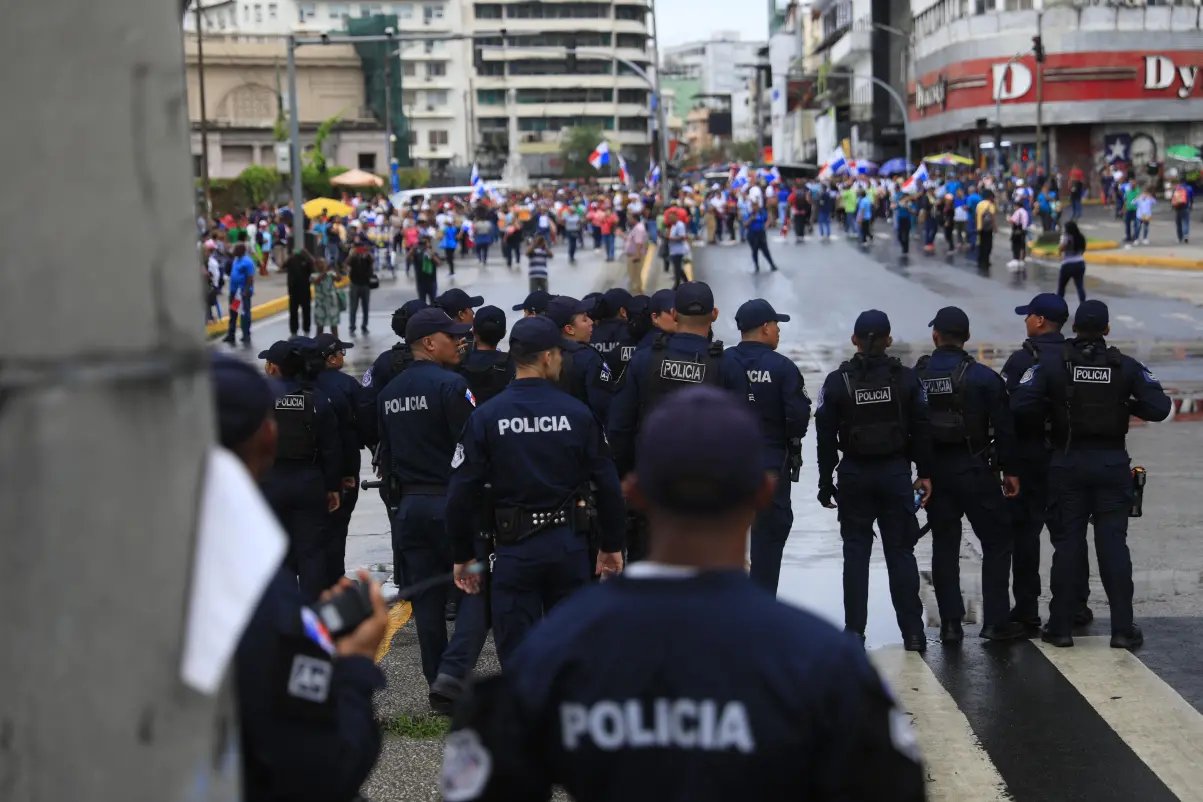
What until then moved in the realm of rumors from police within unions and social groups opposed to the Government, repeated warnings as slogans aired at political rallies, ended up becoming a reality recognized by the National Police itself. The Public Force speaks of undercover agents within the law; popular organizations, of illegal political espionage. Where is the red line between what is allowed and abuse? How far can an undercover agent go before crossing that line that separates lawful investigation from illegal surveillance?
The Panamanian regime regulates covert operations within a legal framework in which different regulations interact under the protection of the Constitution. The latter establishes the maximum limits within which the main institutions involved in the operations act: the Public Ministry, the Judicial Branch, through the judges, and the Police. Consequently, no action by agents can violate fundamental rights, such as due process, the right to life, the inviolability of communications, freedom of association or the right to privacy.
“States are empowered to adopt investigative measures for security reasons against internal or foreign threats, always within the legal framework. The problem does not lie in the covert operation itself, but in the purpose that justifies it: if it responds to political interests, we would be facing violations of human rights,” explains Jorge Castañeda Patten, criminal lawyer.
To control these power imbalances, the Criminal Procedure Code (Law 63 of 2008) establishes parameters for these operations. Article 315 establishes the ability of prosecutors to order them as part of an investigation, with the purpose of collecting evidence that allows determining the occurrence of a punishable act.
According to the evidence presented to the United Nations rapporteur, a group of organizations from the United People’s Alliance for Life – made up of unions, student groups, environmentalists and teaching unions -, which in turn are opponents of the Government of President José Raúl Mulino, would have been infiltrated under a systematic structure from the National Directorate of Police Intelligence (DNIP), by at least twenty police officers who posed as activists and militants to monitor, infiltrate and harass the organizations from inside, including the “fabrication of evidence” and surveillance that would have reached the families of those involved. All, social groups claim, without a court order, something that the Police deny.
The red lines
Law 121 of December 31, 2013, which adopts measures against activities related to the crime of organized crime, further limits the conditions under which police officers must operate. There, he devotes an entire chapter to describing special investigation techniques, among which are undercover operations, establishing that these can be used to search for information and evidence that allow the prosecution of people who are part of criminal groups, including their dismantling. Everything, again, under the order of a prosecutor and subject to the control of a guarantee judge within a period of sixty days.
The rule also establishes protections for the undercover agent when carrying out their duties, making it clear that they cannot violate the human rights recognized by the Constitution. In addition, if he has participated in an investigation, he could testify in court, with his identity reserved and with witness protection provisions.
In Castañeda Patten’s opinion, not only would the legal basis and evidence that would justify a structure of this magnitude and scope on social groups have to be taken into account, an already delicate scenario as it involves, in its vast majority, opposition sectors. Furthermore, the action must be framed in the principle of conventionality. That is to say, the work of judges, courts and State authorities cannot occur in contradiction with the international agreements to which Panama is a party. This includes the American Convention on Human Rights and the rulings of the Inter-American Court of Human Rights (Inter-American Court), whose jurisdiction the country recognizes and which constitute binding jurisprudence.
Law without carte blanche
In the opinion of the former Attorney General of the Nation, Ana Matilde Gómez, the mere fact that the surveillance structure has been discovered is a failure in itself of the capabilities of the Public Force. He also agrees that covert operations are common in States, but these are not a “carte blanche” to infiltrate without reasons and they would have to be motivated by serious indications.
“It is usually to protect a greater good, for example, the security of the Canal, the security of a critical infrastructure such as a bridge against a possible attack, a possible attack against a senior official; but there it should be made known through a complaint to the Public Ministry,” said Gómez.
Given the impact of the news, at times of high unpopularity of the Government and tension after the protests against the social security reform (Law 462), the rejection of mining exploitation and the Río Indio reservoir by peasant communities, the jurist considers that the MP could should clarify the situation. “Without going into detail, I could confirm whether there is an ongoing investigation for a high security risk.”
“This situation could not come at a worse time and in a worse way. There is enough animosity towards the Police due to the history of excesses and generating more fear among social organizations. If the Government wanted to keep the streets open and social peace, it has to know that it must be handled with high democratic standards so that the good it wants to protect does not go against fundamental guarantees,” he said.
The organizations question that the Government maintains a policy of “criminalization” of social protest; The Government denies it. To date, the MP has not yet confirmed whether he admitted the criminal complaint about the infiltrations.