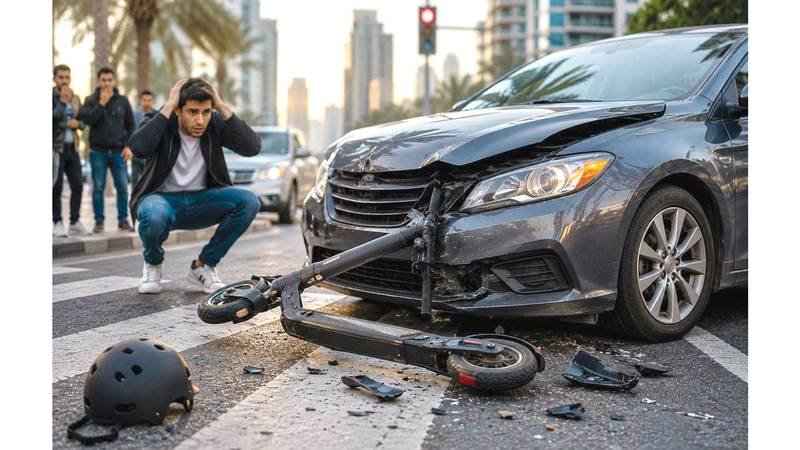
Dealers with insurance companies reported that some companies charged the owners of damaged vehicles with a percentage of liability, or considered them to be the party that caused the accident, despite the fact that police reports held the other party fully responsible, especially in accidents in which the person responsible was an underage child or an electric scooter driver.
For his part, an official source, who preferred to remain anonymous, said that the final report approved by the competent official authorities or the final judicial ruling is what matters in the end, and not any internal description issued by the insurance company, adding that there are procedures against violating companies, and the customer can resort to the “Sanadak” unit, affiliated with the Central Bank, if the problem is not resolved.
On the other hand, two experts in the insurance sector said that the insurance document is the primary reference in determining the rights and obligations of all parties, and as long as the police report proves that the driver of the vehicle is the one affected, and has a comprehensive insurance policy, he is entitled to compensation according to the terms and conditions of the policy, regardless of whether the person responsible is a child or driving an uninsured scooter, adding that the presence of a child or scooter driver as a party to the accident does not eliminate legal responsibility for the resulting damages, as the responsibility of the minor is transferred to his guardian, in accordance with the applicable legal rules.
Damaged vehicles
In detail, (affected) dealers with insurance companies reported that some companies charged the owners of damaged vehicles with a percentage of liability or considered them to be the party that caused the accident, despite the fact that police reports held the other party fully responsible, especially in accidents in which the person responsible was an underage child or an electric scooter driver.
They confirmed that insurance companies asked them to pay a percentage of the repair cost, or opened accident files as accidents of unknown responsibility or joint responsibility, despite the issuance of clear police reports explicitly identifying the responsible party, which raised questions about the extent of some companies’ commitment to the results of official reports.
They said that the problem occurs more frequently when the culprit is a child riding a bicycle or an electric scooter, as some companies report that recovering the value of the damages from the culprit or his guardian may be complicated, which prompts them to bear the insured part of the cost or apply the deductibility conditions contained in the policy.
These complaints come in light of the increasing use of electric scooters and bicycles by minors, as the competent authorities have previously warned against allowing children to drive vehicles or means of transportation on public roads, stressing that parents are legally responsible for such violations. Law enforcement authorities have also recorded cases in which measures have been taken against parents of children who drove vehicles or scooters in violation of the law.
Affected people called on the insurance sector supervisory authorities to verify complaints that the affected people are charged liability rates or responsibilities that do not match what was stated in the police reports, and to oblige companies to adhere to the results of official investigations when settling claims, in a way that ensures the protection of the rights of policyholders and achieves justice between the parties to the accidents.
Limitation of liability
On the other hand, an official source, who preferred to remain anonymous, said, “The basis for determining liability and the percentage of fault in traffic accidents is the final police report or the final judicial ruling, if any, and not the description or conditioning that the insurance company sets individually.”
He explained that “insurance companies, when studying the claim, may review documents, facts, and technical reports, and may request clarification, reconsideration, or correction of a material error, if it becomes apparent that there is a discrepancy, deficiency, or error in the initial report. This is an applicable legal and procedural matter, and is not necessarily a violation in itself.”
The source stated, “In some cases, the report may be amended or corrected by the competent authority, if it is proven that there is a material error or inaccurate information, or new evidence emerges. Therefore, what matters in the end is the final report approved by the competent official authorities or the final judicial ruling, and not any internal description issued by the insurance company.”
He continued: “If any company rejects or changes the position of the affected person contrary to the approved final official report, without a legal or judicial document, this may constitute a violation that requires supervisory review and taking appropriate measures in accordance with the regulations and instructions in force in the UAE.”
He stressed that “in the event that a mutual agreement is not reached between the two parties, one can resort to the Banking and Insurance Dispute Resolution Unit (SANADIC) and file a complaint in accordance with the established procedures.”
Committed companies
For his part, the expert and insurance consultant, Bassam Gilmiran, said: “The insurance document is the primary reference in determining the rights and obligations of all parties, and if the police report, which is the official reference in determining responsibility for the accident, proves that the vehicle driver is the injured person, and has a comprehensive insurance policy, then he is entitled to compensation according to the terms and conditions of the policy, regardless of whether the culprit is a child or driving an uninsured scooter.”
Gilmiran added: “In the UAE, the laws, regulations and instructions regulating the insurance sector are clear in regulating the relationship between the insured and the insurance company and protecting the rights of all parties.”
He stressed that he believes that “insurance companies, which are generally professional companies, resort to such practices as a method of settling claims. However, if a dispute arises in the interpretation of the terms of the policy, or there is a rejection of the claim or the insured is charged any percentage of liability, then the insured has the right to ask the insurance company to state the reasons and basis on which it based its decision, and in the event that the response is not convinced, one can resort to the (Sanadak) unit, affiliated with the Central Bank, as its doors are always open to look into customer complaints, and it has the experience. And the necessary powers to study each case and establish rights in accordance with the provisions of the law and the terms of the insurance policy.
In turn, the insurance expert, Muhammad Ali, said that “the accident report issued by a competent official body cannot be violated or objected to except through official means.”
He explained that “it is known that the police report represents the primary reference in determining liability when traffic accidents occur, and that insurance companies are supposed to base their compensation decisions on what is contained in it regarding the identification of the culprit and the injured person.” He also explained that the presence of a child or scooter driver involved in the accident does not eliminate legal responsibility for the resulting damages, as the responsibility of the minor is transferred to his guardian, in accordance with the applicable legal rules.
They added that comprehensive insurance policies usually cover damages to the damaged vehicle according to the terms of the policy, while the issue of recourse against the person responsible or legally responsible for it remains an issue between the insurance company and the responsible party, and it may not lead to harming the rights of the injured person if liability is proven according to an official report.
Official source:
What matters in the end is the final report approved by the competent official authorities, or the final judicial ruling, and not any internal description issued by the insurance company.
Dealers:
Insurance companies requested to pay a percentage of the repair cost, or opened accident files as unknown accidents or joint liability, despite identifying the responsible party.
Two experts:
The insurance document is the primary reference in determining the rights and obligations of all parties in the accident.