The turning point was supposed to be a German awakening. But four years after Olaf Scholz’s speech in the Bundestag and the constitutional change initiated by Friedrich Merz, it is clear that rearmament does not reflect the republic’s strengths, but rather its structural weaknesses.
Germany’s defense strategy, presented in April 2026, avoids the urgently needed strategic realignment. What is positive is that Russia is mentioned as a key threat seventeen times in the German strategy paper. But otherwise it disappoints.

Unfortunately, when it comes to the topic of collective defense, the only thing Berlin can think of is NATO under the leadership of the USA: rearmament is being designed in such a way that Germany “becomes a stronger military ally” to the USA. What is clear is that a European alternative is not easy to establish, especially given concerns about the outcome of the next French presidential election. Nevertheless, the alternative cannot be permanent dependence on the USA. France, which is discussing a European dimension of its nuclear deterrent, does not figure in the German strategy any more than Great Britain or Poland.
Great Britain and Poland are role models
European partners are there. For example, the British lead the Nordic defense alliance Joint Expeditionary Force. The strongest army in Europe, Ukraine, is associated as a central partner.
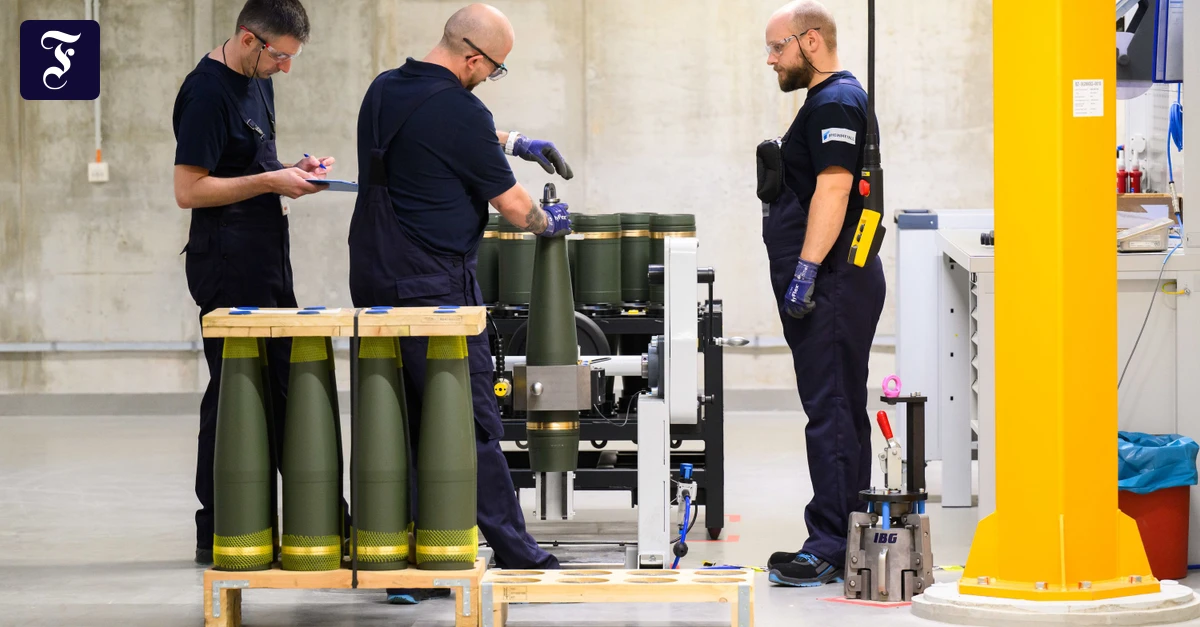
The absence of Europe is also reflected in procurement. In our study for the Kiel Institute, we analyze all 736 procurement orders from Germany, Great Britain and Poland from the last five years. We show that Germany now places more than sixty percent of its orders with domestic companies; almost nothing is ordered directly from European partners. This means that dependencies on the USA remain intact for weapons systems for which there have long been European alternatives.
Secondly, technological superiority in the strategy is classified in “Phase 3”, with a target horizon of 2035 to 2039. That is too late given the threat situation. In London, Prime Minister Keir Starmer personally called for modernization and lessons from Ukraine in the “Strategic Defense Review”, as did Polish Prime Minister Donald Tusk. The German Chancellor, on the other hand, does not seem to be calling for this technological modernization.
The result: The Bundeswehr buys what she knows and not what she needs. We show that only a small and falling proportion of German orders are for what the Ukrainian war experience defines as a “new paradigm”: autonomous systems, AI-based reconnaissance and fire control, networked air and missile defense, electronic warfare, drone defense. Great Britain, on the other hand, has more than doubled its spending on the new paradigm in absolute terms. Poland has even increased its share eightfold.
Orders without a final delivery date
Third, there are implementation problems. The expected delivery times for German defense orders vary between two and four years. It looks similar in London and Warsaw. But the proportion of German orders for which no final delivery date is published has increased continuously since the beginning of the new era. Added to this is the lack of automated central recording of what has now been delivered from the order backlog at the turn of the century.
It is obvious that this triad represents a general criticism of the Federal Republic itself. The pattern can be found in the digitalization of administration, in rail transport or in industrial transformation. Rearmament is therefore not an additional construction site, but rather the magnifying glass under which the structural problems of the German state become visible. There is an opportunity here. The Chancellor would have to make the defense strategy a top priority and begin with a ruthless analysis. Germany would have to put regional cooperation, including with Ukraine, at the center of its collective defense strategy.
Procurement and training would have to be calibrated to the new war picture, with clear targets for autonomous systems and AI, for example. The ministry would have to be obliged to radically modernize, for example to be able to say in real time what has been ordered and delivered. This modernization would be a political feat and could be a blueprint for the renewal of the Federal Republic. The large amount of money raised through debt would then be well spent.