Loading Text-to-Speech…
In recent weeks, Ankara has made it clear in various ways that the period that had become more widely known as that of “calm waters” in Greek-Turkish will soon be a thing of the past. The debate on the upcoming bill of the so-called “Blue Country”mainly through leaks, as well as the targeting of Greece and the Republic of Cyprus as Israel’s “long arms” behind Turkey’s back, have brought back tension reminiscent of the pre-2023 atmosphere.
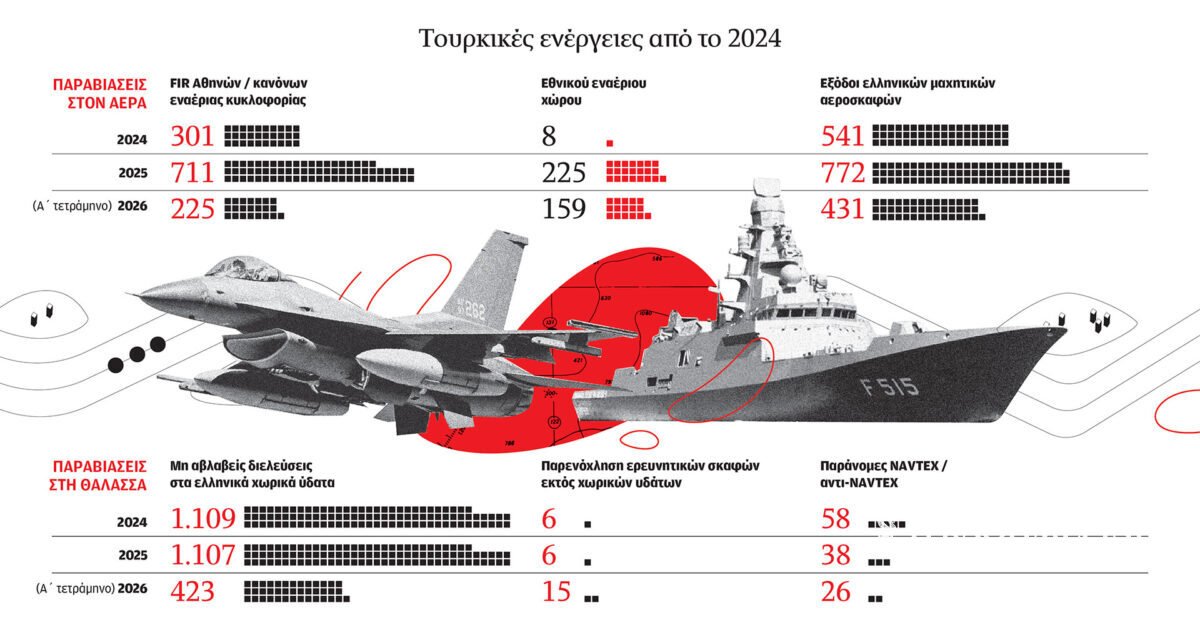
The data presented by “K” today, and come from the processing done by the Armed Forces, reflect the fluctuations of the political questioning of the sovereign rights of Greece by Turkey during the period 2024-2026.
Return to tension – Leaks about the so-called “Blue Homeland” bill and the targeting of Greece and Cyprus as Israel’s “long arms” behind Turkey’s back have brought back tension reminiscent of the pre-2023 atmosphere.
A characteristic element is the violations of Greek territorial waters by ships of the Turkish navy and coast guard, which carry out harmless crossings. In 2024, 1,109 such crossings were recorded, while in 2025 the number was similar (1,107). Only in the first quarter of 2026 (January – April), 423 violations have already been recorded, a number that, on an annual basis, shows an increase compared to the previous two years.
And in the air
In the airspace over the Aegean the situation has also worsened since 2023. Violations of the National Airspace (NEA) jumped from 8 in 2024 to 225 in 2025 (a 28-fold increase). At the same time, violations of the Air Traffic Rules (ATC) are recorded within the Athens FIR (Turkish aircraft that do not file flight plans). Violations went from 301 in 2024 to 711 in 2025, an increase of 410 incidents in just one year. Cumulatively, in the first quarter of 2026, 225 violations of the CEC have already been recorded in the Athens FIR and 159 violations of the EEC, a trend that, if it continues, then the annual tally will reach higher levels than 2025.

These numbers also have an operational impact, as incidents of violations require the immediate reaction of the Air Force (AF). During 2024 the fighters of the P.A. conducted a total of 541 sorties to intercept Turkish aircraft and unmanned aerial vehicles (UAVs). In 2025, fighter sorties required to deal with air violations increased to 772. While in the first quarter of 2026, for a total of 384 violations, 431 take-offs of Greek fighter aircraft had to be made.
On the surface of the sea, in addition to the violations of territorial waters that are a perennial element of delinquency, the Turkish navy is now increasingly harassing research vessels and cable-laying vessels with the method of radio harassment (Hailing). In 2024, 6 such incidents were recorded, in 2025 also 6, while only in the first quarter of 2026 the incidents have risen to 15. Abusive use of the Hailing method (where the identity and work of a research vessel is requested to be clarified by radio) is also done within Greek territorial waters.
Strategic Maneuvers – In 2026, only two harassments of ships have been recorded inside and 15 outside Greek territorial waters, which reflects the shift of the center of gravity of Turkish strategy from territorial waters to contesting the Greek continental shelf.
In the second half of 2023, 20 such incidents were recorded, in 2024 they reached 32, in 2025 they decreased to 16, while in the first quarter of 2026 they reached two. According to the analysis of the competent Armed Forces, this reduction, in contrast to the simultaneous launch of harassment outside Greek territorial waters, is not a de-escalation, but a deliberate shift of Turkish offensive tactics from territorial waters to contesting the Greek continental shelf. It is recalled that the most problematic case was the obstruction of the vessel “Ievoli Relume” in July and August 2024 to carry out surveys for the future laying of the electric interconnection cable of Crete – Cyprus (Great Sea Interconnector – GSI).

Another field that “K” has recorded repeatedly is the “paper war” of NAVTEX, anti-NAVTEX and NOTAM, i.e. of the international maritime and air notification broadcasting systems, through which it asserts claims within potential Greek maritime zones, on the occasion of scientific research and military exercises.
Only for 2024, 58 NAVTEX and anti-NAVTEX were issued, in 2025 a total of 38 NAVTEX and anti-NAVTEX, while in the first quarter of 2026 this number has already reached 26. It is worth noting that, since October 2024, Turkey has changed its tactics by issuing long-lasting NAVTEX. These instructions concern activities mainly east of the 25th meridian (ie in the middle of the Aegean). Characteristic examples of long duration NAVTEX broadcasts are 0060/26 (January 16, 2025) and 0888/25 (September 17, 2025) with which it is claimed that no maritime borders have been defined between Greece and Turkey (nor indeed a continental shelf), but it is also broadcast that Greece is wrongly maintaining Forces on the islands of the Eastern Aegean.

The transitions
Athens has reacted to all this in the diplomatic field as well. A few days ago, on May 21, it took place regular visit to the Ministry of Foreign Affairs of Turkey for issues related to delinquency in the maritime domain. At that time, a total of 14 verbal communications were served for violations of national territorial waters by Turkish fishing vessels, which were several times accompanied by Turkish coast guard vessels. The reports highlight the increase in Turkish delinquency at sea. Specifically, it is noted that in March 2026, violations increased by 74% compared to February and by 99% compared to March 2025.