Havana/State passenger transportation has practically disappeared in Camagüey. Of the nearly 350,000 users that it moved every day, the system now only transfers about 15,000, a drop of almost 96%, as acknowledged by Miguel Arias Vázquez, provincial delegate of the Ministry of Transportation.
The figure summarizes a collapse that the authorities attribute mainly due to the lack of fuel, but also to the shortage of tires, batteries, spare parts and other essential resources to keep the fleet operational. The result is a service incapable of guaranteeing even minimal mobility for thousands of people.
The few buses available make, in the best of cases, one route in the morning and another in the afternoon, and not even all routes have these two departures. Precariousness has forced passengers to depend more and more on private means, whose prices are out of reach for a large part of the population.
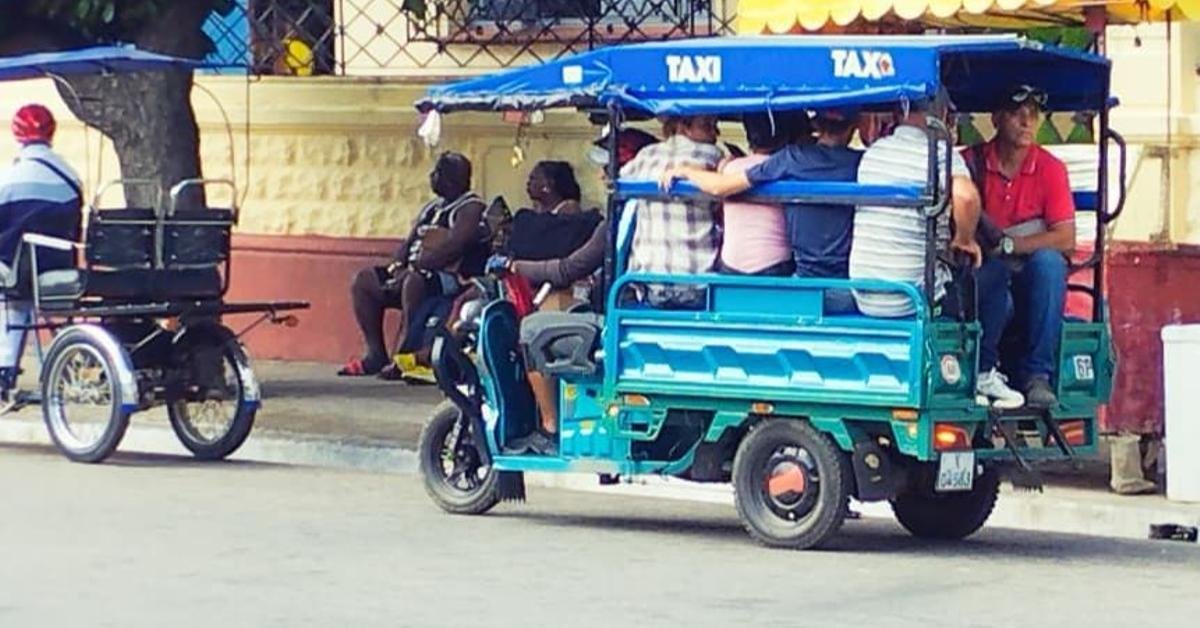
To alleviate the situation, the province received 15 Chinese electric tricycles and ten Foton brand minibuses in recent months. The 25 vehicles were destined for the main corridors of the city, with priority for the morning hours, when demand is greatest.
Transport of the sick also depends on promises still unfulfilled
The incorporation, however, is insignificant compared to the magnitude of the collapse. The new means barely allow some stops to be relieved, while the majority of the population continues to be exposed to long waits, overcrowded vehicles and increasingly high private fares. The ten Foton microbuses also do not function as conventional urban transport, but rather as taxis.
The crisis is even more serious outside the provincial capital. Arias Vázquez admitted that connections with the rest of the municipalities are completely paralyzed. Only some vehicles known as Medibus are maintained on Tuesdays and Thursdays, intended to transport patients with consultations at the city’s main hospitals.
Transportation of the sick too depends on promises still unfulfilled. The Government plans to incorporate electric vehicles to guarantee the transportation of more than 250 patients undergoing hemodialysis treatment. According to the official, the first ten media should arrive “at an early date,” although he did not offer a specific schedule.
In the absence of a sufficient state service, private transporters have gained prominence. The authorities accuse them of imposing “extremely harmful” rates and recall that the approved price is still 50 pesos for each official section. Any charge above that amount is considered a violation.
The official discourse, however, omits that it is those same individuals who cover a good part of the routes abandoned by the State. Fuel barely appears in service centers and, when it is available on the informal market, it reaches prohibitive prices.
Of the 16 piqueras that operate in Camagüey, only four have the approval of Traffic Engineering
The provincial delegate also recognized numerous irregularities among tricycle drivers. The most serious thing is that some circulate without a driving license. The authorities claim to have occupied between 20 and 30 vehicles for various reasons. Arias Vázquez asked for greater collaboration from the population to “denounce” overpricing and other violations. As he explained, control operations have been carried out in various parts of the city, but passenger complaints do not always translate into formal complaints that allow the drivers to be “punished.”
The legalization of piqueras is another pending issue. Of the 16 that operate in Camagüey, only four have the approval of Traffic Engineering. The other twelve operate without all permits, another indication of the degree of informality that dominates the sector.
Nor is it planned for the State to install solar stations to recharge electric vehicles intended for public service. The authorities leave this possibility open to private projects, an increasingly common formula to transfer investments that the Government cannot assume to the non-state sector.
Difficulties also affect interprovincial travel. Given the shortage of capacity on national trains and buses, the Provincial Transportation Directorate set up an office to receive requests from passengers interested in obtaining a ticket.
The Ministry of Transportation announced this Thursday several extraordinary trains to the east of the country during the first half of July, intended mainly for the return of students and teachers at the end of the school year. The measure, of temporary scope, attempts to alleviate a network in which regular trains to Camagüey, Santiago de Cuba, Holguín and Guantánamo have been reduced to only three weekly frequencies. The incorporation of these additional trips does not modify, however, the structural deterioration of the service.