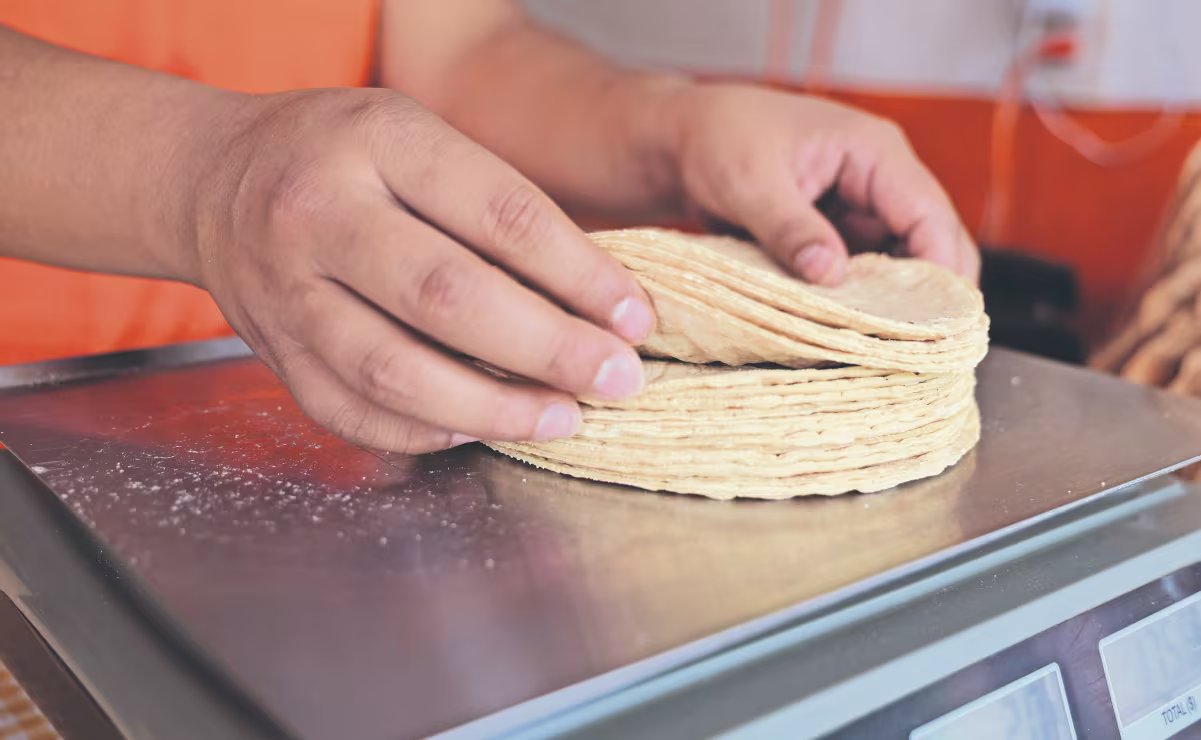
The tortillas of corn, the main food of Mexicans, were sold on average at 23.7 pesos per kilo in bulk in urban areas, although in northern cities such as Mexicali, Hermosillo and Ciudad Acuña reached 35.
This is revealed by the monitoring carried out by the National Institute of Statistics and Geography (Inegi) took place during March in the 55 main cities of the country.
The president of the National Tortilla Council (CNT), Homero Lopez Garciacalculated that the kilo will register a increase from two to four pesos due to the higher cost of a ton of flour of corn.
Read also Banxico appoints Aldo Heffner as chief economist; strengthens its area of economic research
The company Maseca announced that tomorrow, April 15, a ton of corn flour will increase to 450 pesos, which is equivalent to an approximate increase of 25 cents per kilo.
He highlighted that Minsaa group headed by Altagracia Gómez Sierra, is not going to increase prices, although it was previously one of the first to raise them.
However, the CNT leader stated that there is an accumulated delay in the costs of production that may be reflected during the coming weeks.

Source: Inegi
“For three months to date there have been adjustments in gas, freight, food grade paper, spare parts and so on, but the most expensive thing is that we have gasoline that have increased in recent days up to three pesos per liter and mobility costs more,” he commented in an interview with THE UNIVERSAL.
In addition, he explained that better payments should be made salaries so that the job in a formal business is attractive, because the transfers of money via the government programs They make people not want to work.
He pointed out that one of the great disadvantages for tortillerias is in unfair competition, because informal businesses do not pay taxes or electricity, nor social security and lack operating licenses from the Cofepris and Civil Protection.
“Unfair competition is damaging the sector, because informal workers evade all obligations,” said the representative of the organization founded in 1998.
In López García’s opinion, informal tortillerias do not necessarily open their curtains, since they distribute the product by bicycle or motorcycle and, although they are producers of that food, “they are not regulated, because they do not have an operating license and that generates more unfair competition.”
Lacking fixed expenses, informal ones can sell a kilo for 18 pesos, but formal tortilla shops must sell more expensively since they face higher costs.
“After evaluating our latest production costs, a kilo cost us 25 pesos using corn flour and 22.15 with nixtamalized corn,” he explained.
Given the situation, Homero López warned that the final price at consumer It will increase by two to four pesos and it will not be throughout the country, but it will be in Mexico City, the State of Mexico and places where the kilo is sold today between 22 and 24.
“Each tortilla maker makes the decision, but from the surveys we do with delegates and colleagues from all over the country, the tortilla will begin to have an increase. We have done an analysis and we have a deficit of 16%. If we set a percentage above 22 pesos, we would be talking about an increase of two to four pesos in the consumer price,” he explained.
Read also They contain a spill at the Pemex refinery in Deer Park; Total cleaning will take 2 days
He announced that the National Tortilla Council requested the federal government to combat unfair trade to have a price within the reach of all consumers.
“Let’s hope that there is political will against unfair trade, because it harms consumers and all of Mexico.”
On June 12 of last year, the government launched the National Corn-Tortilla Agreement with producers, marketers, flour producers, nixtamaleros and tortilleros, in order to “improve the production chain and maintain prices.”
Read also Acapulco recovers 86% of hotels from Otis
However, Homero López explained that tortilla shops can raise their prices if inputs become more expensive, because the agreement is voluntary.
“If the prices of inputs moved, go ahead with the adjustment to tortilla prices, although in some areas it will not have an impact due to government programs,” he said.
He emphasized that there is no price control by the government and, through the Federal Consumer Protection Agencylacks the power to close tortilla factories if there is a price increase generated by more expensive inputs.

Join our channel EL UNIVERSAL is now on Whatsapp! From your mobile device, find out about the most relevant news of the day, opinion articles, entertainment, trends and more.
cdm