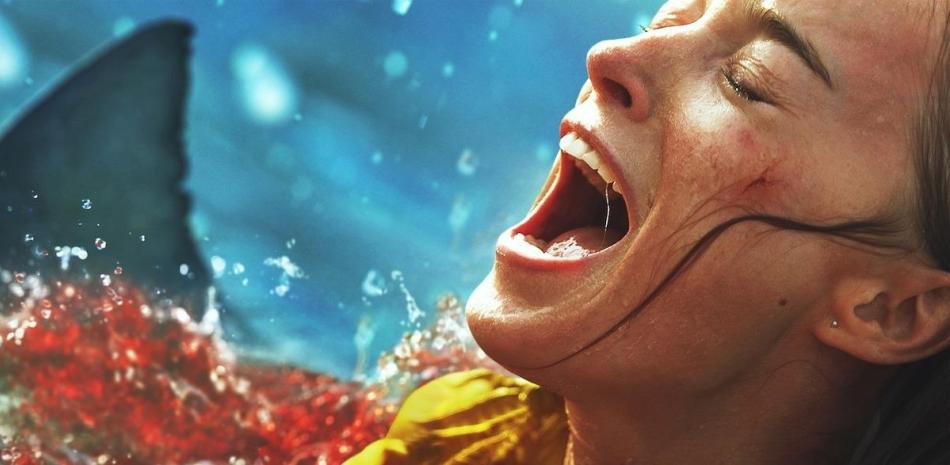
“Thrash” starts from a premise that, in theory, should work almost by inertia. A hurricane devastates a coastal city, water invades the streets and, with it, sharks that turn the natural disaster into carnage. It’s the kind of idea that doesn’t need sophistication to entertain, just execution, rhythm, and a minimal awareness of what the genre demands.
The problem is that the film, released on Netflix on April 10, seems to not understand that last part, and what should be a visceral experience ends up being, above all, a wasted opportunity.
There’s something particularly frustrating about watching such a straightforward proposition dilute into a surprisingly flat experience. It’s not about the characters making absurd decisions or the story embracing the ridiculous, that’s part of the DNA of this type of cinema.
The real problem is the lack of intention in the staging. The film doesn’t build tension, it doesn’t generate expectation, and what should be a succession of chaotic moments ends up feeling inert. There is no pulse. There is no urgency. Just a series of events that happen without apparent consequence.
Tommy Wirkola, a director who in other projects has shown to understand the value of excess and self-conscious humor, appears here trapped between two approaches that he never manages to reconcile.
At times, Thrash tries to take itself seriously, relying on the drama of its characters and the gravity of the disaster.
In others, it seems to want to lean towards the exaggerated spectacle that its premise suggests. But he never fully commits to either path, and that indecision ends up being his greatest weakness.
A director like Wirkola should know that this genre does not forgive lukewarmness: either you go all out with chaos, or you build suspense with precision. Neither of the two things happens here.
The narrative doesn’t help either. The story is fragmented into multiple lines that fail to integrate effectively.
On the one hand there is Lisa, a pregnant woman trapped in the middle of the flood, whose situation could have been the perfect axis for a more contained and tense survival story.
On the other hand, a marine researcher who tries to rescue his niece in the midst of chaos.
Added to this is a group of children in a subplot that seems to belong to another film, with its own logic and tone that clashes with the rest of the story.
The result is a scattered structure that constantly interrupts any attempt to build tension, as if the film doesn’t trust any of its own stories enough to follow them to the end.
That lack of focus inevitably translates into a loss of rhythm.
The film jumps from one character to another at moments that break emotional continuity, even during scenes that should sustain danger.
Instead of accumulating intensity, it disperses it. It’s a disconcerting decision, especially in a genre that depends so much on the progression of suspense and the ability to make the viewer feel that danger is real, immediate and inevitable.
The attack sequences, which should be the driving force of the film, also fail to stand out. There is blood, there is movement, there are attempts at visual impact, but the danger is rarely felt.
Much of the action occurs in a confusing manner, with threats that are often not even clearly perceived.
Violence exists, but it has no weight, it does not generate a reaction, it leaves no impression. The problem is not one of budget or ambition, but of execution: the best films of this subgenre have known how to do a lot with little, building fear from anticipation and not from the accumulation of images. Thrash seems to ignore that lesson.

VIDEO. “Thrash” | Official Trailer | Netflix
The technical section It also fails to compensate for these deficiencies. Although the initial atmosphere has some potential, a city slowly being overtaken by the force of water, with a geography that could have been a character in itself, that momentum is quickly lost.
The effects, especially towards the end, do not contribute to building credibility, and the film never finds a visual identity that reinforces its proposal. Everything looks functional, but nothing is memorable.
There are, however, elements that suggest what could have been. Phoebe Dynevor brings a presence that manages to sustain some credibility even when the story doesn’t back it up. His character is the closest to a genuine emotional center, and in his best moments you sense what the film could have been if it had opted for a more concentrated story.
Djimon Hounsou, as is often the case, provides a solid foundation that gives weight to his scenes. They even seem trapped in a movie that doesn’t know what to do with its own resources, that puts them in extreme situations without taking the time to make those situations matter.
The most striking thing is that Thrash does not fail due to excess, but on the contrary. It does not embrace the absurdity that its premise allows, nor does it build the suspense that its context demands.
It settles in an intermediate point where nothing stops working. Even the moments that try to lean towards the exaggerated arrive late, as if the film finally recognized its potential, but no longer had the time or conviction to develop it.
The result is an experience that is neither entertaining enough to justify its simplicity, nor conscious enough to turn that simplicity into a virtue.
It has all the elements to work within its own genre – a solid premise, capable actors, a context with real visual possibilities – but it never finds a way to organize them. And in that void, what remains is not the promised chaos, but a lingering sense of wasted opportunity.
Thrash is, ultimately, a film that is not remembered for what it does, but for everything it decides not to do.