It is undeniable that our view of Miguel Grau It focuses on his heroic and humanitarian gestures, immense and exemplary. This leads us to military events taking center stage every October 8. But the commemoration of everything that Grau means to the Peruvian nation does not end with them, but rather extends and is built around the symbols that inhabit our cities, museums and cultural spaces. We remember the hero and the person in each object that tells us a piece of their actions and that becomes a transmitter of the values that are considered most notable. Among these goods, art has bequeathed us a variety of representations of Grau, showing us not only an institutionalized vision but also imprinting the personal view of the artist, of the space and of his time.
After all, the nation, an imagined community, needs shared elements that sustain the identification of those who grow up in it. Monuments are one of those elements. Places of memory are silent witnesses that refer to an idea, a character or an event that a community deemed worthy of not forgetting and transmitting. Thus, Grau was the first hero of the Pacific War to have a monument, which was erected in Piura, the city of his childhood (Adriazola, 2018; Monteverde, 2023).
Its construction was not accidental, since, although the war ended, its still latent horrors had to be faced. For this reason, the prefect Federico Moreno, in 1885, promoted a collection to anchor the memory of the sailor in the city, all of this, in the midst of a turbulent National Reconstruction. Raising Grau in marble, in that context, was also an act of modernity, since, with him, the city opened its first attempt at a mall, inaugurating with it a tradition that persists to this day: seeing streets, squares and establishments that still invoke him.

Photo: Reproductions of the University of Piura
But the value of the first monument is not limited only to representing the hero’s sacrifice or its artistic characteristics. It lies in having aged together with Piura—and, since 1948, together with Sullana—in having seen the city grow around it, generation after generation, until it became a sign that the city internalized without noticing it.
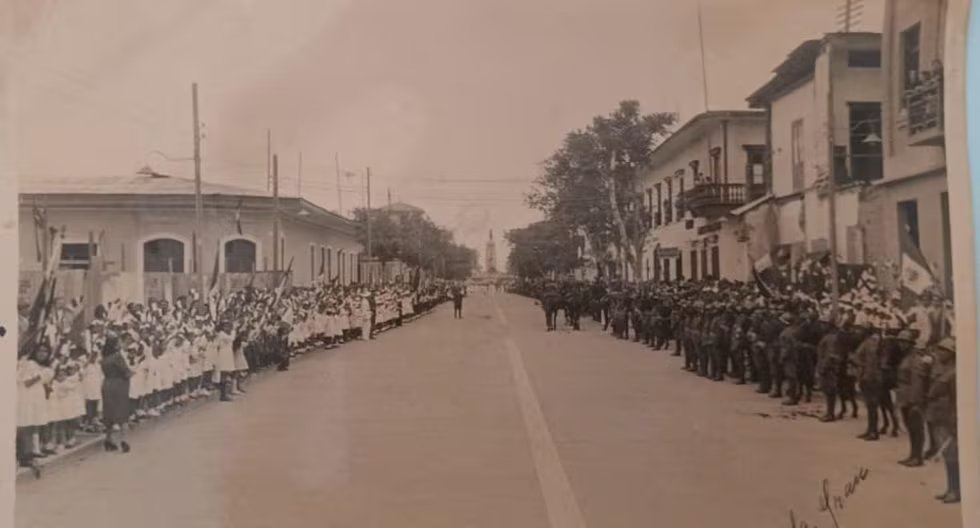
The transfer of the first monument to Grau was accompanied by the completion of the erection of the great monument designed by the Huaqueño sculptor Luis Agurto. Its inauguration was another imposing symbolic gesture, which paralyzed the city and brought about the arrival of the current president himself, Manuel Prado, as well as the last surviving cabin boy of the Huáscar, Alberto Medina. He also donated the bronze model of the monument to Piura, as well as two busts of the hero, one of which was destined for the Grau Club and which the sculptor characterized as “one more offering of my Piuranism… (dedicated to a character) whose figure I have been passionate about all my life” (Robles, 1963).
In the same decade of the forties, the declaration of the Casa Grau as a national monument, through Law 10146, constituted another symbolic gesture that was also seen as a hope for the creation of a House of Culture for the city. All these initiatives were promoted, mainly, by individuals.

Photos: reproductions of the University of Piura
But Grau’s figure not only inhabited the urban space, but also assembly halls and museum spaces. In 1931, the year before the 400th anniversary of the founding of the city of Piura, the cosmopolitan painter Cossío del Pomar offered a standing painting representing Grau as a sailor. This donation was accepted by the Municipality of Piura, and the work arrived in 1932. We do not know if for a practical reason or for greater admiration, the painter photographed himself as Grau, being the basis of the oil painting that to this day, with an academic but freer style, presides over the main hall of the municipality. And already in this century, the Central Museum (Mucen) decides to transfer to its headquarters in Piura a full-length portrait of Grau, signed by the hero painter Etna Velarde.
The monument to Grau, and these memorials in general, are a door that, when crossed, should lead us to broader questions: how and what do we remember? How and what do we transmit? And how do we inhabit our cities? Likewise, these representations should lead us to think about the true legacy of the sailor. It should not be a fixed image that is commemorated every October 8, but a reinterpretation that each generation, anywhere in the country, makes of the Peruvian of the millennium.
*El Comercio opens its pages to the exchange of ideas and reflections. In this plural framework, the Diario does not necessarily agree with the opinions of the columnists who sign them, although it always respects them.