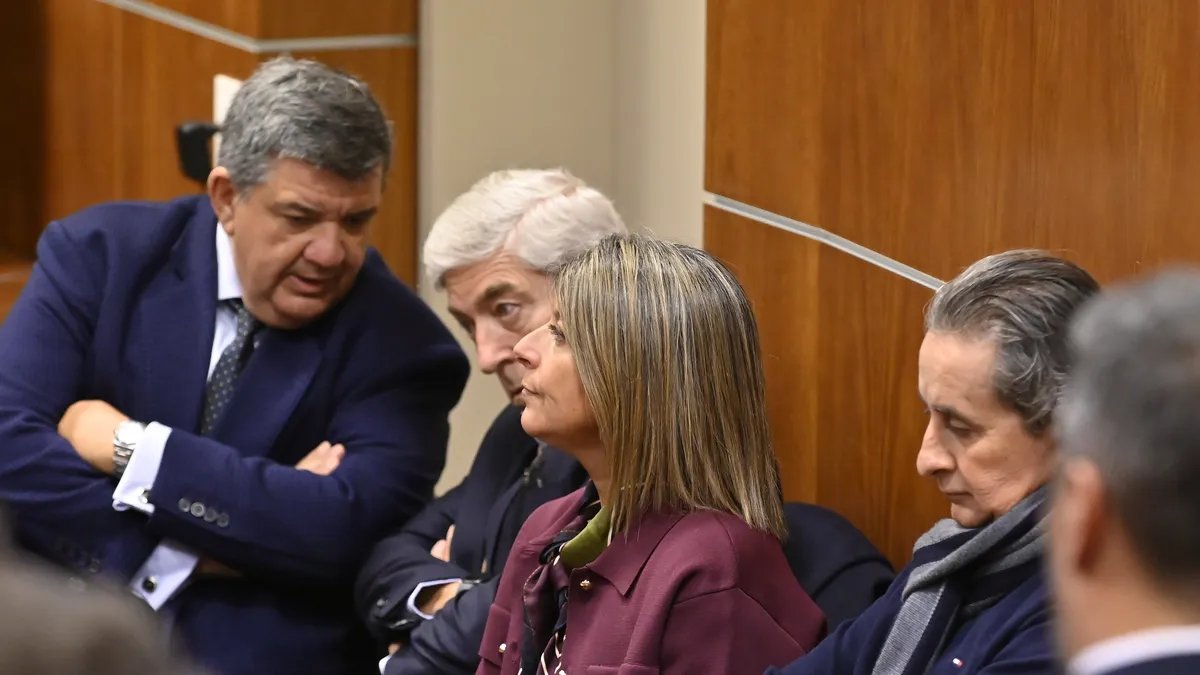
In response to a question from one of the lawyers, the defense of the accused, headed by criminal lawyer Jorge Barrera, clarified that the will is to solve the entire conflicteither. The judge said that she understood what the prosecution was saying as reasonable.
Prosecutor Fleitas announced in a hearing that the investigation is still ongoing and said that there may be more involved in the association to commit a crime. The González Palombo’s partner, the Uruguayan Tamara Taube Grunberg, continues to be investigated.
The prosecution’s story
At the hearing, which witnessed The Observerthe prosecutor argued that the owners were associated with Ignacio González Palombo —which was charged in February for fraud and document falsification– for commit crimes. “The complainants trusted the company due to its track record and seniority and took advantage” of this to attract investments,” Fleitas added in his justification.
Furthermore, he considered that as a result of that “association” they obtained “economic benefits“, both for González Palombo who collected commissions, but also for the Pérez.
González Palombo had been an employee of Pérez Marexiano between 2008 and 2015, preparing financial statements to present to auditors and anti-laundering controls until he was fired for not having made corresponding contributions. However, from that date, the prosecutor said, “he began training the employees who would replace him” and began to attract investments.
“The client portfolio was growing” and In 2020, he partnered with Tamara Taube, a Uruguayan living in Mexico who dedicated herself to attracting investments from that country. although he also participated with González Palombo in virtual meetings with clients from Uruguay.
To substantiate “the endorsement” of the Pérez In everything that González Palombo did, the prosecutor stated that he “gave directives to the operator” about the shares they had to buy and “the traitor had to execute them.” He added that He even gave purchasing directives of up to US$ 1 million.
“When González Palombo brought a client, they gave him the documentation and the Pérez decided whether to create the account or not” within the brokerage company. Furthermore, Fleitas reported that he was paid commissions by order of the partners every two or three months, some of up to US$ 20 thousand which were taken as “own expenses” and were transferred to the personal account of González Palombo de Itaú or by checks signed by the Pérez.
Pérez Marexiano hearing of González Palombo

In that sense, the prosecutor said that when the Central Bank asked them about the link with González Palombo, they responded that he had only been employed, “no mention was made that he acted as an intermediary or that he sent account statements to the company’s clients” because “they knew that they were violating the securities market law.”
“The truth is that Of the 652 clients that the firm had, at the time of the BCU intervention, 107 were those linked to González Palombo“said Fleitas based on the information provided by Pérez Marexiano’s auditor, accountant Ana Chaves.
According to the BCU data, the prosecutor said that The total positive customer balances were US$2,140,000, that it is the amount in cash that clients have the right to receive, of which US$ 445,542 corresponded to the entity and its partners, so it was concluded that PM clients had to be paid US$1,695,156.
In turn, he pointed out that the Company equity in bank accounts is US$927,564 Therefore, it is insufficient to cover the debt. “This is because the shareholders made withdrawals or purchases of securities with funds from client accounts,” said the prosecutor.
Fleitas reported that the multidisciplinary team that worked on the case reported to him that “in order to return clients their positions in cash” PM shareholders should cover an amount of US$ 755,136. He clarified that This figure may increase as complaints continue to be added.
He pointed out that in some cases it was detected that The clients deposited their investments in Pérez Marexiano’s BROU account but instead of being credited to their corresponding accounts, a total of US$576,548 went to other accounts linked to González Palombo. These are two amounts. On the one hand, US$322,622, of which US$ 153 thousand went to an account of González Palombo; US$ 133 thousand in the name of María José González Palombo (sister); US$ 27 thousand to Verónica Albert (wife at the time). The same thing happened with another US$254 thousand that went to the accounts of those three people.
For all this, prosecutor Fleitas said that the lack of controls and irregularities detected by the Central Bank of Uruguay (BCU) They were not “mere forgetfulness” or beginner’s mistakes. but “They endorsed González’s management, paying his commissions, and giving him an open letter so that he could use the money of the victims. All of which meant important economic benefits for both defendants, to the detriment of the complainants, since they charged good commissions for poor management and had other people’s money, carrying out transactions not requested by the investors.”
For all this, he asked to charge them with the association to commit a crime, Fleitas reiterated: “He is also allowed to bring clients to the company. It is not understood how a former employee could carry out operations of someone who is dedicated to stock market activity. It shows that there is an agreement and knowledge,” he added.
Barrera did not object but said he has another theory of the case.
Barrera did not oppose the accusation because considered that giving the debate on the prosecution’s story was not appropriate for this stage of the process besides that the code sets a low standard to formalize the investigation. However, he stated during the hearing that he did not agree “neither with the crime nor with the facts.”.
“We are witnessing 45 minutes of a coherent story, forceful in terms of internal systematization. But it is neither proven nor true. I could make a true story of situations that I cannot prove or are not true,” he said, adding that he has “another theory of the case,” as well as “other evidence.”
“The way to prove the innocence of my clients is to enable the trial.“, he stated but clarified that accepting the accusation did not imply assuming any responsibility on the part of his clients. He took the opportunity to question the criminal process and said that he hopes that the rules “change and are modified.”
Gonzalez Palombo Barrera

Furthermore, as a “catharsis” he stated that he joins the legal doctrine that maintains that for the crime of criminal association to exist, certain requirements are required, that the concert of two people is not enough and multiple participation is not enough.
Judge Olivera said in this regard that there are two positions on the crime of criminal association, and just as Barrera cited Miguel Langón, there is the position of Milton Cairoli who maintains that it enables criminal association to be criminalized when it was used as a means for the commission of other crimes, in this case fraud.
Regarding the BCU figures, amount to be paid of US$ 1.6 million, was considerably reduced because the Pérez made their entire assets available for liquidation “both theirs and their spouses and descendants”, an order that was accepted by the Central Bank “so the figure would be reduced to US$ 320 thousand.” He also said that there is a custody figure from the company that has already paid its holders which is US$ 220 thousand and each stockbroker established a guarantee so he said he is convinced that when the bank executes those actions, “the number is going to reach zero.”
The Pérez family had precautionary measures from December 2025 until June 20at the request of the prosecutor’s office, which had argued that reports from the Central Bank and the Anti-Money Laundering Secretariat gave an account of transfers to a Miami ATM company for US$ 200 thousand.
In that December hearing, the prosecutor also referred to the fact that One of those investigated had sold the cars to his daughters, high-end cars, and that he just transferred them after complaints began to be filed about the stockbroker’s scam.. Those transfers were not mentioned at Thursday’s hearing.
González Palombo was charged on February 26 with a continuing crime of fraud and document falsification.. Prosecutors alleged that González created a “smoke scenario” in which he attracted investments but never created client accounts and the money deposited “was never recovered.”