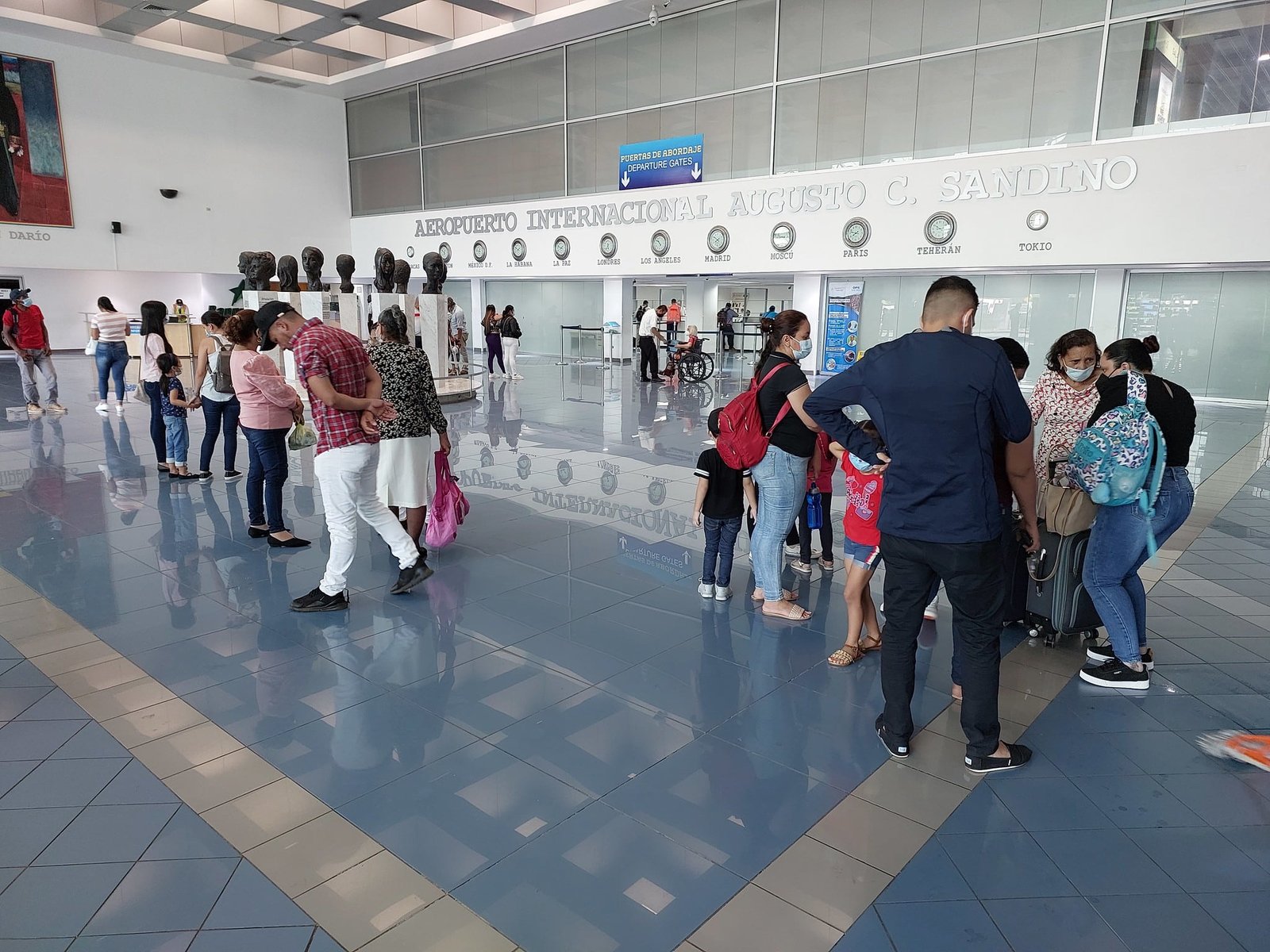
At least six Nicaraguans, who had been prohibited by the dictatorship from returning to Nicaragua after traveling abroad, have received emails from the Ministry of the Interior (MINT) informing them that their entry into the country “is authorized,” he confirmed. CONFIDENTIAL.
“We kindly inform you: entry to our country is authorized. Please acknowledge receipt,” the MINT wrote in the emails, in which it is signed “Ministry of the Interior Republic of Nicaragua.”
Some of the citizens, who were de facto banished, also received a form that the dictatorship asks foreigners entering or leaving Nicaragua to complete, in which they must detail their personal data, nationality, entry details to the country, and whether they were invited by the Government, company, embassy or friend.
The diary The Press also published about the notifications from the Ministry of the Interior. According to its publication, some notices are also received by calls or WhatsApp messages. However, CONFIDENTIAL you have only confirmed email notifications.
Selective authorizations or reverse?
With this decision, the dictatorship of Daniel Ortega and Rosario Murillo would reverse the selective ban on the entry of Nicaraguans into their own country, which it has carried out with greater regularity since mid-2023 and worsened in 2025.
However, the authorities have not made any public announcement, and it is unknown if the restoration of the right to enter the country is complete, or if it will be applied in a discriminatory manner.
CONFIDENTIAL He consulted several people who have been prohibited from returning by the dictatorship, who said they had not been notified of any change in their situation.
In November 2025the head of the MINT, María Amelia Coronel, justified the entry prohibitions by saying:
“We do it, more than anything, because we have the legal power to do so and, above all, to protect national sovereignty and our citizen security, which is the most important thing for the Ministry of the Interior and for all of Nicaragua.”
More than 300 Nicaraguans banned from Nicaragua
The Group of Human Rights Experts on Nicaragua (GRHEN) revealed in February 2025 that the regime has denied entry to some 318 Nicaraguans, between June 2018 and August 2025.
Among the de facto exiled Nicaraguans there are journalists, human rights defenders, activists, relatives of opponents and politically released prisoners, among other citizens.
Also, several youtubers nationals and foreigners have publicly denounced the refusal to enter Nicaragua.
Bans on entry into the country increased after the mass expulsion of 222 political prisoners to the United States in February 2023 and, according to GRHEN, they are part of a “broader pattern of serious and systematic violations of the right to freedom of movement and to freely choose their residence.”
“We are going against organized crime, against terrorism, and against any action by any person that threatens our peace and security that has cost us so much,” alleged the head of the MINT in an interview conducted by the official channel TN8.
This is how entry bans work in Nicaragua
The GRHEN explained that the exile machinery begins when the airlines or bus companies send to the General Directorate of Immigration and Immigration, the lists of passengers who intend to enter Nicaragua.
The Immigration authorities use these lists to compare the names with another updated list that they receive periodically from the Ministry of the Interior. The lists indicate who there is an “alert” about, to prohibit their departure, entry or re-entry into Nicaragua.
In Immigration, officials complement the information with searches for information about the indicated people on the Internet and social networks. With this review, any data, publication on social networks or link considered “suspicious” is enough to put together a file on the person trying to travel and consider them not suitable to leave or enter the country.
Finally, citizens are sent an email from the airline or transportation company, generally 24 hours before their return trip to Nicaragua, informing them of the denial of entry. Several of those who try to leave also have their passports taken away.
Political operators decide who enters or who does not
The GRHEN revealed that there is a chain of command of those who decide the refusals to enter the country headed by the General Subdirectorate of Investigation and Police Intelligence, the Directorate of Information for the Defense of the Army and operators of the Sandinista Front.
These officials and operators investigate citizens and send the information to the MINT so that it may or may not authorize entry into the country.
Then, there is a written or oral notification of prohibition of entry into the country by the Ministry of the Interior towards means of transportation or border posts of Nicaragua.
In de facto exiles there is also under-registration, because many choose not to report for fear of reprisals.
The Group denounces that “the lack of official documentation prevents regularization or relocation procedures in other countries.”
Changes after tensions with the United States
In recent months, the Ortega regime has relaxed its repressive posture following the actions of the United States Government towards its allies in Venezuela and Cuba.
It started with the release of some political prisoners after the capture of Nicolás Maduro, and the rejections of accusations of drug seizures coming from Nicaragua. The propaganda media have even begun to interview alleged drug traffickers arrested after trying to pass through the national territory.
The regime also allowed some Catholic churches to celebrate Holy Week activities and sent its propaganda media to cover them, in an attempt to deny religious persecution, while maintaining prohibitions and police espionage in most parishes.
“We call on those who have spread falsehoods about our religious experiences to deny what evidently constitutes only a political campaign of self-serving disinformation that fuels hatred, which has nothing to do with religion or faith,” said the “Co-Presidency” in a statement, in which it accuses the complainants of “spokespersons for the North American government.”
Since 2019, after imprisoning dozens of priests, more than 200 religious, including four bishops of the Episcopal Conference, have been banished and remain in exile, while the regime has illegally confiscated 39 properties of the Catholic Church and religious orders, as detailed by CONFIDENCIAL in an investigation published at the end of 2025.