The general strike is a political, democratic and social tool of the workers and of the Paraguayan people, considered the only way to defeat anti-popular policies, considering that labor rights were not given, but rather acquired.
Thanks to the sacrifice of thousands of workers who fought to dignify the working class throughout history in our country, in which there were repressed, imprisoned, tortured and murdered, Today’s workers can enjoy the fullness of their rights that were denied to them for centuries..
Besides, Strikes as a political tool in Paraguay were fundamental for the creation of lawschanges in the government and even for the definition of elections. The most remembered date from the years 1958, 1994 and 2014.
The first of them, in 1958, occurred when The dictatorship headed by Alfredo Stroessner began to strengthen.
Read more: Worker’s Day: they criticize Peña’s “wonderland” and demand a 25% readjustment of the minimum wage
What did the striking workers demand?
In this context, it was carried out the general mobilization by the only union movement that managed to survive Estonianismthe Paraguayan Workers’ Central (CPT), which, although it was composed mostly of red-colored public officials, also decided to rise up against the dictatorship.
organized workers They demanded a salary increase of 29.5%in addition to the lifting of the state of siege, freedom of the press and association.
The strike had 80% compliance throughout the territory. The result was a bloody repression accompanied by strong censorship that did not allow the official numbers to be revealed, but it is known that there were Thousands injured and 300 union members detained and confined to inhospitable areas.
“This sector, added to the old labor movement, is the one that held a general strike in 1958. It was the last general strike of the entire communist period, that is, was repressed as the students were later repressedbefore the military had been repressed. From 1954 to 1960 there was a very strong repressive process of Stroessner’s rule, which allowed Stroessner to govern without opposition. Normally repressions were accompanied by very strong press censorship,” explained historian Milda Rivarola.
Read more: Worker in the age of AI: your human skills are more valuable today than ever
Strike in the Wasmosy government
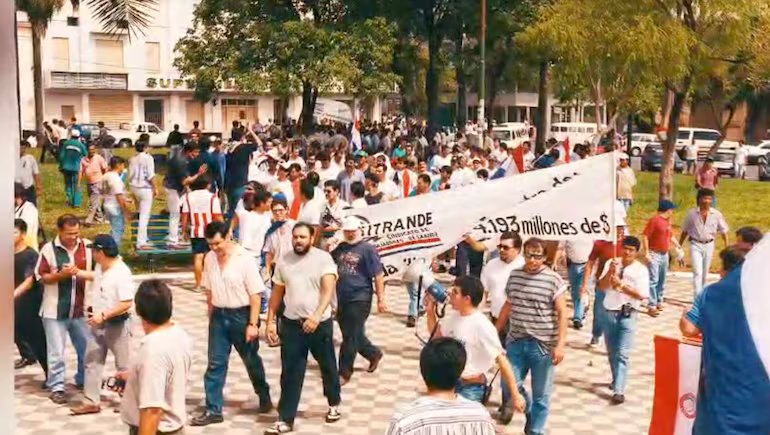
36 years later, In May 1994, workers again demanded the same diminished rights. Juan Carlos Wasmosy reached his first year in government and the general strike broke out, which had almost 90% compliance to demand a salary readjustment, the postponement of the validity of the Mercosur treaty, a new organizational charter in the IPS and freedom of association.
Despite a denialist campaign by the government that tried to establish the idea that the mobilizations had failed, ABC Color publications portrayed reality. The State’s response was the same, a violent repression that left thirty people injured and the death of a peasant. One of the survivors is the unionist Eduardo Ojeda, who highlighted the achievements of the working class in ’94.
“The general strike that took place was a strike when Stroessner fell and when Rodríguez took office after a year and a half of his mandate, The first general public transport strike was held, where eight working hours were achieved and a 30% increase in the salary of the collection driver was achieved.. Another very important achievement was that in the general strikes of the second post-democracy government, Rodríguez and Wasmosy, the demand for advance salary increases was won,” he explained.
He added that with the general strikes they managed to get the government to give a 10% salary increase in advance. They also achieved freedom of association, the collective agreement, among many other rights that were achieved, which is why he highlighted that The general strike is a political, legal, constitutional and historical right of the working class.
Read more: Human economy: formal employment as an engine of the country’s development
General strike in the government of Horacio Cartes
The last major mobilization took place in March 2014, just 7 months after the arrival to power of the questioned president Horacio Cartes.whose intention to implement the public-private alliance was flatly rejected by a population that demonstrated en masse in different parts of the country. Peasants, students, workers and even public officials joined the general strike.
The protesters They blocked routes, marched, filled squares and avenues and at every point where they gathered they displayed posters, banners and flags with messages of resounding rejection of the intention of the Colorado politician.
“The last strike, we could call it that impacted, was in 2014. where upon assuming the Cartes government, he approved the law of the public-private alliance and that Thanks to that strike, today it could not be implemented as a system of privatization of public companies. in our country,” Ojeda recalled.
He highlighted that The strike had 100% compliance, which was recognized by the government itself.and that it was convened with the workers’ confederations, due to pressure from the bases and at the same time also with the support of the Paraguayan peasantry led then by the National Peasant Federation (FNC).