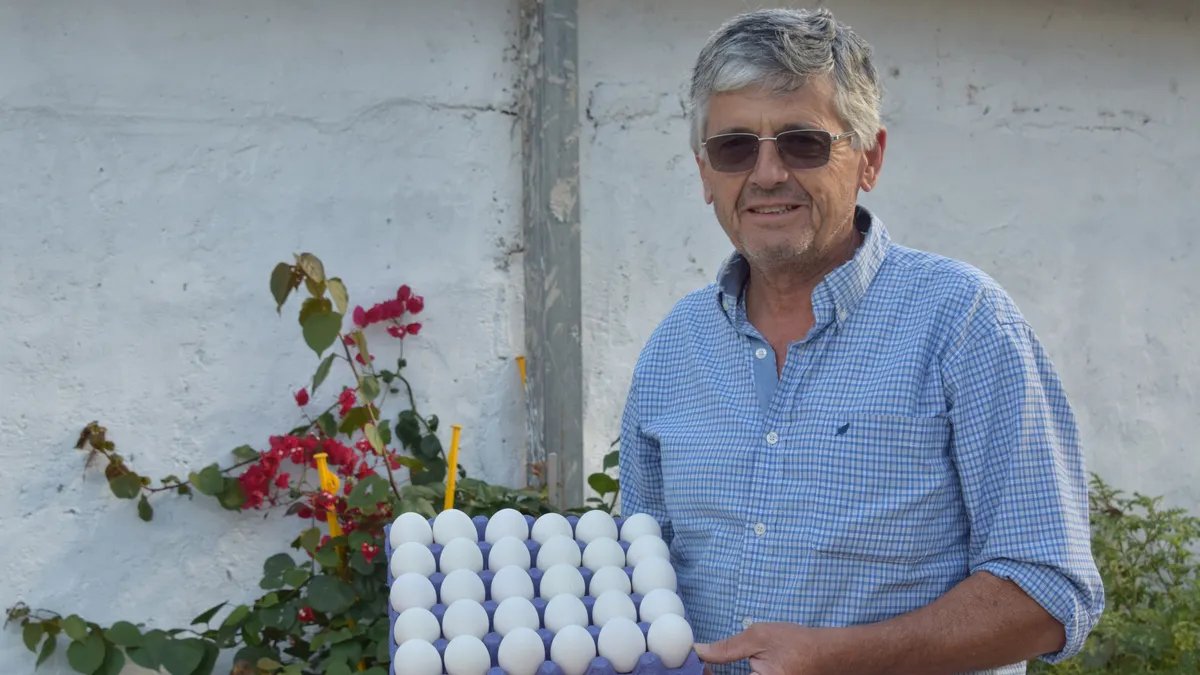
There is some distribution, but almost everything is placed in its own stall in the Multipurpose Market of the Metropolitan Agri-Food Unit (UAM), with direct retail marketing to the final consumer or to merchants who carry one or several boxes, but also to people who distribute by supplying other merchants.
A particularity, with important benefits for management, is that the production of feed for the chickens happens in its own plant, located next to the packing area and near the sheds, where the food is prepared with corn and soy grains, plus ingredients such as calcium and amino acids, using a supplement that is purchased on the market only at the beginning of the birds’ lives.
DSC_0088

DSC_0086

In a brief summary of the management, Danilo explained that the chicks arrive at the farm the day they are born, starting production at 16 or 17 weeks of age (depending on the time of year), they breed for 90 to 100 weeks and then the birds are destined for slaughter in authorized establishments.
Regarding the production level, the peak of laying with 96% to 97% – for example 1,000 pullets give 960 or 970 eggs per day – is sustained for about 30 weeks, starting more or less at 20 weeks of life of the bird.
DSC_0114

DSC_0143

Red egg: a luxury of a poor country
Danilo clarified, at one point in the talk, about the myth of whether the red egg is better than the white one: “I remember that a veterinarian at the mill that supplied us, a grade five technician, emphasized that the red egg is a luxury of a poor country… because in developed countries practically everything is made from white eggs.”
After pointing out that the color of the egg depends on the color of the hen, he added that production is less expensive with white hens and admitted that “people associate the red one with homemade production, something that does not happen in Uruguay, where there is almost no homemade production, something that could not be sustained all year round because that homemade hen only lays in spring.”
White or red
Eggs, as food, whether white or red, “are the same… there are even bakers who prefer white because the white one is fluffier… but it is true that at the consumer level, the red one is more accepted.”
Danilo stated: “When they ask me, I not only say that for those who eat it there is no difference between white or red, I say that I take white eggs home and that I have proven that those who start choosing white eggs later do not leave them.”
At Granja Floriana there are more and more white layers, already advancing from 10% a few years ago to 30% currently, a decision that goes hand in hand with better profitability based on lower production costs.
DSC_0085

DSC_0072

What’s behind the price of eggs
This public preference for red eggs has, as a response in the market, that this egg usually costs a little more, he acknowledged.
The price
Prices can vary, just due to a matter of supply and demand and these days the maple with 30 units ranges from $230 to $300, depending on the caliber, with the red one being worth a little more, but not much.
“It is an affordable price, one maple lasts a whole week for a typical family, the egg is one of the foods that best protects the worker’s pocket, that has been proven,” he emphasized, while pointing out that, as happens in many areas, there are places where you can get maple eggs at an adequate price and, at the same time, in other outlets, the same product can cost much more.
DSC_0110

DSC_0168

DSC_0073

The great advantage that Uruguay has
Another issue on which he focused is that Uruguay has “an enormous advantage,” which gives the consumer a lot of peace of mind: “There is a very natural production, not only in poultry farming, it happens in other areas, but in the area of eggs, which is my thing, I can assure that we are providing the market with very healthy, very natural, very safe food, and that obviously makes us happy.”
He admitted that years ago the egg was questioned about issues such as cholesterol, for example, “but today the doctor recommends you eat them, obviously you have to be careful how you cook it, because the problem is when it is fried, the quality of the oil, that’s why at home I put a splash of water in the pan and nothing more, that’s enough.”
Danilo is clear about the increase in consumption based on a statistic: “20 years ago we had two million laying hens in Uruguay, today there are four million, this is a strong poultry farming area, with 2,000 workers in San Bautista and surrounding areas alone.”
He pointed out the incidence of change in habits, because in these times it is normal for both adult members of a family to work and have less time to cook, which is why the consumption of eggs has grown, not only because it is a low-cost product with high nutritional values, but also because of its versatility in the kitchen plus its simple use to have something to eat.
He praised, also as a differential in Uruguay, that “today we can access cutting-edge technology as soon as something appears in the world, of course there is the issue of having the capital to do it, but here, for example, we have a traditional warehouse, in operation for 20 years, and another very modern one, with the latest technology, which allows for much more efficient production”, with a controlled temperature all year round between 24°C and 27°C, with supported operation even if there is no electricity, with everything automated: the supply of water and ration, temperature, transfer of eggs and removal of excrement.
The context
In the “old or conventional” shed today eggs are produced for about 200 maple trees each day with 8,000 hens, while in the new one that production is much higher, for 500 maple trees, with 17,00 hens, in a farm that also receives eggs from seven sheds of producers who work on a regular basis (each with 3,000 to 7,000 chickens).
DSC_0116

DSC_0119

DSC_0159

Key effort: biosecurity
As in any productive system that generates food, with the responsibility that this establishes, this producer praised all the actors in the national poultry industry for the zeal they put into supporting and increasing biosafety measures, in order to prevent avian influenza, with recent cases in wild birds, from reaching commercial farms.
For this, he stressed, the response of the Ministry of Livestock, Agriculture and Fisheries (MGAP) has been very good, during the previous administration and in the current one, he highlighted: “The ministry got its act together, this area is relatively new, it is growing and it is very important for what it produces and the labor it generates, which is why it seems fundamental to us that the ministry has been getting closer to production all these years.”
“Here in the area there are four poultry farms in three km2 and we take care of each other, with the issue of vehicles for example, we take care of our chickens and we take care of the chickens of our colleagues San Sebastián, El Zorzal and San Isidro, costs were assumed of course, but we do it with great responsibility,” he said.
An example of responsibility, for example, he mentioned, was the suspension of the 2026 Chicken and Hen Festival, a few days before it took place and the episodes of avian flu barely appeared in Uruguay, despite the adversity that considered not being able to carry out this traditional festival every March.
The memory
By the way, Danilo especially remembered in the talk Adrián Peña, a poultry businessman, former minister and former legislator, who died in 2024 at only 48 years old in a traffic accident, “because it is fair to keep him in mind, Adrián was a great entrepreneur, a person who was always pushing the sector and we miss him,” he said, referring to the creator of the aforementioned Chicken and Hen Festival.