It is considered one of the most picturesque villages in Slovakia, its charm is highlighted even beyond our borders. It regularly finds itself on the list of various travelers as a unique tip for a trip in the heart of Europe. It was recently included in a similar selection by a Polish travel blog, which recommends soaking up the atmosphere of the Spanish Valley live.

Photo: Eva Štenclová, Pravda
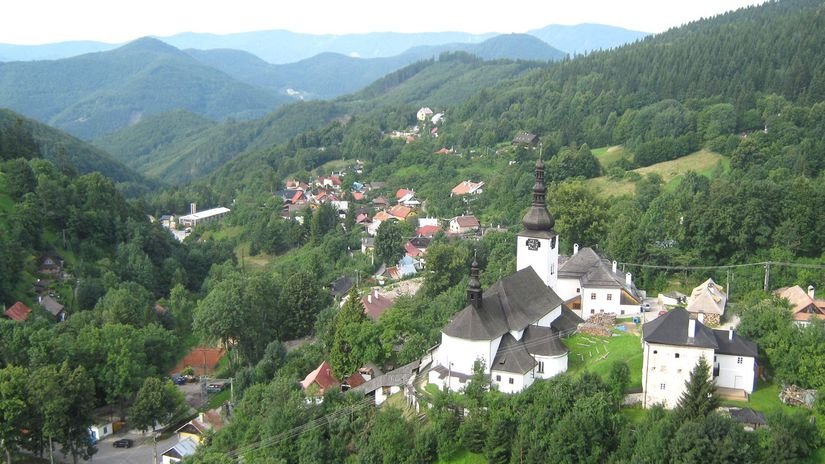
View of Spain Dolina from the Maximilián heap.
It is one of the historical gems famous for its mining past, while the traditional houses in the steep terrain have been preserved there. The dominant feature is the early Gothic Church of the Transfiguration of the Lord from 1254, to which 162 covered wooden steps lead. Their number is linked to an interesting story. During the Reformation, the church belonged to the Evangelicals, later it was reclaimed by the Catholics. But before that, a population census was held to find out which group predominates in Spain Valley. The already mentioned Catholics “won”, and as a sign of gratitude, each family from their ranks made one of the stairs.
Currently, the village has a little over two hundred inhabitants. It has been documented as a mining area since 1263, and it is the architecture associated with it, surrounded by beautiful nature, that makes it special. It was also recently noticed by the Polish travel blog My Wander Lust. “It’s a real hidden gem, definitely worth a trip. It has a lot of scenic hiking trails, at the beginning of which you can see parts of the village, including the houses where the miners once lived. Then you come across the amazing forest scenery,” he writes about the beauty of this village.
Rare color, school and astronomical clock
We wanted to ask the mayor of Španá Dolina, Martina Wilhelmerová, how many tourists visit it every year and what extraordinary things can be seen there. We could not get in touch with her, so we choose from our personal tips.
In addition to the mentioned church, it is worth paying attention to the Banícky Orloj, which was created only at the beginning of the millennium at the initiative of a company that repaired the historic Klopačka in the village. Its owner is also the owner of the astronomical clock. It is installed in the old Ferdinand shaft, which is located right on the square.
The village can also boast of the Historical School of Professor Jozef Mistrík, which is also located in the center of the village. It approximates the time when children learned in completely different conditions than today. Visitors can experience them for themselves by sitting in the antique benches and taking a class with the feeling of going back in time.
The school is located in the so-called Lavondória building from 1650. There used to be a manufactory for the accelerated production of green paint from the copper mines of the Spanish Valley. This very high-quality and expensive color was also used by Baroque painters in the creation of their works – Sandro Botticelli among them.
All in all, in the past, Spania Dolina, eleven kilometers away from Banská Bystrica, had rich deposits of copper ore, including silver, which made it famous throughout Europe. It experienced the golden times of mining in the Middle Ages during the operation of the Turzovsko-Fuggerovská society.
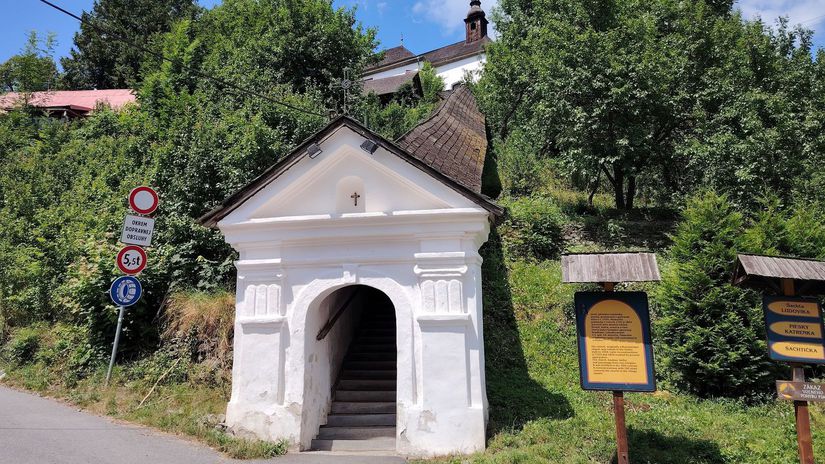 Photo: Eva Štenclová, Pravda
stairs, Spain Valley The stairs to the Spanish Valley church, of which there are 162, are covered.
There are various tunnels and shafts in the vicinity of the village, while tourists can reach the Maximilián heap via the educational trail. It offers a wonderful panoramic view of the local nature and the village itself. The dump is a remnant of mining activity and belongs to one of the largest artificial, man-made, hills in Europe. It is actually a massive pile of excavated rock on slopes reaching 852 meters above sea level.