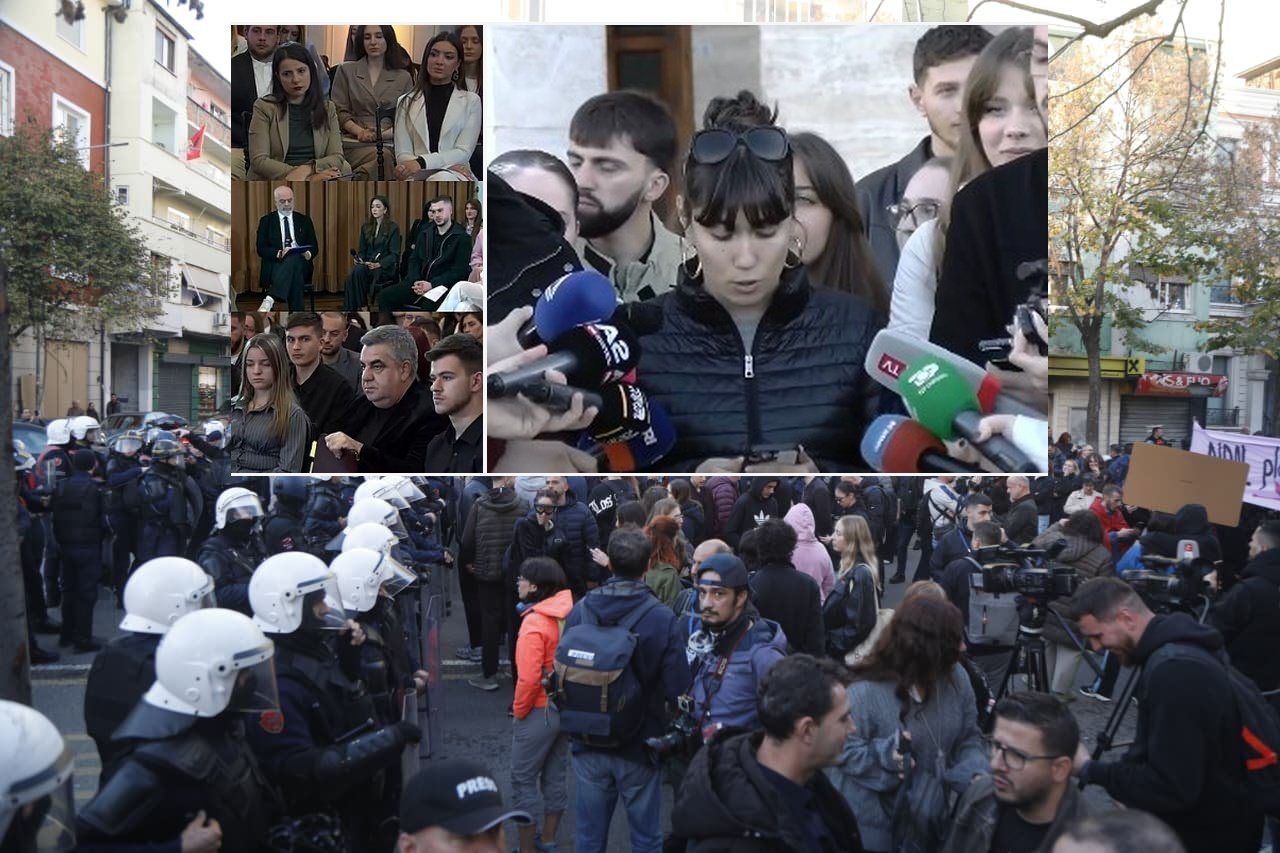
The student protest in Albania seems to be entering a new phase, as the protestors are divided into three groups, with different positions and developments as far as continuity is concerned. A part of the students have decided to organize in a new structure, creating the “Student Movement”, with the aim of continuing their activity through a joint organization.
Meanwhile, another group of protesters responded to the invitation to participate in the meeting with Prime Minister Edi Rama, holding a meeting with the head of the government.
Rama himself reacted through a post, where he published footage from the meeting with the students, whom he describes as young people who “believe in protests, not stones”. The Prime Minister announced that he had agreed with them that, at least for the moment, the debate would not be published, but only the images from the meeting.
In his reaction, Rama also thanked Sara Bodo, appreciating her work in the direction of the National Youth Agency, which he described as a magnet for girls and boys, regardless of belief.
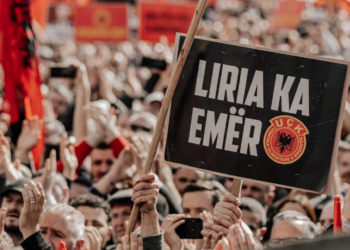
Despite these developments, another part of the students chose not to leave the square, continuing their protest and stance. Today marked the 175th day of the protest. Young people, as well as other citizens, gathered in front of the Ministry of Education and then marched through the streets of the capital, to arrive at the “Dëshmorët e Kombit” Boulevard, in front of the Prime Minister’s Office. The protest continued peacefully and without clashes, while the only incident was the burning of a garbage can.
And precisely the burning of garbage cans has now become a ritual of every protest. Absolute absurdity in terms of the demonstrative action, but also a danger to the health of citizens from the burning of plastic, which is toxic and proven to be carcinogenic.
Thus, the student movement that started with common demands and protests is now appearing in three directions: organization in a new movement, most likely a political party, dialogue with the prime minister and the continuation of the protest in the square by a minority, as is being proven day by day.
The return of the student movement to a political party may be the development that the Socialist Party and the Democratic Party await with the most interest. In a political scene dominated for years by Edi Rama and Sali Berisha, the birth of a new political force, instead of automatically posing a threat to the two big parties, could turn into an opportunity for them.
Rama and Berisha could be the two biggest beneficiaries of this rift. Both have a consolidated electoral, structural and organizational advantage, while a new student movement will have to build its confidence, organization and political representation from scratch.
In a system where SP and PD have long defined the rules of the game, the two main leaders risk remaining in the role of players and referees of a competition where the new opponent enters without experience and without the necessary infrastructure.
With the May 9 local elections approaching, a fragmented student movement, embroiled in partisan competition and without a clear long-term strategy, may face serious difficulties in surviving politically. And this is precisely where the paradox lies, a movement that arises as a revolt against the system can end up giving more space to the system it seeks to change.
Perhaps in complete naivety, students with the hasty idea to create a party, dilute the spirit of protest and thus become part of a political game where the rules and advantages have long been determined by Rama and Berisha. Not for nothing, there is agreement between the two on the expected changes to the Electoral Code, but also to the fundamental law of the state itself, the Constitution.